Have you ever wondered whether a rabbit and a hare are the same animal? You’re not alone. Many people confuse them because they look similar, but they are actually different species.
Rabbits are smaller, social animals that live in burrows, while hares are larger, faster, and live above ground.
People often search for rabbit or hare to identify an animal they’ve seen or to understand the real difference between these close relatives.
In this guide, you’ll discover the key traits, behaviors, and characteristics that set rabbits and hares apart, making it easy to tell them apart with confidence.
Rabbit or Hare – Quick Answer
A rabbit and a hare are not the same animal.
Although they both belong to the family Leporidae, they have important differences.
Quick Comparison
- Rabbit → Smaller, social, lives in burrows.
- Hare → Larger, faster, lives above ground.
Examples
- A pet bunny is usually a rabbit.
- The famous animal in the story The Tortoise and the Hare is a hare.
Simple Rule
If the animal lives in a burrow and is commonly kept as a pet, it is usually a rabbit.
If it has longer legs, longer ears, and runs very fast across open fields, it is likely a hare.
The Origin of Rabbit and Hare
Although rabbits and hares are related, their names have different histories.
Origin of Rabbit
The word rabbit entered English during the Middle Ages.
It comes from the Old French word rabotte or rabet, which referred to a young rabbit.
Over time, the word became the standard English name for the animal we know today.
Rabbits became closely associated with farming, pets, and folklore.
Origin of Hare
The word hare is much older.
It comes from the Old English word hara.
Similar versions of the word exist in many Germanic languages.
Hares have appeared in myths, legends, and cultural stories for thousands of years.
Because they are known for speed and agility, they often symbolize quickness and independence.
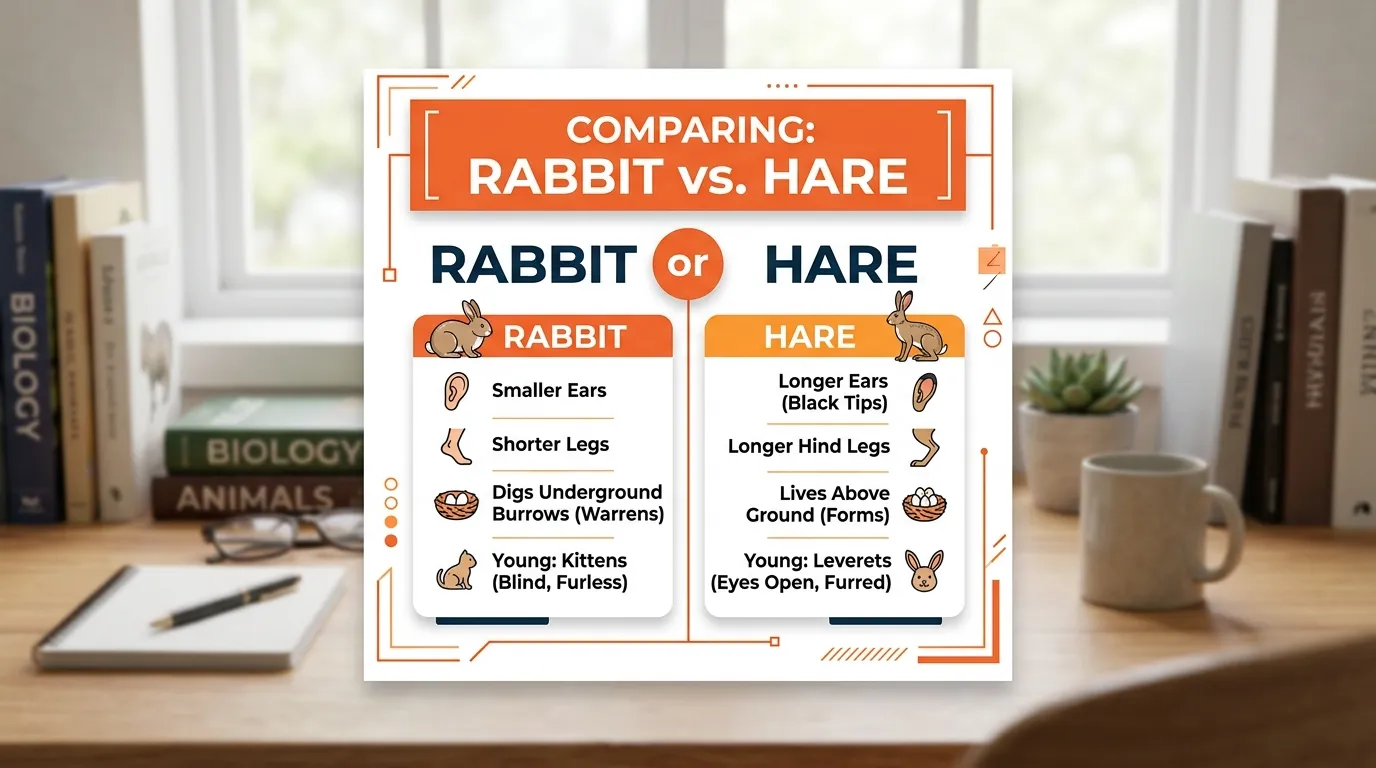
Rabbit vs Hare: Comparison Table
| Feature | Rabbit | Hare |
| Size | Smaller | Larger |
| Ears | Shorter | Longer |
| Legs | Shorter | Longer |
| Speed | Fast | Very fast |
| Habitat | Burrows | Above-ground nests |
| Social Behavior | Social groups | Mostly solitary |
| Babies | Born blind and hairless | Born with fur and open eyes |
| Pet Animal | Common | Rare |
Why People Confuse Hares and Rabbits
Many people assume rabbits and hares are simply different names for the same animal.
Several factors contribute to this confusion.
Similar Appearance
Both animals:
- Have long ears
- Have strong hind legs
- Eat plants
- Belong to the same family
From a distance, they can look almost identical.
Cartoons and Children’s Stories
Movies, books, and cartoons often use the words interchangeably.
As a result, many people never learn the biological differences.
Shared Family
Rabbits and hares both belong to the animal family Leporidae.
Because they are close relatives, they share many characteristics.
However, sharing a family does not make them the same species.
What Is a Rabbit?
A rabbit is a small mammal known for its soft fur, long ears, and social behavior.
Rabbits are found across many parts of the world and are among the most popular pets.
Physical Characteristics of Rabbits
Rabbits typically have:
- Compact bodies
- Shorter ears
- Shorter legs
- Softer appearance
- Smaller overall size
Their bodies are built more for agility and hiding than for long-distance running.
Habitat of Rabbits
Rabbits prefer:
- Burrows
- Underground tunnels
- Grasslands
- Forest edges
- Gardens
Groups of rabbits often live together in complex tunnel systems called warrens.
Behavior of Rabbits
Rabbits are highly social animals.
They often:
- Live in groups
- Groom each other
- Communicate through body language
- Stay close to shelter
Their survival strategy depends heavily on hiding and quick escapes.
What Is a Hare?
A hare is a larger relative of the rabbit.
Hares are built for speed and survival in open spaces.
Unlike rabbits, they rarely live underground.
Physical Characteristics of Hares
Hares usually have:
- Longer legs
- Longer ears
- Larger bodies
- Leaner build
- Stronger muscles
These features help them escape predators through speed.
Habitat of Hares
Hares often live in:
- Open grasslands
- Farmland
- Meadows
- Prairies
Instead of burrows, they create shallow depressions in the ground called forms.
Behavior of Hares
Hares are generally solitary animals.
They prefer:
- Independent living
- Open environments
- Fast escape tactics
When threatened, a hare relies on running rather than hiding.
Hare vs Rabbits: Physical Differences
One of the easiest ways to distinguish these animals is by appearance.
Size
Hares are usually larger than rabbits.
They have longer bodies and stronger limbs.
Ears
A hare’s ears are noticeably longer.
Many hare species also have black markings on the ear tips.
Legs
Hares have much longer hind legs.
This allows them to reach impressive speeds.
Fur
Hare fur is often rougher and less fluffy than rabbit fur.
Rabbits generally have softer coats.
Rabbit vs Hare: Differences at Birth
A major biological difference appears immediately after birth.
Baby Rabbits
Baby rabbits, called kits, are:
- Blind
- Hairless
- Helpless
They depend completely on their mother.
Baby Hares
Baby hares, called leverets, are:
- Born with fur
- Born with open eyes
- Able to move shortly after birth
This helps them survive in open habitats.
Rabbit vs Hare: Speed and Movement
Both animals are fast, but hares are faster.
Rabbit Speed
Most rabbits can run between 25 and 35 miles per hour.
They use quick zig-zag movements to escape danger.
Hare Speed
Many hare species can exceed 40 miles per hour.
Their long legs make them excellent runners over open ground.
This speed advantage is one reason hares prefer open habitats rather than burrows.
Here’s Part 2 of the article.
British English vs American English Usage
Unlike many word comparisons, rabbit and hare do not have different British and American spellings.
Both countries use the same words.
Comparison Table
| Feature | British English | American English |
| Rabbit | Rabbit | Rabbit |
| Hare | Hare | Hare |
| Meaning | Same | Same |
| Pronunciation | Similar | Similar |
| Usage | Common | Common |
The difference is not about spelling. It is about choosing the correct animal.
Which Term Should You Use?
Choosing between rabbit and hare depends entirely on the animal you are describing.
Use “Rabbit” When:
- Referring to pet rabbits
- Talking about burrow-dwelling species
- Discussing social animals
- Referring to common backyard rabbits
Examples:
- My rabbit loves carrots.
- Rabbits live in underground warrens.
- The rabbit quickly disappeared into its burrow.
Use “Hare” When:
- Referring to larger wild species
- Discussing fast-running mammals
- Talking about open-field animals
- Mentioning the famous fable character
Examples:
- The hare raced across the field.
- Hares can run extremely fast.
- The tortoise challenged the hare.
Audience-Based Advice
| Audience | Recommended Term |
| Wildlife enthusiasts | Use the correct species name |
| Pet owners | Usually rabbit |
| Students | Learn the biological difference |
| General writing | Use the accurate animal name |
| Global audience | Rabbit or hare based on context |
Common Mistakes with Hare or Rabbits
Many people make the same errors when discussing these animals.
Mistake #1: Assuming They Are the Same Animal
❌ Rabbits and hares are identical.
✔ Rabbits and hares are different species within the same family.
Mistake #2: Calling Every Wild Rabbit a Hare
❌ I saw a hare in my garden.
✔ Confirm the animal’s size, ears, and habitat before identifying it.
Mistake #3: Thinking Hares Live in Burrows
❌ Hares spend most of their lives underground.
✔ Hares generally live above ground.
Mistake #4: Believing Hares Can Be Common Pets
❌ Hares are popular household pets.
✔ Rabbits are commonly kept as pets. Hares rarely are.
Quick Tip
Remember:
Rabbits hide. Hares run.
This simple rule helps many people identify them correctly.
Rabbit or Hare in Everyday Examples
In Emails
- We spotted a rabbit near the campsite yesterday.
- The wildlife reserve protects several hare species.
In News Articles
- Rabbit populations increased this year.
- Conservationists are monitoring local hare numbers.
On Social Media
- Look at my adorable pet rabbit!
- I saw a hare sprint across the field this morning.
In Formal Writing
- Rabbits play an important role in many ecosystems.
- Hares are adapted for life in open environments.
Rabbit vs Hare – Google Trends & Usage Data
Search data shows that both terms are popular, but they attract different audiences.
Rabbit Searches Are Common For:
- Pet care
- Rabbit breeds
- Feeding advice
- Housing and cages
- Veterinary information
Hare Searches Are Common For:
- Wildlife identification
- Nature studies
- Animal comparisons
- Hunting information
- Educational content
Popular Countries Searching These Terms
Interest is especially high in:
- United States
- United Kingdom
- Canada
- Australia
- India
- Pakistan
Search Intent Comparison
| Search Topic | Rabbit | Hare |
| Pets | High | Low |
| Wildlife | Medium | High |
| Education | High | High |
| Animal Facts | High | High |
| Breeding | High | Low |
This shows that rabbits attract more pet-related searches, while hares attract more wildlife-related interest.
Rabbit vs Hare: Comparison Table
| Characteristic | Rabbit | Hare |
| Family | Leporidae | Leporidae |
| Size | Smaller | Larger |
| Ears | Shorter | Longer |
| Legs | Shorter | Longer |
| Habitat | Burrows | Above-ground nests |
| Social Behavior | Social | Solitary |
| Babies | Blind and hairless | Fur-covered with open eyes |
| Speed | Fast | Faster |
| Pet Potential | Common | Rare |
| Lifestyle | Group living | Independent living |
Simple Memory Trick
A quick memory trick can help:
Rabbit = Burrow
Hare = Hairy at birth
Baby rabbits are born hairless.
Baby hares are born with fur.
This difference is one of the easiest ways to remember which animal is which.
FAQs
Is a rabbit the same as a hare?
No. Rabbits and hares are different species, although they belong to the same animal family.
Which is bigger, a rabbit or a hare?
A hare is usually larger and has longer legs and ears.
Can rabbits and hares breed together?
No. They are different species and cannot successfully breed with each other.
Why are hares faster than rabbits?
Hares have longer legs and stronger muscles, which allow them to run faster.
Are rabbits or hares better as pets?
Rabbits make excellent pets. Hares are rarely kept as pets because they are wild and less social.
What is a baby hare called?
A baby hare is called a leveret.
What is a baby rabbit called?
A baby rabbit is called a kit or kitten.
Do rabbits and hares eat the same food?
Both mainly eat grasses, plants, and vegetation, although their diets can vary slightly by habitat.
Conclusion
The confusion between rabbit and hare is common because these animals share many physical features and belong to the same family. However, they are not the same animal.
Rabbits are generally smaller, more social, and live in underground burrows. They are also the species most commonly kept as pets. Hares, on the other hand, are larger, faster, and better adapted to life in open environments. They rely on speed rather than hiding to avoid predators.
One of the biggest differences appears at birth. Baby rabbits are born blind and hairless, while baby hares are born with fur and open eyes. This reflects their different lifestyles and survival strategies.
If you remember one simple rule, make it this: rabbits hide in burrows, while hares run across open fields. That distinction will help you identify these fascinating animals more accurately in conversation, writing, and wildlife observation.

I’m English language author writing emphasises clarity, structure, and close attention to language. My work is often examined for stylistic comparison, focusing on Grammar work, narrative control, and subtle thematic development.