Have you ever wondered whether it should be lose or loose? You’re not alone. These two words look similar, but they have completely different meanings and are often confused in everyday writing.
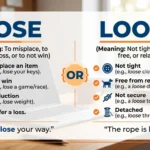
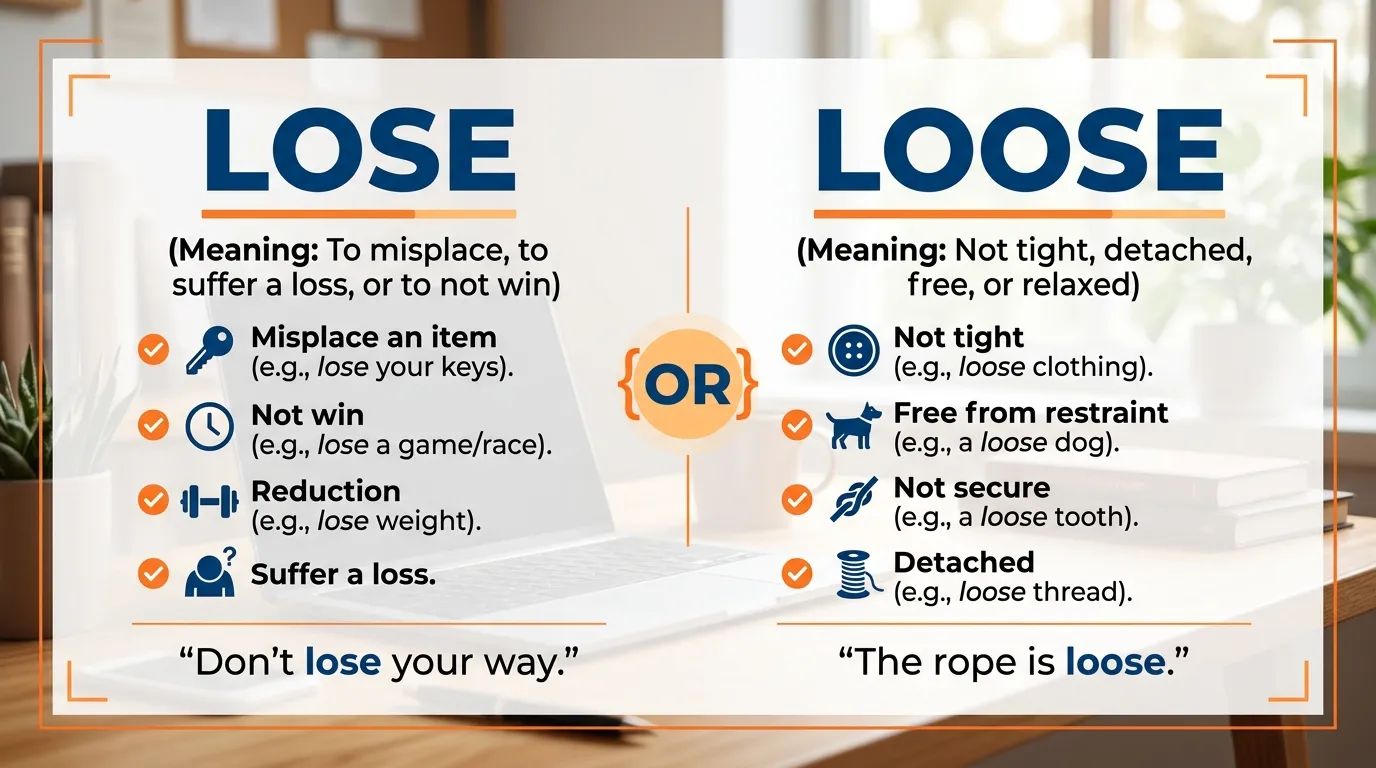
Lose means to misplace something or fail to win, while loose means not tight or free.
Both words are correctly spelled, mistakes can easily slip past spell check.
In this guide, you’ll learn the difference between lose and loose, see clear examples, and discover simple tricks to use the right word every time.
Lose or Loose – Quick Answer
The difference between lose and loose is simple.
- Lose is a verb that means to misplace something, fail to keep it, or not win.
- Loose is usually an adjective that means not tight, free, or not securely attached.
Quick Examples
- I don’t want to lose my phone.
- Our team might lose the game.
- These pants are too loose.
- The dog got loose from the yard.
Simple Rule
If you’re talking about losing something, use lose.
If you’re talking about something that isn’t tight, use loose.
Lose Meaning
Lose means to no longer have something, fail to keep it, or fail to win.
It is always used as a verb.
Common Uses of Lose
- Misplacing something
- Losing a competition
- Losing money
- Losing weight
- Losing an opportunity
Examples
- I don’t want to lose my passport.
- She may lose the election.
- We could lose a lot of money.
- He wants to lose weight.
Loose Meaning
Loose means not tight, not firmly attached, or free to move.
It is most commonly used as an adjective.
Common Uses of Loose
- Clothing
- Objects
- Animals
- Hair
- Screws or parts
Examples
- This shirt feels loose.
- The dog is loose in the park.
- A loose screw caused the problem.
- She wore her hair loose.
The Origin of Lose and Loose
Although these words look similar today, they developed from different Old English roots.
Origin of Lose
The word lose comes from the Old English word losian, meaning “to perish,” “be destroyed,” or “cease to possess.”
Over time, the meaning expanded to include:
- Misplacing something
- Being defeated
- Giving up possession
Origin of Loose
The word loose comes from the Old Norse word lauss, meaning “free,” “unbound,” or “released.”
Its meaning remained largely the same throughout history.
Why People Confuse Them
People confuse these words because:
- Their spellings are similar.
- They sound similar.
- They often appear in everyday writing.
- Spell-check tools may not catch the error.
British English vs American English Spelling
Unlike many English word comparisons, there is no spelling difference between British and American English.
Both countries use:
- Lose
- Loose
Comparison Table
| Word | British English | American English |
| Lose | Lose | Lose |
| Loose | Loose | Loose |
| Meaning | Same | Same |
| Pronunciation | Similar | Similar |
Examples
British English:
- We might lose the match.
- Your shoelaces are loose.
American English:
- We might lose the game.
- Your shoelaces are loose.
The spelling and meaning remain consistent across regions.
Which Spelling Should You Use?
The correct choice depends on your meaning, not your location.
Use Lose When
You mean:
- Misplace
- Fail to win
- Stop having something
Examples:
- Don’t lose your keys.
- They may lose the championship.
- I don’t want to lose this opportunity.
Use Loose When
You mean:
- Not tight
- Free
- Unsecured
Examples:
- My jacket feels loose.
- The horse got loose.
- There is a loose wire behind the wall.
Audience-Based Advice
| Audience | Recommended Word |
| Students | Use meaning as guide |
| Business writers | Double-check context |
| Bloggers | Watch for typos |
| Global audience | Same rules everywhere |
Quick Memory Trick
Lose = Lost
Both relate to losing something.
Loose = Extra O = Extra Space
A loose object has more room or space.
Common Mistakes with Loose or Lose
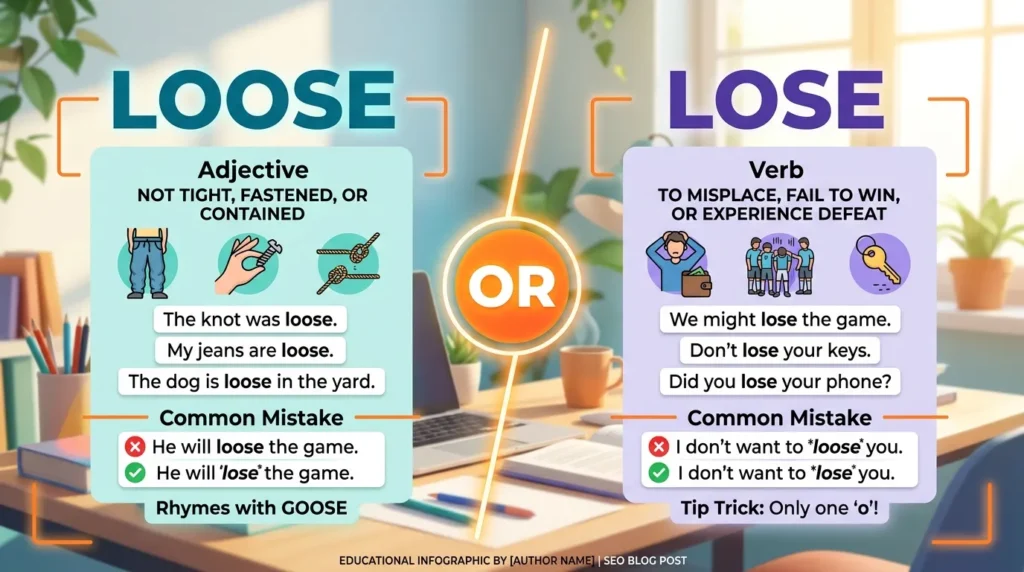
This confusion appears everywhere online.
Mistake #1
❌ I don’t want to loose my phone.
✔ I don’t want to lose my phone.
Mistake #2
❌ We may loose the game.
✔ We may lose the game.
Mistake #3
❌ My pants are lose.
✔ My pants are loose.
Mistake #4
❌ The dog is lose.
✔ The dog is loose.
Why This Happens
Many people pronounce lose and loose similarly in fast speech.
Because both words are real English words, spell-check often misses the error.
Quick Tip
If you can replace the word with misplace or fail to win, use lose.
If you can replace it with not tight, use loose.
Loose and Lose in Everyday Examples
Understanding the difference becomes much easier when you see these words in real situations.
In Emails
Lose
- Please do not lose this document.
- We cannot afford to lose this client.
Loose
- The attachment appears loose in the folder.
- The packaging was loose upon arrival.
In News Articles
Lose
- The team could lose its top position this season.
- Investors may lose confidence in the market.
Loose
- Authorities reported a loose animal near the highway.
- A loose cable caused the power outage.
On Social Media
Lose
- I don’t want to lose all my photos.
- Trying to lose a few pounds this month!
Loose
- These jeans are getting loose.
- My bracelet became loose after a few weeks.
In Formal Writing
Lose
- Companies may lose revenue if customer satisfaction declines.
- Students can lose marks for incorrect citations.
Loose
- Inspectors discovered several loose components.
- A loose connection interrupted the system.
Loose vs Lose – Google Trends & Usage Data
Search data shows that lose or loose is one of the most searched word confusions in English.
Many users search this keyword because the words:
- Look similar
- Sound similar
- Have completely different meanings
- Are frequently confused online
Popular Search Queries
People commonly search:
- lose or loose
- how to spell lose
- lose vs loose
- loose meaning
- lose meaning
- when to use lose or loose
- loose or lose weight
Usage by Context
| Context | Common Word |
| Competitions | Lose |
| Weight loss | Lose |
| Misplacing items | Lose |
| Clothing | Loose |
| Wires and screws | Loose |
| Animals escaping | Loose |
Countries with High Search Interest
The confusion is common in:
- United States
- United Kingdom
- Canada
- Australia
- India
- Pakistan
Because English learners and native speakers alike make this mistake, the keyword remains popular worldwide.
Lose vs Loose: Comparison Table
| Feature | Lose | Loose |
| Word Type | Verb | Adjective |
| Meaning | To misplace or fail | Not tight or free |
| Pronunciation | /luːz/ | /luːs/ |
| Related Words | Lost, Losing | Loosen, Loosely |
| Example | Lose your wallet | Loose shoelaces |
| Common Error | Written as loose | Written as lose |
| Frequency | Very common | Very common |
Why People Confuse Lose and Loose
Several factors make this mistake common.
Similar Spelling
Only one extra letter separates the words.
- Lose
- Loose
At a quick glance, they appear almost identical.
Similar Pronunciation
Although the ending sounds differ slightly, many people pronounce them similarly in everyday speech.
Autocorrect Limitations
Since both words are correctly spelled English words, spell-check tools may not identify the mistake.
Fast Typing
Writers often add an extra “o” by accident, especially when typing quickly.
Simple Memory Trick
A simple trick can help you remember the difference forever.
Lose = Lost
Both words relate to losing something.
- Lose money
- Lose keys
- Lose a game
Loose = Extra O = Extra Space
Loose has an extra “O.”
Think of that extra letter as extra room or space.
- Loose clothing
- Loose rope
- Loose screw
Simple Rule:
If something has extra space, use loose.
If something disappears or fails, use lose.
Lose vs Loose: Comparison Table
| Feature | Lose | Loose |
| Part of Speech | Verb | Adjective |
| Meaning | Misplace, fail to win | Not tight, free |
| Pronunciation | Looz | Loos |
| Example | Lose your wallet | Loose clothing |
| Common Usage | Actions | Descriptions |
FAQs
Is it lose or loose weight?
The correct phrase is lose weight.
✔ I want to lose weight.
❌ I want to loose weight.
What is the difference between lose and loose?
Lose means to misplace something or fail.
Loose means not tight or free.
Is loose a verb?
Usually, loose is an adjective.
However, it can occasionally be used as a verb meaning to release, though this usage is uncommon.
Why do people write loose instead of lose?
Because the words look similar and both are valid English words.
Is “I might loose the game” correct?
No.
The correct sentence is:
✔ I might lose the game.
What does loose mean?
Loose means not tight, not attached securely, or free to move.
How can I remember lose vs loose?
Remember:
Lose = Lost
Loose = Extra O = Extra Space
This simple trick works for most situations.
Conclusion
The confusion between lose and loose is one of the most common mistakes in English, but the difference is actually simple once you understand it.
Lose is a verb that means to misplace something, fail to keep it, or fail to win. You can lose your keys, lose money, lose weight, or lose a game.
Loose, on the other hand, describes something that is not tight, secure, or fixed in place. Clothing can be loose, a screw can be loose, and even a pet can become loose if it escapes.
The good news is that there is no British or American spelling difference. The rules remain the same everywhere.
If you remember one simple trick, make it this:
Lose = Lost.
Loose = Extra O, Extra Space.
Using the correct word will make your writing clearer, more professional, and easier for readers to understand. Once you learn the distinction, you’ll never confuse lose and loose again.

I’m American writer known for precise, economical use of language and strong narrative voice. My work is frequently studied for sentence rhythm, word choice, and how meaning is shaped through grammar, making it valuable for close reading and English comparison studies.