Have you ever stopped while writing and wondered whether the correct word is bail or bale? You’re not alone. These two words sound exactly the same, which makes them easy to confuse. However, their meanings are completely different.
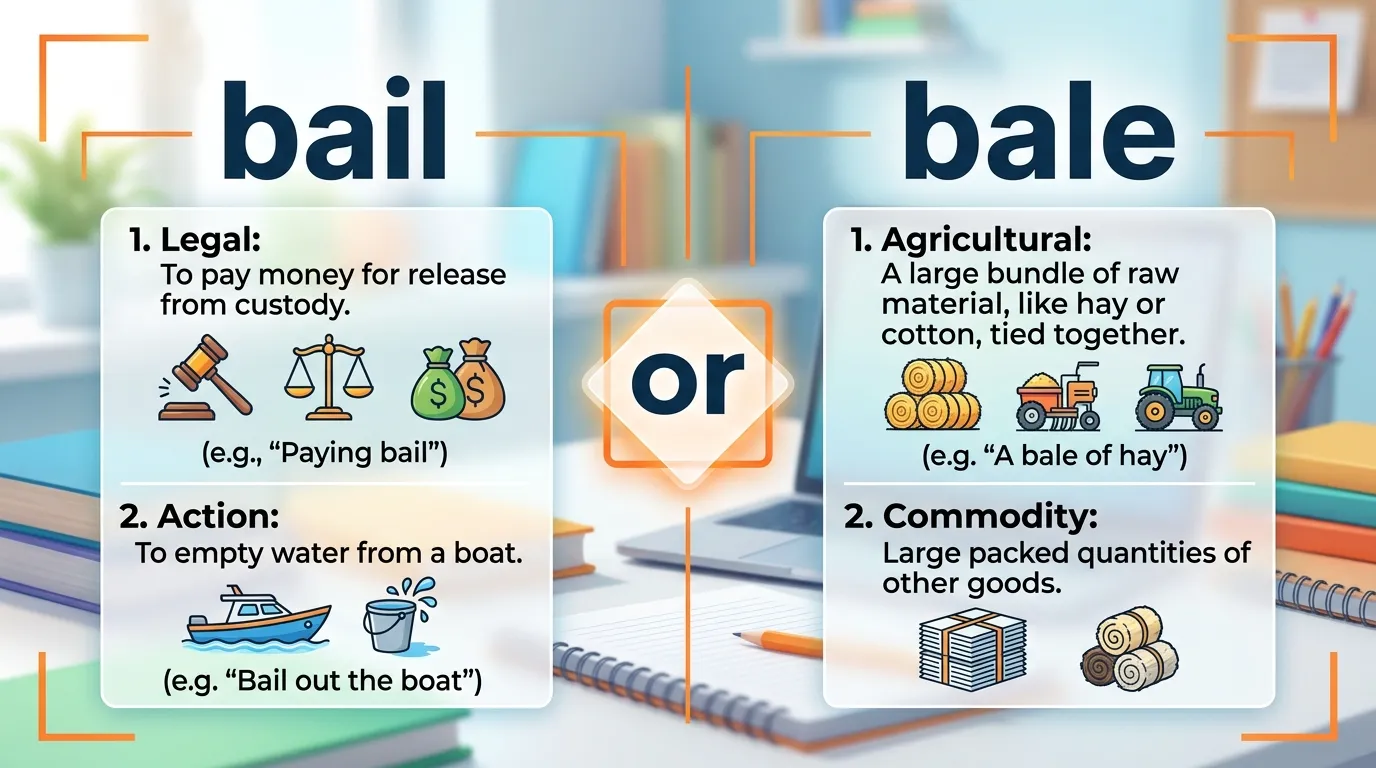
Bail is usually related to legal release, helping someone out of trouble, or removing water from a boat.
Bale refers to a tightly packed bundle of materials such as hay, cotton, straw, or paper.
This confusion often appears in school assignments, emails, legal discussions, farming articles, and online content. Understanding the difference is important for clear communication and professional writing.
In this guide, you’ll learn the meanings, origins, usage rules, common mistakes, examples, and practical tips that will help you confidently choose between bail and bale every time.
Bail or Bale – Quick Answer
The difference between bail and bale is simple.
| Word | Meaning | Example |
| Bail | Release from custody, help someone, remove water | He paid bail to leave jail. |
| Bale | A large bundle of materials | The farmer stacked a bale of hay. |
Examples
The judge set the defendant’s bail at $5,000.
The sailor had to bail water from the boat.
The farmer loaded a bale of hay onto the truck.
Several bales of cotton were stored in the warehouse.
A useful memory trick:
- Bail = Court or Boat
- Bale = Bundle
The Origin of Bail and Bale
Although these words sound identical, they come from different historical roots.
Origin of Bail
The word bail comes from the Old French word baillier, meaning “to deliver” or “to hand over.”
It later entered Middle English and became associated with:
- Temporary release from jail
- Legal guarantees
- Taking responsibility for someone
Over time, additional meanings developed, including removing water from a boat and helping someone out of a difficult situation.
Origin of Bale
The word bale comes from Middle English and Old French sources referring to a wrapped package or bundle.
Historically, merchants used the term when transporting:
- Cotton
- Wool
- Hay
- Straw
- Paper
Today, the meaning remains largely unchanged.
Why the Difference Exists
Unlike many spelling confusion pairs, bail and bale are not spelling variations of the same word.
They are completely different words that happen to sound alike.
This makes them homophones.
British English vs American English Spelling
Unlike words such as theatre/theater or defence/defense, there is no British vs American spelling difference here.
Both countries use exactly the same spellings.
Comparison Table
| Word | British English | American English |
| Bail | Bail | Bail |
| Bale | Bale | Bale |
| Meaning | Same | Same |
| Usage | Same | Same |
Examples
British English:
- The suspect was granted bail.
- The farmer sold several bales of hay.
American English:
- The suspect was granted bail.
- The farmer sold several bales of hay.
The spelling never changes.
Only the meaning changes.
Which Spelling Should You Use?
Choosing between bail and bale depends entirely on context.
Use Bail When Talking About:
- Legal release
- Court cases
- Helping someone escape trouble
- Removing water from a boat
Examples:
- The family posted bail.
- We bailed him out financially.
- Sailors bailed water during the storm.
Use Bale When Talking About:
- Farming
- Agriculture
- Bundles of materials
- Storage and transportation
Examples:
- The tractor carried a bale of hay.
- Cotton bales filled the warehouse.
- The farmer sold 200 bales this season.
Audience-Based Advice
| Audience | Recommended Word |
| Legal professionals | Bail |
| Farmers | Bale |
| Students | Depends on meaning |
| Business writers | Depends on context |
| Global audiences | Same spelling worldwide |
The key is understanding the meaning, not the audience location.
Common Mistakes with Bale or Bail
These homophones create several common writing errors.
Mistake #1
❌ The farmer stored fifty bails of hay.
✔ The farmer stored fifty bales of hay.
Mistake #2
❌ The court approved his bale.
✔ The court approved his bail.
Mistake #3
❌ The lawyer argued for a lower bale amount.
✔ The lawyer argued for a lower bail amount.
Mistake #4
❌ Several bails of cotton were shipped overseas.
✔ Several bales of cotton were shipped overseas.
Quick Tip
If the sentence involves:
- Court → Use bail
- Bundles → Use bale
This simple rule solves most confusion.
Bale and Bail in Everyday Examples
Understanding real-life usage is one of the easiest ways to remember the difference between bail and bale.
In Emails
Bail
- The family is trying to arrange bail for their relative.
- We cannot help bail out the project without additional funding.
Bale
- The supplier delivered twenty bales of cotton this morning.
- Please confirm the shipment of hay bales before Friday.
In News Reports
Bail
- The court granted bail after reviewing the evidence.
- The suspect was released on bail pending trial.
Bale
- Farmers harvested thousands of bales of hay this season.
- Cotton bales were exported to several countries.
On Social Media
Bail
- My friend helped bail me out when my car broke down.
- The judge denied bail.
Bale
- Just finished stacking hay bales all afternoon.
- The farm produced over 500 bales this year.
In Formal Writing
Bail
- The defendant requested bail before the hearing.
- The company received financial support to bail out operations.
Bale
- Agricultural exports included cotton bales and grain products.
- Each bale was inspected before shipment.
Why People Confuse Bail and Bale
The confusion happens because bail and bale are homophones.
Homophones are words that:
- Sound the same
- Have different spellings
- Have different meanings
Examples include:
- Their and there
- Flower and flour
- Sale and sail
- Bail and bale
Another reason is that both words are commonly used in specific industries.
People who rarely deal with courts may not recognize bail, while those unfamiliar with farming may not know bale.
Since spellcheck accepts both words, mistakes often go unnoticed.
When to Use Bail
Use bail whenever your sentence relates to:
Legal Matters
Examples:
- The judge set bail at $10,000.
- She was released on bail.
Helping Someone
Examples:
- His parents bailed him out financially.
- We need someone to bail us out of this situation.
Removing Water
Examples:
- The sailors bailed water from the boat.
- We had to bail continuously during the storm.
Simple Rule
If the sentence involves:
- Court
- Jail
- Rescue
- Help
- Boats
Use bail.
When to Use Bale
Use bale whenever discussing bundles of materials.
Agriculture
Examples:
- A bale of hay fed the horses.
- The farmer stacked several bales.
Shipping and Storage
Examples:
- Cotton bales were loaded onto trucks.
- Paper bales were recycled.
Manufacturing
Examples:
- The warehouse stored hundreds of bales.
- Each bale weighed 500 pounds.
Simple Rule
If the sentence involves:
- Hay
- Cotton
- Straw
- Paper
- Bundles
Use bale.
Bale vs Bail – Google Trends & Usage Data
Search behavior shows that many users regularly confuse these words.
Popular Search Queries
People often search:
- bail or bale
- bail vs bale
- what is the difference between bail and bale
- bale meaning
- bail meaning
- is it bail or bale
Usage by Context
| Context | Common Word |
| Legal system | Bail |
| Courts | Bail |
| Agriculture | Bale |
| Farming | Bale |
| Shipping | Bale |
| Financial rescue | Bail |
Countries Showing Interest
The confusion is common in:
- United States
- United Kingdom
- Canada
- Australia
- India
- Pakistan
Because English learners often encounter both words, searches continue to grow globally.
Bail vs Bale: Comparison Table
| Feature | Bail | Bale |
| Part of Speech | Noun / Verb | Noun |
| Main Meaning | Legal release or help | Bundle of materials |
| Industry | Law | Agriculture |
| Example | Released on bail | Bale of hay |
| Spelling Variation | None | None |
| British English | Bail | Bale |
| American English | Bail | Bale |
Simple Memory Trick
A quick memory trick can prevent mistakes.
Bail = Bars
Both words contain the letter “i”.
Think:
Bail = Jail Bars
Bale = Bundle
Both words contain the letter “e”.
Think:
Bale = Hay Bundle
This trick works for most writers.
Related Words Often Confused
Bail and bale are not the only confusing homophones.
Other common pairs include:
| Word 1 | Word 2 |
| Sale | Sail |
| Their | There |
| Flour | Flower |
| Principal | Principle |
| Complement | Compliment |
Learning homophones improves writing accuracy and confidence.
FAQs
1. What is the difference between bail and bale?
Bail relates to legal release, helping someone, or removing water from a boat. Bale means a large bundle of materials such as hay or cotton.
2. Is it a bale of hay or a bail of hay?
The correct phrase is a bale of hay.
3. What does bail mean in law?
In law, bail is money or a guarantee that allows a person to leave custody until a court hearing.
4. Can bail be used as a verb?
Yes. For example:
- We had to bail water from the boat.
- His friends bailed him out.
5. What does bale mean in farming?
A bale is a tightly packed bundle of hay, straw, cotton, or similar materials.
6. Are bail and bale different in British and American English?
No. Both spellings and meanings are the same in British and American English.
7. Why do people confuse bail and bale?
Because they sound identical but have different meanings and spellings.
Conclusion
The confusion between bail and bale is common because both words sound exactly the same. However, their meanings are completely different.
Bail is connected to legal release, helping someone out of trouble, or removing water from a boat. It is commonly used in law, finance, and everyday expressions such as “bail someone out.”
Bale, on the other hand, refers to a large bundle of materials such as hay, cotton, straw, or paper. It is most often used in farming, agriculture, shipping, and storage.
A simple way to remember the difference is this:
- Bail = Court, Jail, Help
- Bale = Bundle, Hay, Cotton
Since there is no British or American spelling difference, your only job is choosing the word that matches your meaning.
Once you understand the context, selecting the correct word becomes easy. Whether you’re writing an email, a legal document, a school assignment, or a blog post, using bail and bale correctly will make your writing clearer, more professional, and easier to understand.

I’m English language author writing emphasises clarity, structure, and close attention to language. My work is often examined for stylistic comparison, focusing on Grammar work, narrative control, and subtle thematic development.