Confused between questionnaire and questioner? You’re not alone these words look similar but have different meanings.
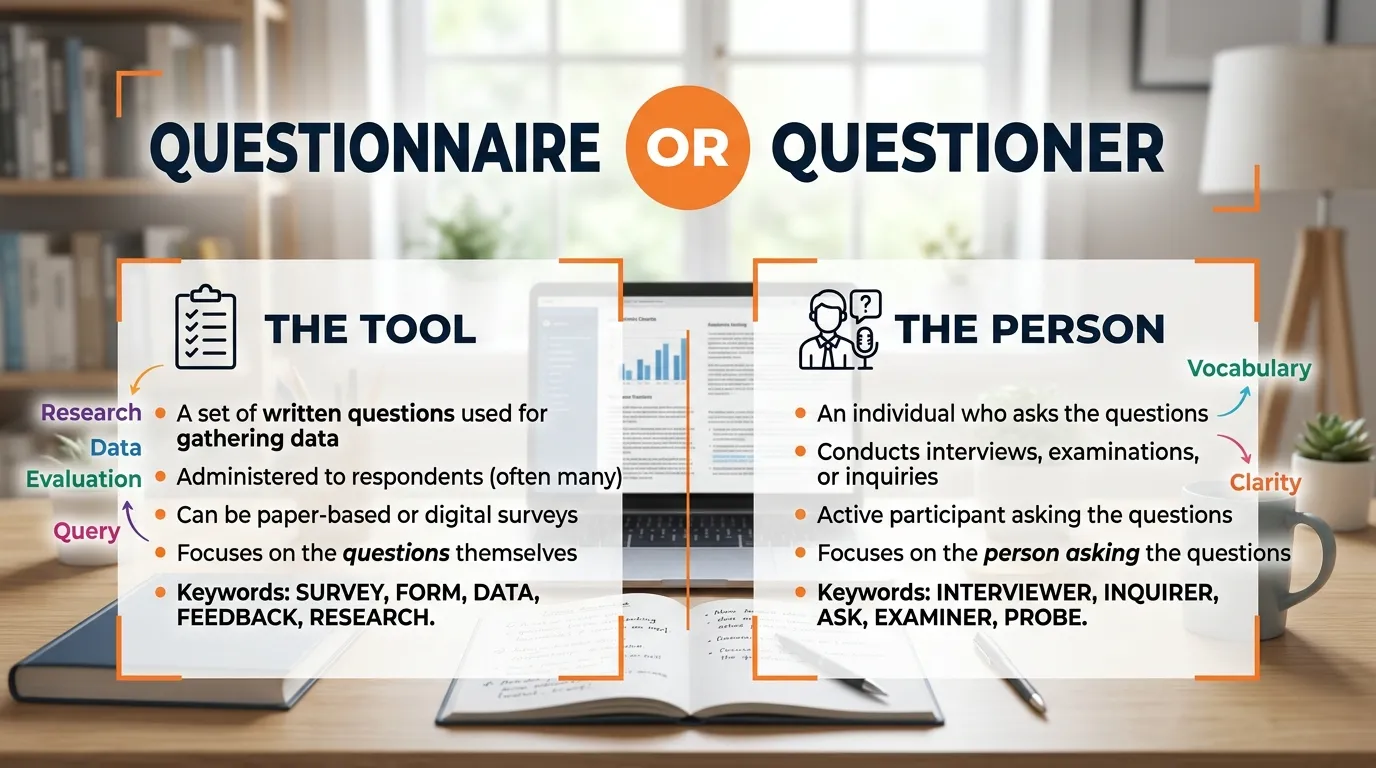
Questionnaire is a set of questions, while questioner is a person who asks questions.
People often mix them up in emails, surveys, and professional writing, but the difference is simple once you know it.
In this guide, you’ll quickly learn when to use each word and avoid mistakes with confidence.
Questionnaire or Questioner – Quick Answer
The difference between questionnaire and questioner is simple.
- Questionnaire is a form or document containing a list of questions.
- Questioner is a person who asks questions.
Examples
- Please complete the questionnaire before the meeting.
- The questioner asked several thoughtful questions.
In short:
- Questionnaire = a set of questions
- Questioner = a person asking questions
The Origin of Questionnaire and Questioner
Both words come from the English word question, but they developed in different ways.
Origin of Questionnaire
Questionnaire comes from French. It entered English in the late 1800s.
- Derived from the French word questionnaire
- Originally meant a list of questions for gathering information
- Common in research, education, healthcare, and business
Today, it is widely used for surveys, forms, and feedback collection.
Origin of Questioner
Questioner is formed by adding the suffix -er to the verb question.
- Question + -er = one who questions
- It simply means a person who asks questions
This follows a common English pattern, like:
- teach → teacher
- write → writer
- question → questioner
British English vs American English Spelling
There is no spelling difference between British and American English for these words.
Both varieties use:
- questionnaire
- questioner
The meanings are also the same in all English-speaking countries.
Comparison Table
| Word | British English | American English | Meaning |
| Questionnaire | Questionnaire | Questionnaire | A list of questions |
| Questioner | Questioner | Questioner | A person who asks questions |
Examples
- British: Please complete the questionnaire.
- American: Please complete the questionnaire.
- British: The questioner was very polite.
- American: The questioner was very direct.
Which Spelling Should You Use?
Choosing the right word depends on what you mean.
Use Questionnaire When:
- You mean a survey or form
- You are collecting information
- You are referring to written questions
Examples:
- The customer satisfaction questionnaire is ready.
- Students completed the questionnaire online.
Use Questioner When:
- You mean a person asking questions
- You are describing an interviewer, reporter, or participant
Examples:
- The questioner challenged the speaker.
- Every good journalist is a skilled questioner.
Audience-Based Advice
| Audience | Recommended Word |
| United States | Use the word that matches your meaning |
| United Kingdom | Use the word that matches your meaning |
| Commonwealth Countries | Same usage applies |
| Global Audience | Questionnaire for forms, questioner for people |
Common Mistakes with Questioner or Questionnaire
Many writers confuse these words because they share the same root.
Mistake 1
❌ Please fill out the questioner.
✔ Please fill out the questionnaire.
Mistake 2
❌ The questionnaire asked difficult questions during the interview.
✔ The questioner asked difficult questions during the interview.
Mistake 3
❌ She is a skilled questionnaire.
✔ She is a skilled questioner.
Quick Tip
- If it is a document, use questionnaire.
- If it is a person, use questioner.
Questioner and Questionnaire in Everyday Examples
In Emails
- Please return the completed questionnaire by Friday.
- The questioner requested further clarification.
In News Reports
- The questionnaire gathered public opinion.
- The questioner pressed the minister for answers.
On Social Media
- I just completed a personality questionnaire.
- The questioner asked exactly what everyone was thinking.
In Formal Writing
- Participants completed a demographic questionnaire.
- The questioner maintained a neutral tone.
Questioner vs Questionnaire – Google Trends & Usage Data
Search data shows that questionnaire is far more common than questioner.
This is because questionnaires are widely used in:
- surveys
- education
- market research
- customer feedback
- healthcare
Questioner is less common and appears mainly in journalism, interviews, and academic discussions.
Popular Search Queries
- questionnaire meaning
- questionnaire vs survey
- questioner meaning
- questionnaire or questioner
Countries with High Search Interest
- entity[“country”,”United States”,”United States”]
- entity[“country”,”United Kingdom”,”United Kingdom”]
- entity[“country”,”India”,”India”]
- entity[“country”,”Pakistan”,”Pakistan”]
- entity[“country”,”Canada”,”Canada”]
Questionnaire vs Questioner: Comparison Table
| Feature | Questionnaire | Questioner |
| Type | Noun | Noun |
| Meaning | A set of questions | A person asking questions |
| Usage | Surveys, forms, research | Interviews, discussions |
| Frequency | Very common | Less common |
| Example | Complete the questionnaire | The questioner spoke first |
FAQs
What is the difference between questionnaire and questioner?
A questionnaire is a written set of questions. A questioner is someone who asks questions.
Is questionnaire a person or a document?
A questionnaire is a document or form containing questions.
Who is called a questioner?
A questioner is any person who asks questions, such as an interviewer or journalist.
Can I say “fill out the questioner”?
No. The correct phrase is “fill out the questionnaire.”
Is questioner a common word?
Yes, but it is much less common than questionnaire.
Are questionnaire and survey the same?
A questionnaire is a tool used within a survey. A survey is the broader research process.
Is there a British or American spelling difference?
No. Both words are spelled the same in British and American English.
Conclusion
A questionnaire is a written form containing questions. It is used to collect information in surveys, research, and feedback forms.
A questioner is a person who asks questions. This could be an interviewer, journalist, teacher, or anyone seeking answers.
The spelling does not change between British and American English. Your choice depends entirely on meaning.
Remember this simple rule:
- Questionnaire = questions on paper or screen
- Questioner = person asking questions
Using the correct word will make your writing clearer, more accurate, and more professional.

I’m American writer known for precise, economical use of language and strong narrative voice. My work is frequently studied for sentence rhythm, word choice, and how meaning is shaped through grammar, making it valuable for close reading and English comparison studies.