Have you ever stopped while writing and wondered whether to use empty or vacant? You are not alone. These words have similar meanings, but they are used in different situations.
Empty means something has nothing inside, while vacant means something is unoccupied or available.
For example, an empty bottle has nothing in it, but a vacant room means no one is using it. Because both words relate to absence, many writers and English learners confuse them in daily writing, emails, advertisements, and conversations.
This guide will clearly explain the difference between empty vs vacant, with simple meanings, examples, common mistakes, and easy usage tips so you can choose the correct word confidently every time.
Empty or Vacant – Quick Answer
Both empty and vacant are correct English words, but they are used differently.
- Empty means containing nothing inside.
- Vacant means not occupied, used, or filled by a person.
Examples
- The bottle is empty.
- The apartment is vacant.
- Her mind felt empty.
- There is a vacant seat near the window.
Simple Rule
- Use empty for objects, containers, feelings, or spaces without contents.
- Use vacant for rooms, jobs, seats, buildings, or positions that are available or unoccupied.
The Origin of Empty and Vacant
Understanding word origins helps explain why these words feel slightly different in English.
Origin of Empty
The word empty comes from the Old English word æmettig, meaning “containing nothing” or “unoccupied.”
Over time, the meaning expanded to include:
- Physical emptiness
- Emotional emptiness
- Lack of meaning or value
Today, it is one of the most common descriptive words in English.
Origin of Vacant
The word vacant comes from the Latin word vacare, meaning “to be free” or “to be unoccupied.”
Later, it entered English through Old French and Middle English.
Its meaning became associated with:
- Available spaces
- Unoccupied property
- Open job positions
- Free seats or offices
This is why vacant often sounds more formal than empty.
British English vs American English Spelling
Good news: there is no spelling difference between British English and American English for empty and vacant.
Both regions use the same spelling and meanings.
Empty vs Vacant: Comparison Table
| Feature | Empty | Vacant |
| Meaning | Contains nothing | Not occupied |
| Common Usage | Objects, feelings, spaces | Rooms, jobs, seats |
| Tone | Neutral | More formal |
| British English | Same spelling | Same spelling |
| American English | Same spelling | Same spelling |
Which Spelling Should You Use?
Since there is no regional spelling difference, your choice depends on meaning and context.
Use “Empty” When Talking About:
- Containers
- Boxes
- Rooms without objects
- Feelings
- Silence
- Lack of content
Examples
- The glass is empty.
- My wallet feels empty.
- The hall looked empty after the event.
Use “Vacant” When Talking About:
- Apartments
- Offices
- Hotel rooms
- Seats
- Jobs
- Parking spaces
Examples
- The office remains vacant.
- There is a vacant position available.
- We found a vacant parking spot.
Audience-Based Advice
| Audience | Recommended Word |
| Everyday conversation | Empty |
| Business writing | Vacant |
| Real estate listings | Vacant |
| Emotional writing | Empty |
| Job advertisements | Vacant |
| Academic writing | Depends on context |
Common Mistakes with Vacant or Empty
Many writers confuse these words because both suggest absence.
However, their usage differs in important ways.
Mistake 1: Using Vacant for Containers
❌ The bottle is vacant.
✔ The bottle is empty.
Reason:
- Bottles contain things.
- “Vacant” is usually for occupied spaces or positions.
Mistake 2: Using Empty for Job Positions
❌ The company has an empty position.
✔ The company has a vacant position.
Reason:
- Jobs are considered available positions, not containers.
Mistake 3: Using Vacant Emotionally
❌ I feel vacant inside.
✔ I feel empty inside.
Reason:
- Emotional expressions usually use “empty.”
Mistake 4: Using Empty for Hotel Availability
❌ The hotel has empty rooms.
✔ The hotel has vacant rooms.
Reason:
- In hospitality and real estate, “vacant” sounds more professional.
Quick Memory Trick
A simple trick can help you remember the difference:
- Empty = nothing inside
- Vacant = nobody inside
This rule works in most situations.
Vacant and Empty in Everyday Examples
Real-world examples make the difference easier to understand.
In Emails
Empty
- My inbox is empty today.
- The file folder is empty.
Vacant
- We currently have a vacant role in marketing.
- The meeting room is vacant.
In News Writing
Empty
- The streets were empty during the storm.
Vacant
- Several vacant buildings were renovated downtown.
On Social Media
Empty
- Feeling empty after finishing the series.
Vacant
- Found a vacant seat at the concert.
In Formal Writing
Empty
- The container remained empty throughout the experiment.
Vacant
- The committee announced a vacant leadership position.
Empty vs Vacant: Comparison Table
| Situation | Correct Word |
| A bottle with nothing inside | Empty |
| An available apartment | Vacant |
| A free seat | Vacant |
| A box with nothing in it | Empty |
| Emotional loneliness | Empty |
| Open job role | Vacant |
Vacant vs Empty – Google Trends & Usage Data
Search data shows that empty is much more common than vacant in everyday English.
This happens because “empty” appears in:
- Daily speech
- Emotional writing
- Education
- Entertainment
- Social media
Meanwhile, “vacant” appears more in:
- Real estate
- Business
- Legal writing
- Hotel industry
- Employment advertisements
Countries with High Search Interest
“Empty” Is Highly Searched In:
- United States
- India
- Pakistan
- United Kingdom
- Canada
“Vacant” Is Highly Searched In:
- United States
- Australia
- United Kingdom
Usage by Context
| Context | Common Word |
| Daily conversation | Empty |
| Real estate | Vacant |
| Hospitality | Vacant |
| Emotional expression | Empty |
| Business jobs | Vacant |
| Science | Empty |
Why People Confuse Empty and Vacant
Several reasons cause this confusion.
1. Similar Meanings
Both words describe absence.
This makes them appear interchangeable.
2. Overlapping Contexts
Some situations allow both words:
- empty room
- vacant room
However, the tone changes slightly.
“Vacant room” sounds more formal and professional.
3. Translation Issues
In many languages, one word covers both meanings.
English separates physical emptiness from occupancy.
4. Business vs Everyday Tone
“Vacant” sounds formal.
“Empty” sounds natural and conversational.
This difference confuses many learners.
When to Use Empty
Use empty for:
- Containers
- Feelings
- Spaces without contents
- Lack of activity
- Silence
Examples
- The cup is empty.
- The classroom looked empty.
- He felt emotionally empty.
When to Use Vacant
Use vacant for:
- Property
- Jobs
- Rooms
- Seats
- Parking spots
- Offices
Examples
- The apartment is vacant.
- There is a vacant chair near the door.
- The company posted a vacant position online.
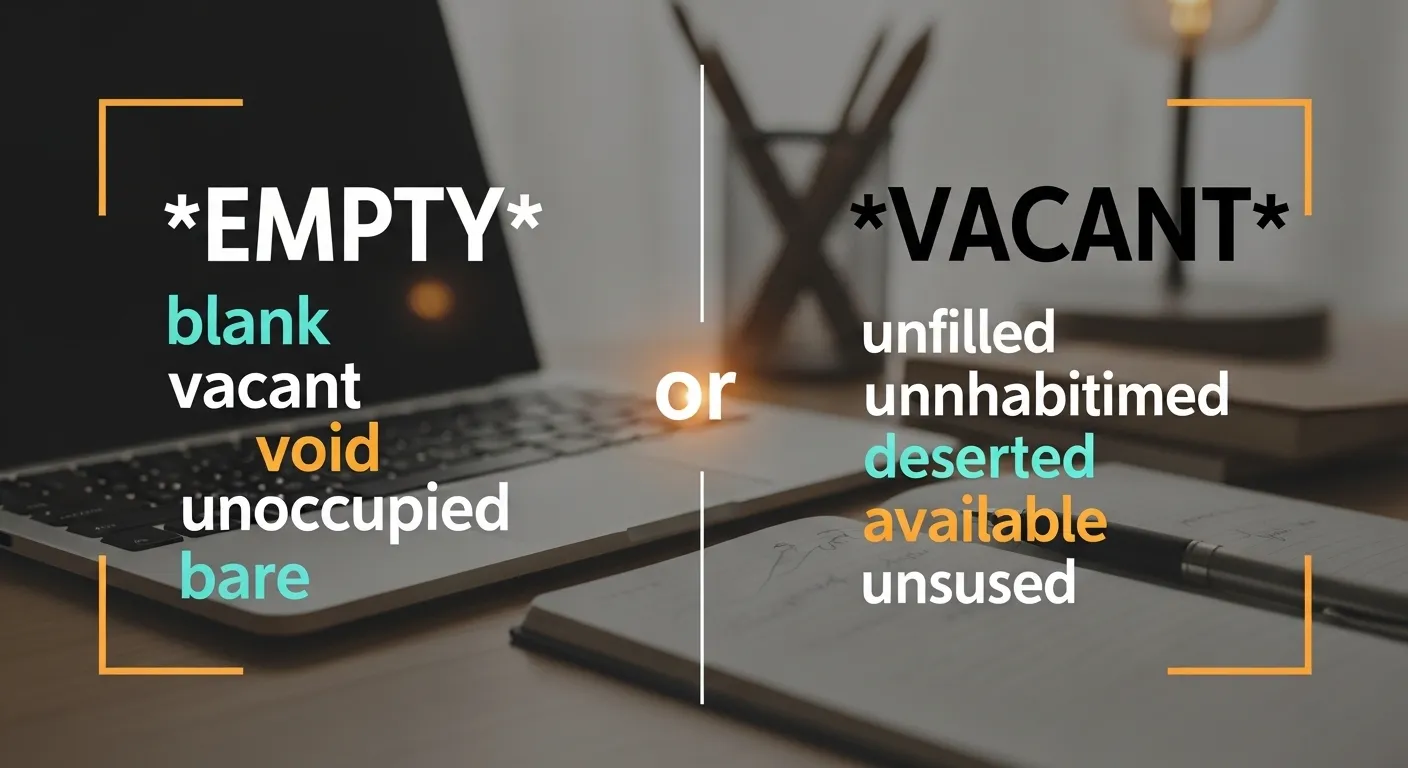
Similar Words and Synonyms
Synonyms of Empty
- Blank
- Hollow
- Bare
- Clear
- Unfilled
Synonyms of Vacant
- Available
- Unoccupied
- Free
- Open
- Unused
These synonyms can help improve vocabulary and writing variety.
Empty vs Vacant in Professional Writing
Professional writing often prefers “vacant” in business contexts.
Common Business Usage
- Vacant office
- Vacant role
- Vacant property
Meanwhile, “empty” remains common in descriptive writing.
Common Descriptive Usage
- Empty streets
- Empty shelves
- Empty bottle
Understanding tone improves writing quality.
FAQs
1. What is the difference between empty and vacant?
Empty means containing nothing inside, while vacant means unoccupied or available.
2. Can empty and vacant mean the same thing?
Sometimes yes, especially for rooms or buildings. However, “vacant” sounds more formal.
3. Is an empty seat the same as a vacant seat?
Yes, both can work. But “vacant seat” is more formal.
4. Which word is better for job positions?
Use “vacant” for jobs or roles.
5. Can a person feel vacant?
Technically yes, but English speakers usually say “empty” for emotions.
6. Is there a spelling difference in British and American English?
No. Both regions use the same spellings.
7. Which word is more common in daily English?
“Empty” is much more common in everyday conversation.
Conclusion
The difference between empty and vacant is simple once you understand the context.
Use empty when something contains nothing inside. This word works best for objects, containers, feelings, silence, and general descriptions.
Use vacant when something is unoccupied or available. This word is more common in business, real estate, hotels, offices, and job advertisements.
Although both words describe absence, they focus on different ideas:
There is no British or American spelling difference, which makes usage easier worldwide.
- Empty = no contents
- Vacant = no person or occupant
A quick memory trick can help:
- Empty = nothing inside
- Vacant = nobody inside
Once you remember this simple rule, choosing between empty and vacant becomes much easier in every type of writing.

I’m English language author writing emphasises clarity, structure, and close attention to language. My work is often examined for stylistic comparison, focusing on Grammar work, narrative control, and subtle thematic development.