Have you ever wondered whether the correct word is bore or boar? You’re not alone. These two words sound exactly alike, but they have completely different meanings.
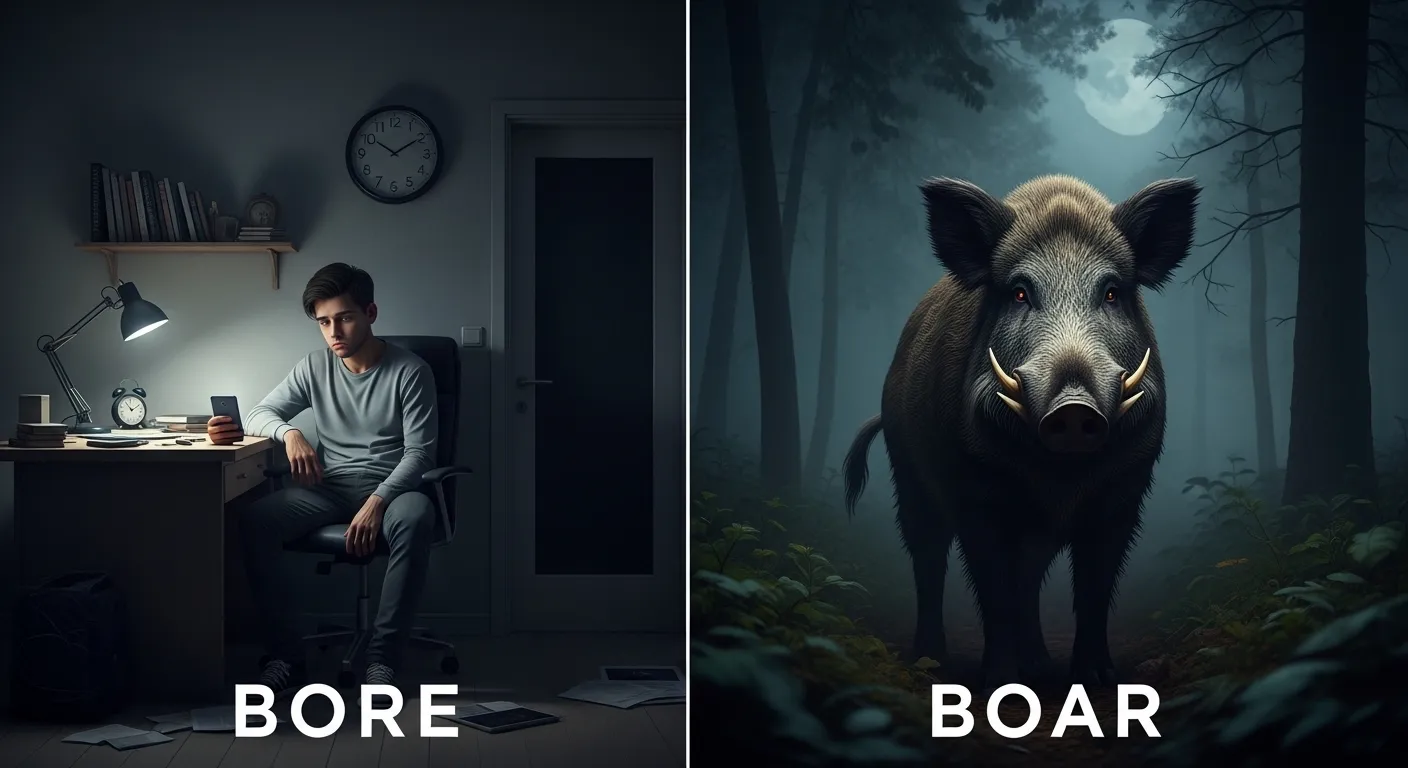
Bore means to make someone feel uninterested or can refer to drilling a hole, while boar is a wild male pig.
Because they are homophones, many writers accidentally use the wrong word.
In this guide, you’ll learn the difference between bore and boar, see clear examples, and discover simple memory tricks to use the correct word every time.
Bore or Boar – Quick Answer
Bore and boar are homophones. They sound the same but have different meanings and spellings.
- Bore → To make someone feel tired or uninterested
Example: This lecture will bore you. - Boar → A wild pig (animal)
Example: The hunter saw a boar in the forest.
👉 Simple Trick:
- If it is about feeling bored → use “bore”
- If it is an animal → use “boar”
The Origin of Bore and Boar
Origin of “Bore”
The word bore comes from Old English borian, meaning “to drill” or “to pierce.” Over time, its meaning changed. It began to describe something dull or tiring, as if it “drills into your patience.”
Later, it became commonly used to describe people or situations that are not interesting.
Origin of “Boar”
The word boar comes from Old English bār, which means a male pig. It has always been related to animals and hunting.
Unlike bore, the meaning of boar has stayed almost the same for centuries.
Why the Confusion Exists
Both words:
- Sound exactly the same
- Have different meanings
- Are spelled differently
This makes them homophones, which often confuse learners.
British English vs American English Spelling
Good news! There is no spelling difference between British and American English for these words.
Both regions use:
- Bore (same spelling)
- Boar (same spelling)
Comparison Table
| Meaning | British English | American English | Example Sentence |
| To annoy/tire | Bore | Bore | This game will bore you. |
| Wild animal | Boar | Boar | A boar ran across the road. |
👉 Unlike words like “color/colour,” these words do not change by region.
Which Spelling Should You Use?
Choosing between bore and boar is simple. It depends on meaning, not location.
Use “Bore” if:
- You are talking about feelings
- Something is dull or uninteresting
- You are writing emails, blogs, or reviews
Example:
- This meeting will bore everyone.
Use “Boar” if:
- You are talking about an animal
- Writing about wildlife, nature, or hunting
Example:
- The boar is a strong and dangerous animal.
Global Advice
- For US, UK, and worldwide audiences, the rule is the same
- Focus on meaning, not spelling style
Common Mistakes with Boar or Bore
Here are some frequent errors people make:
❌ Incorrect:
- That movie was a boar.
✔ Correct: - That movie was a bore.
❌ Incorrect:
- I saw a bore in the jungle.
✔ Correct: - I saw a boar in the jungle.
❌ Incorrect:
- He is very boar in class.
✔ Correct: - He is very boring in class.
❌ Incorrect:
- Don’t bore me with animal stories about bores.
✔ Correct: - Don’t bore me with animal stories about boars.
👉 Tip: Always check the sentence meaning before choosing the word.
Boar and Bore in Everyday Examples
1. In Emails
- This report may bore the reader.
- The wildlife report mentions a wild boar.
2. In News
- The speech did not bore the audience.
- A wild boar entered the city last night.
3. On Social Media
- This trend is starting to bore people.
- Look at this huge boar I spotted!
4. In Formal Writing
- Repetitive content can bore readers quickly.
- The boar is known for its strength and aggression.
Boar vs Bore – Google Trends & Usage Data
Popularity Insights
- “Bore” is used much more often
- It appears in:
- Daily conversations
- Movies and reviews
- Work emails
- Daily conversations
- “Boar” is less common
- It appears mainly in:
- Wildlife content
- News reports
- Educational material
- Wildlife content
By Country
- US & UK: “Bore” dominates general usage
- Rural regions worldwide: “Boar” appears more in hunting and farming contexts
Search Intent
People search “bore or boar” when:
- Writing essays
- Learning English
- Avoiding grammar mistakes
Comparison Table: Bore vs Boar
| Feature | Bore | Boar |
| Meaning | To make someone uninterested | A wild pig |
| Word Type | Verb / Noun | Noun |
| Usage | Emotions, reactions | Animals, nature |
| Example | This class bores me | The boar ran fast |
| Frequency | Very common | Less common |
FAQs
1. Are bore and boar pronounced the same?
Yes. They sound exactly the same. That is why they are confusing.
2. Is “boar” ever used to mean boring?
No. Boar only refers to an animal. It cannot mean boring.
3. Can “bore” be used as a noun?
Yes.
Example: He is such a bore. (meaning a boring person)
4. How do I remember the difference?
- Bore = Boring
- Boar = Animal
5. Which word is more common?
Bore is much more common in daily English.
6. Is there any regional difference?
No. Both words are spelled the same in British and American English.
7. Can “bore” have other meanings?
Yes. It can also mean:
- To drill a hole
- A hole itself (noun)
Conclusion:
Understanding the difference between bore and boar is simple once you focus on meaning. Even though they sound the same, their uses are completely different. One relates to feelings and interest, while the other refers to an animal.
There is no difference between British and American English for these words. This makes things easier.
To avoid mistakes, always read your sentence carefully. Ask yourself: Am I talking about boredom or an animal? This simple check will help you write clearly and confidently.
With practice, you will stop second-guessing and start using both words correctly in any situation.

I’m American writer known for precise, economical use of language and strong narrative voice. My work is frequently studied for sentence rhythm, word choice, and how meaning is shaped through grammar, making it valuable for close reading and English comparison studies.