Have you ever wondered whether the correct spelling is reoccuring or recurring? You are not alone. This is a very common spelling mistake in English writing.
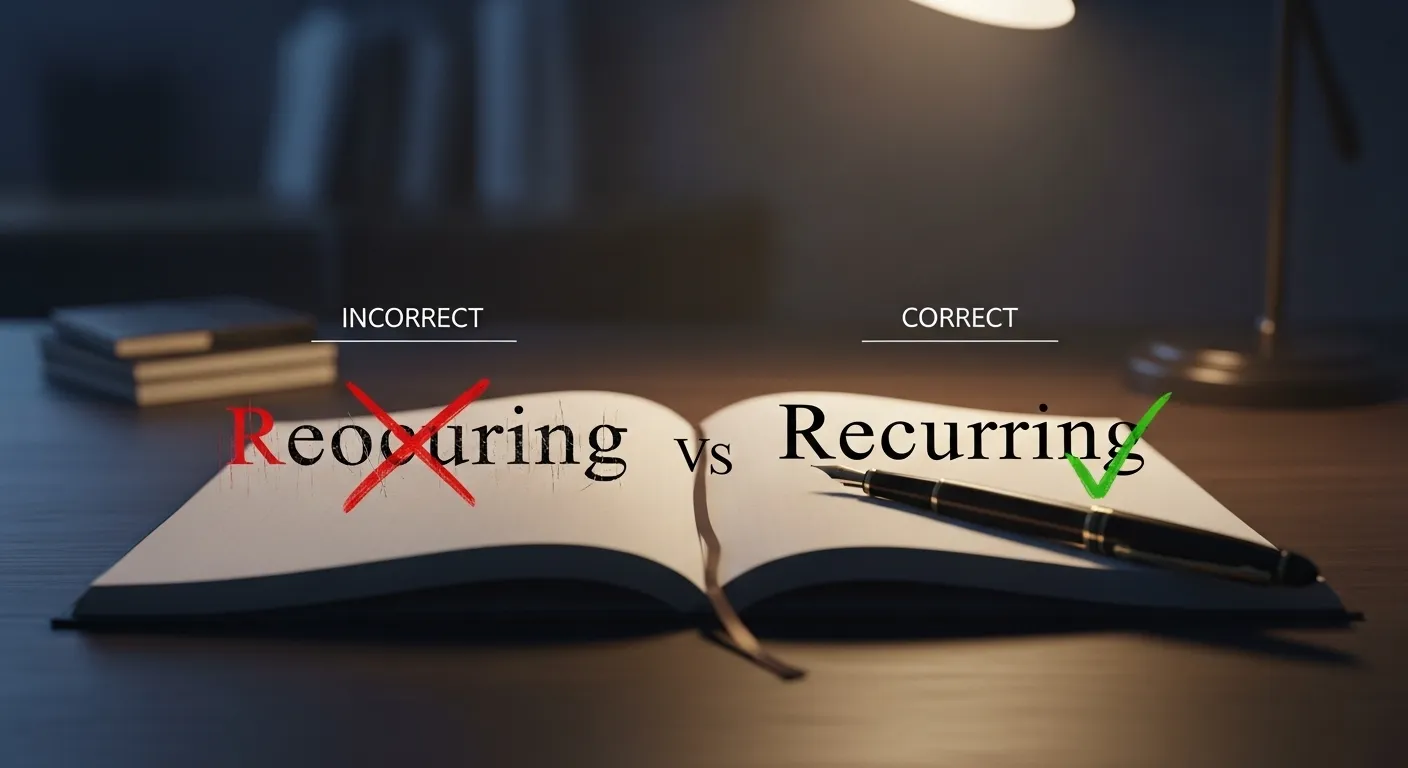
Recurring is the correct spelling. Reoccuring is incorrect.
Many writers add an extra “o” because the word seems connected to occur, but standard English spelling uses recurring instead.
This guide will explain the correct spelling, meaning, examples, and easy memory tips so you can write confidently without making this mistake again.
Reoccuring or Recurring – Quick Answer
The correct spelling is recurring.
“Reoccuring” is incorrect.
✅ Correct:
- The meeting is recurring every Monday.
- She has a recurring headache.
- This is a recurring problem.
❌ Incorrect:
- The meeting is reoccuring every Monday.
- He has a reoccuring issue.
The confusion happens because the base verb is “recur,” not “reoccur.” When adding -ing, we double the “r” and write recurring.
The Origin of Reoccuring and Recurring
To understand the spelling, we need to look at the root word.
The word recur comes from Latin recurrere, which means “to run back” or “to happen again.”
“Recur” = to happen again
“Recurring” = happening again and again
Many people think the word comes from “occur.” But that is different.
- Occur = to happen
- Recur = to happen again
Although they look similar, they are separate words with different roots.
When we add -ing to “recur,” we follow the English rule:
- If a verb ends in consonant-vowel-consonant (CVC), we double the last consonant before adding -ing.
Recur → Recurring
Not → Reoccuring
That is why recurring is correct and “reoccuring” is wrong.
British English vs American English Spelling
Good news: there is no difference between British and American spelling here.
Both use:
✔ Recurring
There is no accepted version of “reoccuring” in:
- 🇺🇸 American English
- 🇬🇧 British English
- 🇨🇦 Canadian English
- 🇦🇺 Australian English
Comparison Table
| Version | American English | British English | Correct? |
| Recurring | ✔ Yes | ✔ Yes | ✅ Correct |
| Reoccuring | ❌ No | ❌ No | ❌ Incorrect |
Unlike words such as “color/colour” or “judgment/judgement,” this word has only one correct spelling worldwide.
Which Spelling Should You Use?
The answer is simple: always use recurring.
If Your Audience Is:
- 🇺🇸 United States → Use recurring
- 🇬🇧 UK/Commonwealth → Use recurring
- 🌍 Global readers → Use recurring
There is no situation where “reoccuring” is preferred. It is considered a spelling mistake in academic, professional, and digital writing.
If you are writing:
- Business emails
- Blog posts
- SEO articles
- School essays
- Social media content
Always use recurring.
Common Mistakes with Recurring or Reoccuring
Here are frequent errors people make:
1. Adding an Extra “O”
❌ Reoccuring
✔ Recurring
People think of “occur,” so they insert an extra “o.”
2. Forgetting to Double the “R”
❌ Recuring
✔ Recurring
Remember the double consonant rule.
3. Mixing “Recur” and “Reoccur”
These words are similar but not the same.
- Recur = happens again repeatedly
- Reoccur = happens again (less common, slightly different meaning)
However, even if you use “reoccur,” the -ing form would be reoccurring, not “reoccuring.”
4. Using It Incorrectly in Formal Writing
Spelling errors in professional content reduce trust. Always proofread.
Recuring and Reoccuring in Everyday Examples
Let’s see how “recurring” is used in real life.
1. In Emails
- This is a recurring payment.
- The issue keeps recurring every month.
2. In News Writing
- The city faces recurring flooding problems.
- Lawmakers discussed recurring budget issues.
3. On Social Media
- I’m having a recurring dream lately.
- This bug is recurring after every update.
4. In Business and Finance
- The company earns recurring revenue.
- We scheduled a recurring meeting.
5. In Healthcare
- He suffers from recurring migraines.
- The patient has a recurring infection.
In all cases, “recurring” is the only correct spelling.
Recurring vs Reoccuring – Google Trends & Usage Data
Search data shows that:
- “Recurring” is widely used in all English-speaking countries.
- “Reoccuring” appears in search queries because people are unsure of the spelling.
In countries like:
- United States
- United Kingdom
- Canada
- Australia
- India
- Pakistan
The correct spelling “recurring” dominates written content, academic texts, and professional documents.
“Reoccuring” mostly appears in:
- Search engines (as a misspelling)
- Informal posts
- Unedited content
This proves that “reoccuring” is not a regional variant. It is simply a common spelling mistake.
Comparison Table: Reoccuring vs Recurring
| Feature | Recurring | Reoccuring |
| Correct spelling | ✅ Yes | ❌ No |
| Used in US English | ✅ Yes | ❌ No |
| Used in UK English | ✅ Yes | ❌ No |
| Accepted in academic writing | ✅ Yes | ❌ No |
| Common search mistake | ❌ No | ✅ Yes |
FAQs:
1. Is reoccuring a real word?
No. It is a spelling mistake. The correct word is recurring.
2. Why do people spell it reoccuring?
Because they confuse it with the word “occur.” It looks similar, so they add an extra “o.”
3. Is recurring correct in British English?
Yes. British English and American English both use recurring.
4. What is the difference between recur and reoccur?
“Recur” means to happen again repeatedly.
“Reoccur” means to happen again, but it is less common.
5. How do I remember the correct spelling?
Think of the base word: recur.
Then double the “r” → recurring.
6. Is recurring formal?
Yes. It is used in professional, academic, medical, and business writing.
7. Can reoccuring ever be correct?
No. It is always incorrect spelling.
Conclusion:
The confusion between “reoccuring or recurring” is common, but the rule is clear. The correct spelling is recurring.
There is no British vs American difference. No formal vs informal variation. There is only one correct spelling worldwide.
If you want your writing to look professional and polished, always use recurring.
Now you can write with confidence whether it’s a recurring payment, recurring meeting, or recurring problem.

I’m English language author writing emphasises clarity, structure, and close attention to language. My work is often examined for stylistic comparison, focusing on Grammar work, narrative control, and subtle thematic development.