Have you ever wondered whether the correct word is allusion or illusion? You’re not alone. These two words sound almost identical, but their meanings are completely different.
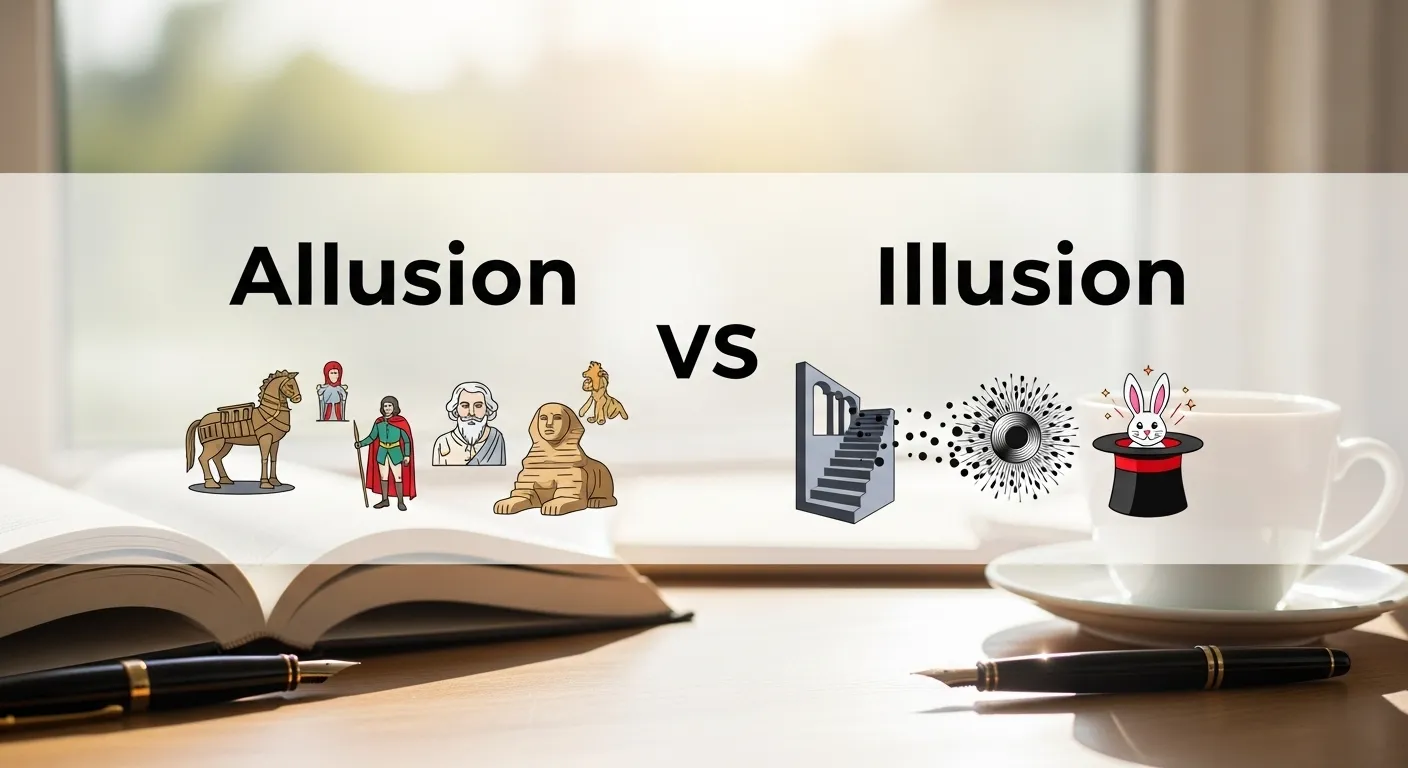
An allusion is an indirect reference to something, while an illusion is a false appearance or trick that deceives the senses.
Because of their similar spelling and pronunciation, many writers mix them up. However, using the wrong word can completely change the meaning of your sentence.
In this guide, you’ll learn the difference between allusion and illusion, see real-world examples, and discover simple tricks to remember the correct word every time.
Allusion or Illusion – Quick Answer
Allusion is an indirect reference to a person, event, book, or idea.
Illusion is a false image, mistaken belief, or deceptive appearance.
Simple Examples
- Her speech made an allusion to Shakespeare.
- The magician created an amazing illusion.
Think of it this way:
- Allusion = reference
- Illusion = deception
If you are hinting at something, use allusion.
If something is not real or appears misleading, use illusion.
The Origin of Allusion and Illusion
Understanding the roots of these words makes the difference much easier to remember.
Origin of Allusion
The word allusion comes from the Latin word alludere, meaning “to play with” or “to refer to indirectly.” Over time, it came to mean a subtle or indirect reference.
Writers often use allusions to connect their ideas to famous stories, history, or culture.
Origin of Illusion
The word illusion comes from the Latin illusio, meaning “mockery,” “deception,” or “trick.” It later developed the meaning of something that misleads the senses or mind.
This is why illusions are often linked to magic, visual tricks, or false beliefs.
Why the Confusion Exists
These words:
- Sound alike
- Share Latin roots
- Have similar spelling patterns
But their meanings are completely different.
British English vs American English Spelling
Good news: both allusion and illusion are spelled the same in British English and American English.
Unlike words such as colour/color or organise/organize, there is no spelling variation here.
Comparison Table
| Word | British English | American English | Meaning |
| Allusion | Allusion | Allusion | Indirect reference |
| Illusion | Illusion | Illusion | False appearance or belief |
So whether you are writing for readers in the United States, the United Kingdom, Canada, Australia, or anywhere else, the spelling remains unchanged.
Which Spelling Should You Use?
Since there is no regional spelling difference, the choice is simple.
- Use allusion when referring to an indirect reference.
- Use illusion when referring to something deceptive or unreal.
Audience-Based Advice
- United States: Use the standard forms allusion and illusion.
- United Kingdom: Use the same standard spellings.
- Canada and Australia: Also use the same spellings.
- Global audiences: These spellings are universally accepted.
Your focus should be on choosing the correct meaning, not a regional spelling.
Common Mistakes with Illusion or Allusion
Many writers mix these words up because of their similar pronunciation.
Mistake 1: Using Illusion Instead of Allusion
❌ The author made an illusion to Greek mythology.
✅ The author made an allusion to Greek mythology.
Mistake 2: Using Allusion Instead of Illusion
❌ The mirror created an allusion of extra space.
✅ The mirror created an illusion of extra space.
Mistake 3: Assuming They Are Interchangeable
They are not synonyms.
- Allusion = reference
- Illusion = false appearance
Quick Memory Trick
- Allusion = A reference to another thing.
- Illusion = Image that is not real.
Illusion and Allusion in Everyday Examples
Seeing these words in context helps you remember them.
In Emails
- Your presentation included an interesting allusion to recent events.
- The advertisement created the illusion of luxury.
In News Writing
- The politician made an allusion to past economic crises.
- The scam gave victims the illusion of easy profits.
On Social Media
- That meme is an allusion to a famous movie scene.
- Filters can create the illusion of perfect skin.
In Academic Writing
- The poem contains an allusion to classical mythology.
- The study explores the illusion of control.
In Daily Conversation
- Was that an allusion to our last meeting?
- The stage setup created an illusion of depth.
Illusion vs Allusion – Google Trends and Usage Data
Search interest for allusion or illusion remains strong because these words are often confused.
Why People Search for This Pair
- Similar pronunciation
- Similar spelling
- Different meanings
- Common use in writing and education
Popular Search Regions
- United States
- United Kingdom
- Canada
- Australia
- India
Students, writers, editors, and English learners search this term frequently.
Usage Contexts
| Word | Common Contexts |
| Allusion | Literature, speeches, essays, reviews |
| Illusion | Psychology, magic, design, philosophy |
Illusion tends to appear more often in everyday speech, entertainment, and psychology.
Allusion is more common in literature, writing, and education.
Allusion vs Illusion Comparison Table
| Feature | Allusion | Illusion |
| Part of Speech | Noun | Noun |
| Meaning | Indirect reference | False appearance or belief |
| Related To | Literature, speech, writing | Vision, psychology, magic |
| Example | An allusion to Romeo and Juliet | An optical illusion |
| Memory Aid | A = reference | I = imaginary |
When to Use Allusion
Use allusion when you are:
- Referring indirectly to something
- Mentioning a famous event, person, or text without naming it directly
- Adding depth or cultural meaning to writing
Examples
- The novel contains many biblical allusions.
- His joke was an allusion to an old television show.
- The speech included an allusion to the civil rights movement.
When to Use Illusion
Use illusion when you are describing:
- Something that appears real but is not
- A visual trick
- A false belief or impression
Examples
- The desert created an illusion of water.
- The magician performed a stunning illusion.
- Success can sometimes create an illusion of certainty.
FAQs
1. What is the main difference between allusion and illusion?
An allusion is an indirect reference. An illusion is something false or deceptive.
2. Are allusion and illusion pronounced the same?
They are similar, but not identical. Their close pronunciation is a major reason people confuse them.
3. Can I use allusion and illusion interchangeably?
No. They have completely different meanings.
4. Which word is used in literature?
Allusion is commonly used in literature to reference other works, events, or figures.
5. Which word relates to magic or visual tricks?
Illusion is the correct word for magic tricks and visual deception.
6. Is there a spelling difference between British and American English?
No. Both words are spelled the same in all major forms of English.
7. How can I remember the difference easily?
Remember:
- Allusion = alludes to something
- Illusion = imaginary or deceptive image
Conclusion
The difference between allusion and illusion is simple once you know what each word means. An allusion is an indirect reference to something, such as a book, person, or historical event. An illusion, on the other hand, is a false appearance, a trick of the eye, or a mistaken belief.
Writers use allusion to add meaning, depth, and cultural connection to their work. Illusion is used when discussing deception, visual effects, or false impressions.
There is no difference in spelling between British and American English.
If you are referring to something indirectly, choose allusion. If you are describing something unreal or misleading, choose illusion.

I’m English language author writing emphasises clarity, structure, and close attention to language. My work is often examined for stylistic comparison, focusing on Grammar work, narrative control, and subtle thematic development.