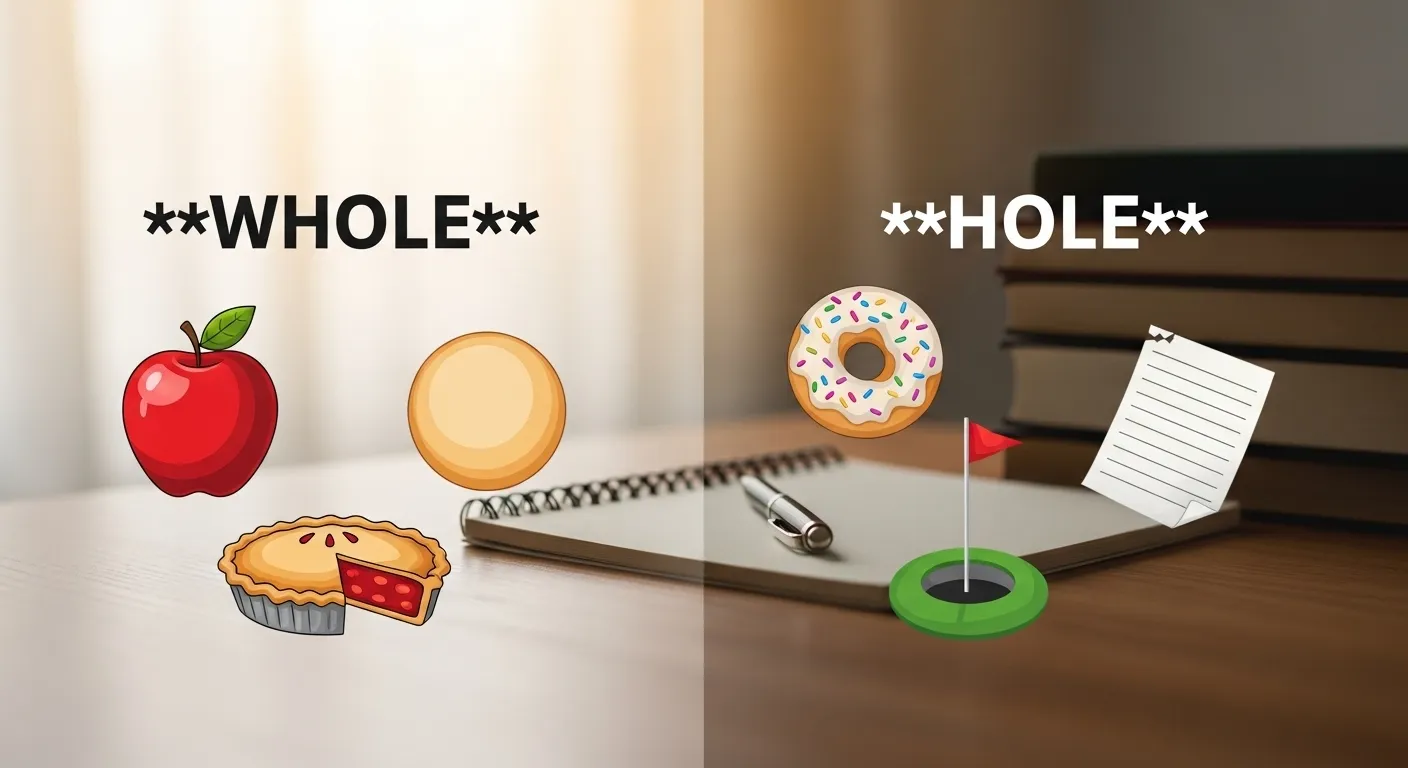
Whole and hole sound the same, but they mean very different things. That is why so many writers mix them up.
Whole means complete or entire. Hole means an opening, gap, or hollow space.
One missing letter can change your meaning completely.If you have ever wondered whether to write the whole story or a hole in the wall, you are not alone.
This simple guide will show you the difference, explain when to use each word, and help you avoid common mistakes.
Whole or Hole – Quick Answer
Whole means complete, entire, or all of something.
Hole means an opening, gap, or hollow space.
Examples
- I ate the whole pizza.
- There is a hole in my sock.
- She told me the whole truth.
- The dog dug a hole in the garden.
A simple trick:
- Whole = all of it.
- Hole = an empty space.
The Origin of Whole and Hole
Origin of Whole
The word whole comes from Old English hāl, meaning healthy, complete, or unbroken. It is related to words like heal and health. The idea is something full, sound, and complete.
Origin of Hole
The word hole comes from Old English hol, meaning hollow place or cavity. It has always referred to an opening or empty space.
Why the Confusion Exists
Over time, both words came to be pronounced the same way. English spelling kept their old forms, even though their meanings stayed very different. That is why whole and hole sound alike but are not interchangeable.
Whole Meaning: Complete or Entire
Whole means complete, entire, or all of something without any parts missing.
Example:
She ate the whole pizza by herself.
Whole Definition: What Does Whole Mean?
Whole is an adjective, noun, or adverb that refers to something complete, entire, or undivided.
Whole Noun or Adjective?
Whole can be both a noun and an adjective.
As an adjective:
- The whole family attended the event.
As a noun:
- The whole is greater than the sum of its parts.
Whole Synonym:
Common synonyms for whole include:
- Entire
- Complete
- Total
- Full
- Intact
- Undivided
Whole vs Complete Difference
Whole emphasizes that all parts are present and nothing is missing, while complete emphasizes that something has been finished or fully accomplished.
Example:
- I read the whole book. (the entire book)
- I completed the book. (finished reading it)
Hole Meaning: An Opening or Empty Spac
Hole refers to an opening, gap, or hollow space in a surface or object.
Example:
There is a hole in the wall.
Black Hole Meaning
A black hole is a region in space with such strong gravity that nothing—not even light—can escape from it.
Hole Definition: What Does Hole Mean?
Hole is a noun that means an opening, cavity, or hollow area in a surface, object, or material.
Hole Synonym:
Common synonyms for hole include:
- Opening
- Gap
- Cavity
- Hollow
- Pit
- Puncture
Hole Noun or Verb?
Hole is most commonly used as a noun, but it can also be a verb.
As a noun:
- The dog dug a hole in the garden.
As a verb:
- The boat was holed by a sharp rock.
Difference Between Whole and Hole
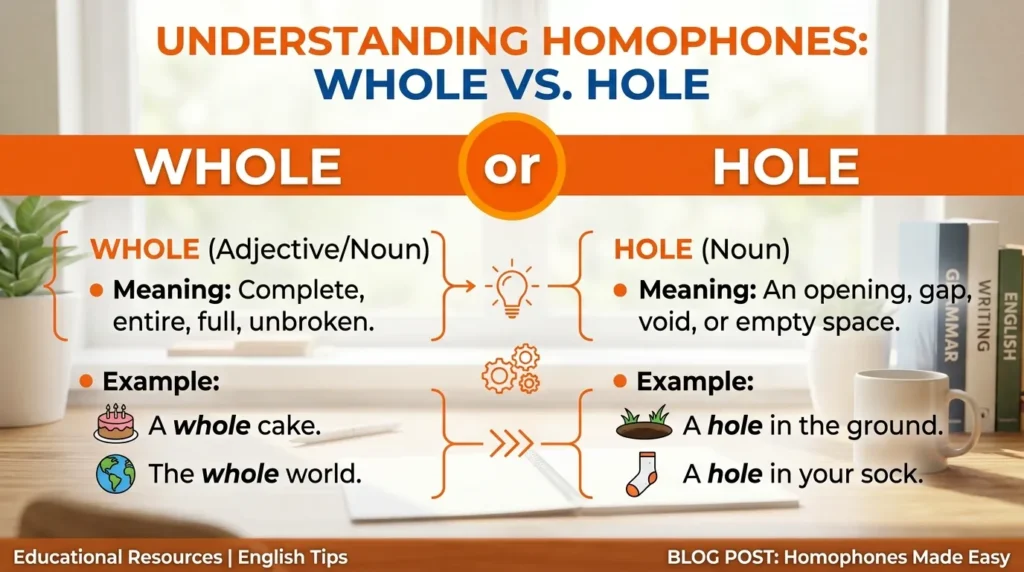
Although they sound the same, whole means complete or entire, while hole means an opening or hollow space. They are homophones with different meanings and spellings.
British English vs American English Spelling
Good news: whole and hole are spelled the same in both British and American English.
There is no regional spelling difference between these two words. The only challenge is choosing the correct one based on meaning.
Comparison Table
| Meaning | Correct Word | Example |
| Complete or entire | Whole | I read the whole book. |
| Opening or gap | Hole | There is a hole in the roof. |
Because the spelling is identical across English varieties, the focus should always be on meaning, not location.
Which Spelling Should You Use?
The answer depends on what you want to say not where your audience lives.
- Use whole when you mean complete, full, or entire.
- Use hole when you mean an opening, gap, or hollow space.
For American Audiences
Use the same rule:
- the whole team
- a hole in the ground
For British Audiences
Exactly the same:
- the whole day
- a hole in the fence
For Global Writing
These spellings are universal. Whether your audience is in the United States, the United Kingdom, Canada, Australia, or elsewhere, the meanings remain the same.
Whole or Hole: Which Is Correct?
Both whole and hole are correct words, but they are used in different contexts. Choose whole when talking about completeness and hole when referring to an opening or gap.
Common Mistakes with Hole or Whole
Writers often mix these words because they sound identical.
Incorrect vs Correct
- ❌ I know the hole story.
- ✅ I know the whole story.
- ❌ There is a whole in my shoe.
- ✅ There is a hole in my shoe.
- ❌ She spent the hole day reading.
- ✅ She spent the whole day reading.
- ❌ The rabbit jumped into a whole.
- ✅ The rabbit jumped into a hole.
Quick Memory Tip
- Whole has a W, like with everything.
- Hole starts with H, like a hollow space.
Hole and Whole in Everyday Examples
In Emails
- Please review the whole document before replying.
- There seems to be a hole in our plan.
In News Writing
- The whole country watched the event.
- A sinkhole opened, leaving a massive hole in the road.
On Social Media
- I watched the whole series in one weekend.
- My pocket has a hole, and I lost my keys.
In Formal Writing
- The whole system needs improvement.
- Researchers found a small hole in the sample container.
Hole vs Whole – Google Trends & Usage Data
Whole is used far more often than hole in everyday writing. This is because it appears in many common phrases, such as:
- whole life
- whole family
- whole number
- whole grain
- whole story
Hole is also common, but it is usually used in more specific physical contexts, such as:
- black hole
- hole in one
- rabbit hole
- hole in the wall
Popular Usage by Context
| Word | Common Contexts |
| Whole | Education, health, food, storytelling |
| Hole | Construction, sports, science, everyday objects |
Popularity by Country
Both words are widely used in:
- United States
- United Kingdom
- Canada
- Australia
- India
Their usage depends on context, not region.
Whole vs Hole: Comparison Table
| Feature | Whole | Hole |
| Part of Speech | Adjective, noun | Noun, verb |
| Meaning | Complete, entire | Opening, gap, cavity |
| Example | The whole class agreed. | The ball fell into a hole. |
| Related Words | Entire, total, complete | Gap, hollow, opening |
| Common Phrase | Whole truth | Black hole |
FAQs
Is it whole or hole truth?
Use whole truth. It means the complete truth.
Is it whole day or hole day?
Use whole day. It means the entire day.
What does hole mean?
A hole is an opening, gap, or hollow space.
What does whole mean?
Whole means complete, entire, or all of something.
Are whole and hole pronounced the same?
Yes. They are homophones.
Can whole and hole be used interchangeably?
No. They have completely different meanings.
How can I remember the difference?
Think of whole as “with all parts” and hole as a hollow space.
Conclusion
The difference between whole and hole is simple once you know their meanings. Whole refers to something complete, entire, or unbroken. Hole refers to an opening, hollow, or empty space. Even though they sound the same, they serve very different purposes.
There is no difference between British and American English here. Both use the same spellings. Your choice depends only on meaning.
If you mean all of something, use whole. If you mean an opening or gap, use hole. A quick check of your sentence will usually tell you which word fits.
Remember this simple rule: whole means complete; hole means empty space. Once you know that, you will never confuse them again

I’m English language author writing emphasises clarity, structure, and close attention to language. My work is often examined for stylistic comparison, focusing on Grammar work, narrative control, and subtle thematic development.