Have you ever stopped while writing and wondered whether the correct word is sent or scent? You’re not alone. These two words sound exactly the same, which makes them easy to confuse in everyday writing.
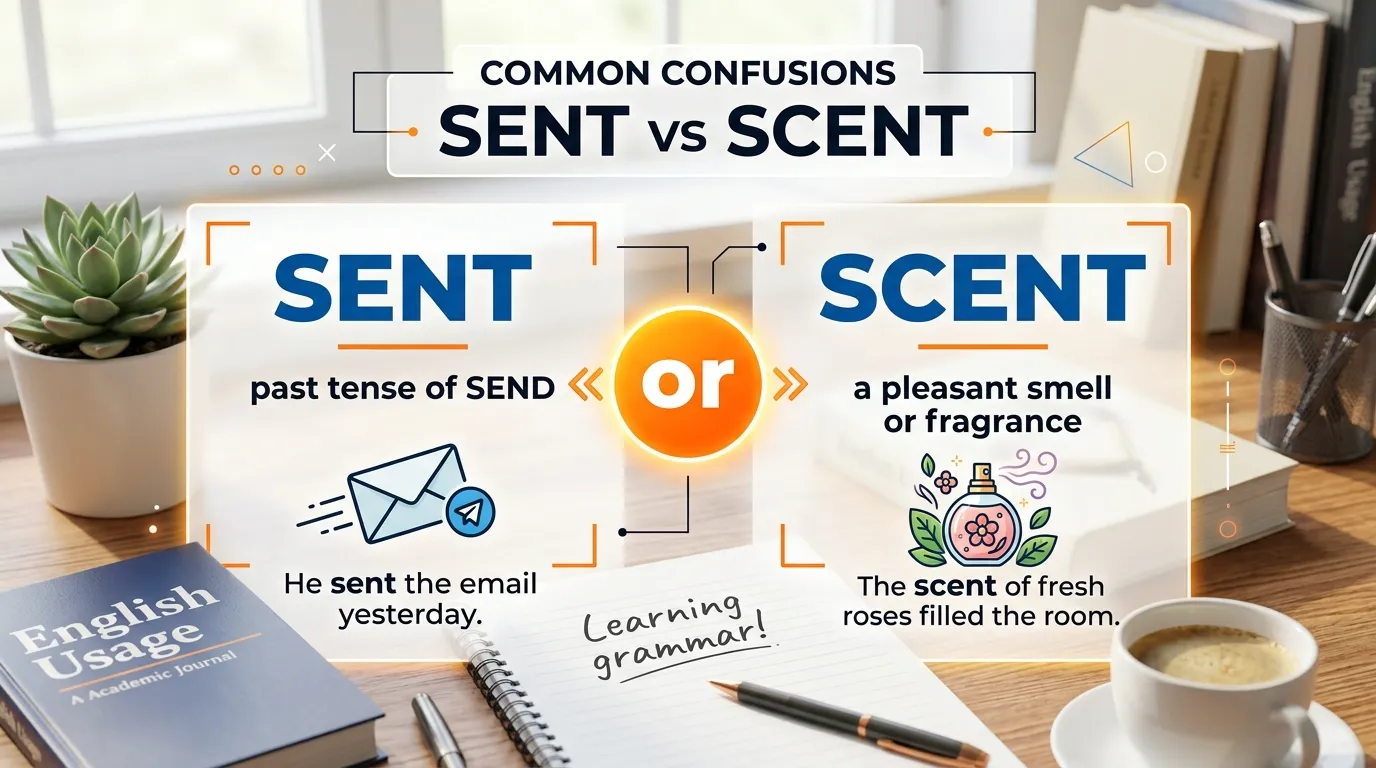
Sent is the past tense of send and refers to delivering or transmitting something, while scent means a smell, fragrance, or aroma.
They are homophones, many people accidentally use the wrong word in emails, messages, and assignments.
This guide will explain the difference between sent and scent, show real life examples, and help you choose the correct word every time.
Sent or Scent – Quick Answer
The difference between sent and scent is simple:
- Sent = past tense of send
- Scent = a smell or fragrance
Examples
I sent an email yesterday.
She sent me a message.
The flower has a pleasant scent.
I recognized the dog’s scent immediately.
Quick Comparison
| Word | Meaning | Example |
| Sent | Past tense of send | I sent the package. |
| Scent | A smell or fragrance | The scent of roses filled the room. |
If you’re talking about mailing, sharing, delivering, or transmitting something, use sent. If you’re talking about smell, fragrance, or odor, use scent.
The Origin of Sent and Scent
Understanding where these words come from makes their meanings easier to remember.
Origin of Sent
The word sent comes from the Old English verb sendan, which meant “to dispatch” or “to cause to go.”
Over time, the verb evolved into the modern word send, with sent becoming its past tense form.
Examples:
- Send a letter
- Sent a letter
- Send a message
- Sent a message
The meaning has remained largely unchanged for centuries.
Origin of Scent
The word scent comes from the Latin word sentire, meaning “to perceive” or “to feel.”
It entered English through Old French and gradually became associated with detecting smells through the nose.
Today, scent commonly refers to:
- Perfume
- Fragrance
- Aroma
- Odor
- Smell
Although the words sound identical today, they developed from completely different origins.
Sent – Meaning
Sent is the past tense of the verb send. It means that something was delivered, transmitted, mailed, or shared from one person or place to another.
Examples:
- I sent an email to my teacher.
- She sent me a text message.
- They sent the package yesterday.
In simple terms, sent means already sent or delivered something.
Scent – Meaning
Scent is a noun that refers to a smell, fragrance, aroma, or odor. It is often used when talking about flowers, perfumes, food, or natural smells.
Examples:
- The scent of roses filled the garden.
- This perfume has a pleasant scent.
- The dog followed the scent of its owner.
In simple terms, scent means a smell or fragrance that can be detected by the nose.
British English vs American English Spelling
Unlike many spelling debates, there is no difference between British and American English here.
Both countries use:
- Sent
- Scent
The spellings remain exactly the same.
Comparison Table
| Word | British English | American English |
| Sent | Sent | Sent |
| Scent | Scent | Scent |
| Pronunciation | Same | Same |
| Meaning | Same | Same |
Examples
British English:
- I sent the parcel yesterday.
- The scent of fresh flowers was lovely.
American English:
- I sent the package yesterday.
- The scent of fresh flowers was lovely.
The only difference is vocabulary choices like parcel/package, not the spelling of sent or scent.
Which Spelling Should You Use?
The correct choice depends on what you want to say.
Use Sent When Talking About Sending
Choose sent when referring to:
- Emails
- Text messages
- Letters
- Packages
- Information
- Documents
Examples:
- I sent the invoice.
- She sent a photo.
- They sent an invitation.
Use Scent When Talking About Smell
Choose scent when referring to:
- Perfume
- Flowers
- Food aromas
- Nature smells
- Fragrances
Examples:
- The scent of lavender is calming.
- The scent of coffee filled the room.
- She loved the scent of roses.
Audience-Based Advice
| Audience | Recommended Word |
| US readers | Use the word based on meaning |
| UK readers | Use the word based on meaning |
| Commonwealth countries | Use the word based on meaning |
| Global audience | Use the word based on meaning |
Since there is no spelling difference between regions, the meaning is the only thing that matters.
Common Mistakes with Scent or Sent
Many writers accidentally swap these words because they sound identical.
Mistake #1
❌ I scent the package yesterday.
✅ I sent the package yesterday.
Reason:
Sending a package requires the verb “sent.”
Mistake #2
❌ The sent of roses was beautiful.
✅ The scent of roses was beautiful.
Reason:
A smell is called a scent.
Mistake #3
❌ She scent me a message.
✅ She sent me a message.
Reason:
Messages are sent, not scented.
Mistake #4
❌ The dog followed the sent.
✅ The dog followed the scent.
Reason:
Dogs track smells, which are scents.
Quick Rule
Ask yourself:
- Am I talking about sending something? → Sent
- Am I talking about a smell? → Scent
Scent and Sent in Everyday Examples
Let’s see how these words appear in daily communication.
In Emails
Sent:
- I sent the report this morning.
- We sent your confirmation email.
Scent:
Rarely used in business emails unless discussing products.
- This perfume has a pleasant scent.
In News Articles
Sent:
- The government sent aid to affected areas.
- The company sent an official statement.
Scent:
- Scientists studied the scent trails of insects.
- The perfume industry values natural scent compounds.
On Social Media
Sent:
- I sent you a DM.
- Just sent the photos.
Scent:
- Love the scent of fresh rain.
- This candle has an amazing scent.
In Formal Writing
Sent:
- The documents were sent to the committee.
Scent:
- Researchers examined scent-based animal behavior.
In Everyday Conversation
Sent:
- I sent your birthday card.
Scent:
- The scent of cookies is making me hungry.
Comparison Table: Sent vs Scent
| Feature | Sent | Scent |
| Part of Speech | Verb | Noun |
| Main Meaning | Past tense of send | Smell or fragrance |
| Related To | Communication, delivery | Aroma, odor |
| Example | I sent a letter. | The scent was wonderful. |
| Common Usage | Daily communication | Describing smells |
| Pronunciation | /sent/ | /sent/ |
This table highlights why these words are often confused.
Scent vs Sent – Google Trends & Usage Data
Search behavior shows that people frequently look up sent or scent because they sound exactly alike.
Why People Search This Keyword
Common searches include:
- sent or scent
- scent vs sent
- how to spell sent
- meaning of scent
- sent meaning
- scent meaning
Most users want a quick answer because they are writing something important.
Usage by Context
| Context | More Common Word |
| Emails | Sent |
| Text messages | Sent |
| Shipping | Sent |
| Perfumes | Scent |
| Flowers | Scent |
| Nature | Scent |
Countries with High Interest
Interest in homophone searches is common in:
- United States
- United Kingdom
- Canada
- Australia
- India
- Pakistan
English learners often search these terms to improve spelling accuracy.
Online Usage Trends
The word sent appears far more frequently because communication happens constantly online.
Meanwhile, scent is especially popular in:
- Beauty content
- Fragrance reviews
- Perfume blogs
- Nature writing
- Pet training articles
Why People Confuse Sent and Scent
Several factors cause this confusion.
They Sound Exactly the Same
Both words are pronounced:
/sent/
This makes it impossible to distinguish them by sound alone.
Homophone Confusion
English contains many homophones such as:
- Their, there, they’re
- To, too, two
- Sent, scent
These words require context to understand correctly.
Spellcheck Doesn’t Always Help
If you use the wrong word in a sentence, spellcheck may not flag it because both spellings are valid words.
For example:
❌ The sent of flowers was nice.
This sentence contains a real word, so many spellcheck tools miss the mistake.
Simple Memory Trick
A quick memory trick can help.
Remember Sent
Sent = Send
Both words share the letters:
- Send
- Sent
Think about delivering something.
Remember Scent
Scent = Smell
Notice the letter C.
Think:
C = Cologne
Cologne has a scent.
This simple trick helps many learners remember the difference instantly.
FAQs
1. What is the difference between sent and scent?
Sent is the past tense of send. Scent means a smell or fragrance.
2. Is it sent or scent an email?
The correct phrase is sent an email.
3. Is scent a smell?
Yes. Scent refers to a smell, fragrance, aroma, or odor.
4. How do you use sent in a sentence?
Example:
“I sent the documents yesterday.”
5. How do you use scent in a sentence?
Example:
“The scent of roses filled the garden.”
6. Are sent and scent pronounced the same?
Yes. They are homophones and share the same pronunciation.
7. Is there a British or American difference?
No. Both countries use the same spellings and meanings.
8. Why do people confuse sent and scent?
Because they sound exactly alike but have different meanings.
Conclusion
The confusion between sent and scent is very common because the two words sound exactly the same. However, their meanings are completely different.
Sent is the past tense of send. It relates to delivering, transmitting, mailing, or sharing something. You might send an email, a package, a text message, or a document.
Scent, on the other hand, refers to a smell, fragrance, aroma, or odor. It is commonly used when talking about flowers, perfume, food, nature, and animals.
The easiest way to remember the difference is this:
- Sent = Send
- Scent = Smell
There is no British or American spelling difference, so the rule stays the same worldwide.
Use sent for communication and delivery, and use scent for smells and fragrances.

I’m English language author writing emphasises clarity, structure, and close attention to language. My work is often examined for stylistic comparison, focusing on Grammar work, narrative control, and subtle thematic development.