Have you ever wondered whether to use economic or economical? You’re not alone. These two words look very similar, but they have different meanings and are often confused in writing.
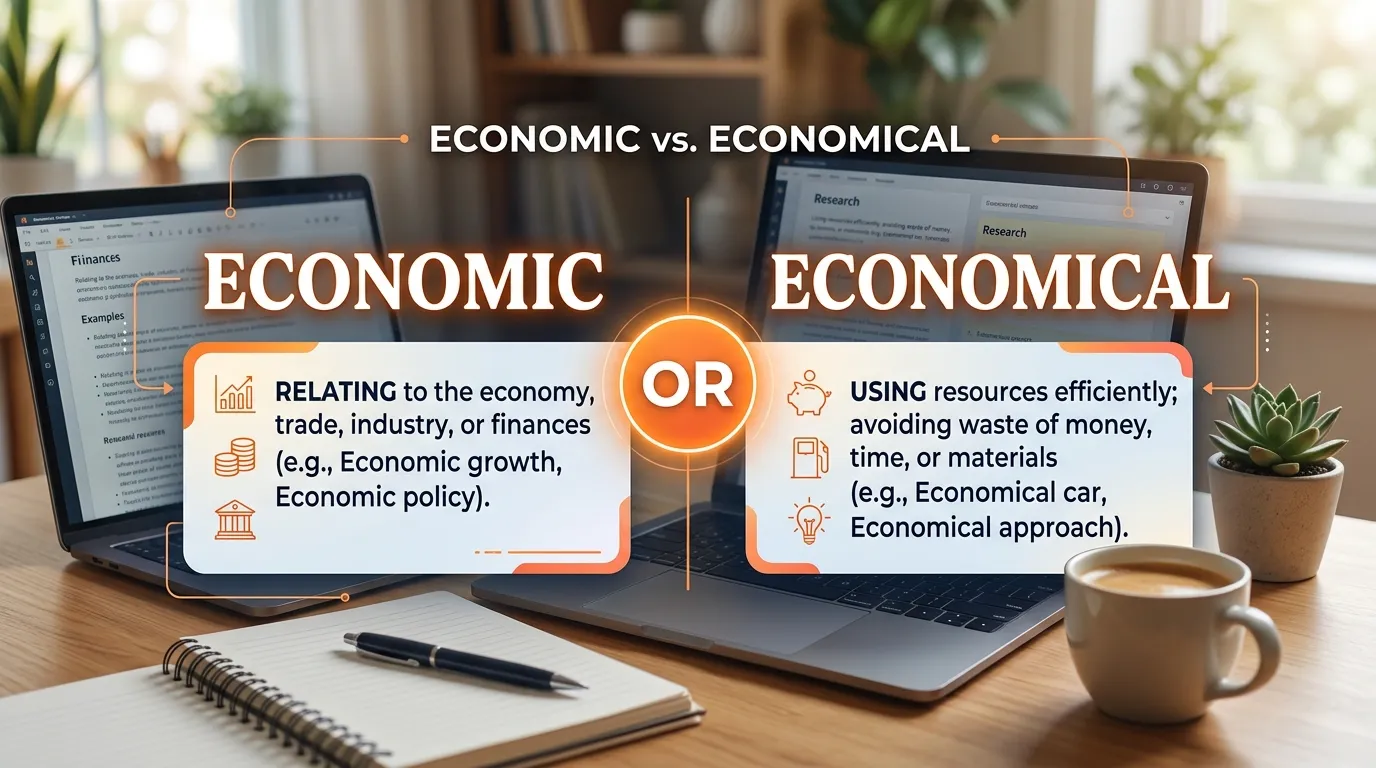
Economic relates to the economy, money, or finance, while economical means saving money, time, or resources.
Because both words come from the same root and are used in similar contexts, many students, writers, and professionals use them interchangeably.
This guide will explain the difference between economic and economical, show when to use each one, provide real life examples, and help you avoid common mistakes.
By the end, you’ll know exactly which word fits your sentence and why.
Economic or Economical – Quick Answer
Economic relates to the economy, finance, trade, or money systems. Economical means using something without waste saving money, time, or resources.
Think of it this way:
- Economic = about the big picture (countries, markets, policies)
- Economical = about saving (practical, not wasteful)
Economic: “The government announced a new economic plan to reduce poverty.”
Economical: “This small car is very economical it uses very little fuel.”
Economical: “She was economical with her words and said only what was needed.”
Simple rule: If you can replace the word with “financial” or “related to the economy,” use economic. If you can replace it with “thrifty” or “not wasteful,” use economical.
The Origin of Economic and Economical
Both words come from the ancient Greek word oikonomia (οἰκονομία), which meant “household management.” It combined oikos (house) and nomos (law or custom).
Over time, the meaning grew bigger. It moved from managing a home to managing a city, a country, and then the whole world.
- Economic entered English around the 1590s, meaning “relating to the management of a household or state.”
- By the 1800s, as economics became a formal science, economic took on its modern meaning: relating to trade, production, and national finance.
- Economical developed as an adjective meaning “not wasteful” someone who managed resources carefully, like a good household manager.
So the original meaning was actually closer to “economical” careful management. The word “economic” later narrowed to mean the formal science and systems of money.
Both adjectives exist in other languages too. French has économique and économique (often the same word used for both), while Spanish uses económico for both meanings showing that English is unusual in having two distinct words.
Economic vs Economical – Side-by-Side Comparison
| Feature | Economic | Economical |
| Meaning | Related to the economy or finance | Avoiding waste; thrifty; efficient |
| Common topics | GDP, trade, jobs, policy, markets | Fuel, money, time, words, effort |
| Synonyms | Financial, fiscal, monetary, commercial | Thrifty, frugal, efficient, sparing |
| Antonyms | Non-financial, social, political | Wasteful, extravagant, lavish |
| Noun form | Economy / economics | Economy (as in savings) |
| Typical subjects | Countries, governments, industries | Cars, habits, people, devices |
| Example | Economic growth, economic crisis | Economical car, economical solution |
British English vs American English
Good news: the spelling of both economic and economical is the same in British and American English. There is no spelling difference here.
However, there are some usage differences:
| Usage Pattern | British English | American English |
| “Economical with the truth” | Common idiom (meaning evasive) | Less common but understood |
| Economic/financial policy | Both terms used widely | “Economic policy” preferred |
| Economical for fuel-saving | Very common in car reviews | Often replaced by “fuel-efficient” |
| Economics as a subject | “Economics” (same) | “Economics” (same) |
| Compound words | Socio-economic, macro-economic | Socioeconomic, macroeconomic |
One notable British English phrase: “economical with the truth” this famous expression means someone is not lying directly but is leaving out important facts. It was made famous by British politician Robert Armstrong in 1986.
British idiom: “The minister was being rather economical with the truth during the press conference.”
Which Word Should You Use?
The answer depends on what you are talking about not where you live.
Use “Economic” when you are talking about:
- National or global money systems
- Government policies about trade and finance
- Business trends, job markets, or GDP
- The academic subject of economics
“The country is facing an economic slowdown due to rising inflation.”
“She studied economic theory at university.”
Use “Economical” when you are talking about:
- A car, appliance, or product that saves fuel or money
- A person or habit that avoids waste
- A solution that uses minimal effort or resources
- Writing or speech that is short and to the point
“This LED bulb is very economical it cuts electricity bills by 70%.”
“The chef was economical with spices, using just enough to add flavour.”
Quick Decision Guide
- Does it relate to a country’s finances? → Economic
- Does it mean saving money or reducing waste? → Economical
- Is it about an efficient machine? → Economical
- Is it about a business or market? → Economic
Common Mistakes with Economical or Economic
Here are the most frequent errors writers make:
The new car is very economic on fuel.→✓ The new car is very economical on fuel.
The country faces economical problems.→✓ The country faces economic problems.
We need an economical policy to boost trade.→✓ We need an economic policy to boost trade.
She chose the most economic option to save money.→✓ She chose the most economical option to save money.
The economic use of words impressed the editor.→✓ The economical use of words impressed the editor.
The most common mistake is using economic when talking about saving or efficiency.
Remember: saving = economical.
Economical and Economic – In Everyday Examples
In News Headlines
“Government unveils new economic stimulus package worth $50 billion.”
“Experts warn of economic recession if interest rates keep rising.”
In Car and Product Reviews
“The Toyota Corolla is one of the most economical cars you can buy today.”
“This washing machine is highly economical, using only 30 litres of water per cycle.”
In Formal Writing and Emails
“We propose an economical solution that will reduce costs by 25% without cutting quality.”
“The report highlights key economic indicators for the next financial quarter.”
In Social Media and Casual Writing
“Just found the most economical way to meal prep for the week. Sharing my tips below! 👇”
“Thread: Why the current economic crisis is affecting young people the most.”
In Academic Writing
“The paper examines the economic impact of climate change on developing nations.”
“A more economical model of resource use is needed in modern manufacturing.”
Economic vs Economical – Google Trends & Usage Data
Globally, “economic” is searched far more often than “economical”. This makes sense news, politics, and business constantly use the word economic.
| Search Term | Search Volume (Global) | Top Regions | Common Context |
| economic | Very High (millions/month) | USA, India, UK, Australia | News, business, academia |
| economical | Medium (hundreds of thousands) | UK, India, Pakistan, Nigeria | Cars, products, personal finance |
| economic vs economical | Low to Medium | India, Pakistan, UK, Nigeria | English learners, students |
| economic definition | High | Global, especially South Asia | Students looking up meanings |
| economical meaning | Medium | South Asia, Africa, Southeast Asia | ESL learners |
The search query “economic vs economical” is most popular among non native English speakers in South Asia (especially India and Pakistan), parts of Africa, and Southeast Asia. This shows the confusion mostly affects people learning English as a second language.
In British English publications, economical appears more often in consumer writing, while American publications tend to favour “cost effective” or “fuel efficient” over “economical.”
In academic databases like Google Scholar, economic appears hundreds of times more often than economical reflecting how it dominates the world of finance, policy, and research writing.
Quick Reference Comparison Table
| Word | Type | Core Meaning | Used With | Example Phrase |
| Economic | Adjective | Relating to economy/finance | Growth, crisis, policy, reform, impact | Economic growth |
| Economical | Adjective | Not wasteful; thrifty; efficient | Car, solution, method, use, approach | Economical with fuel |
| Economy | Noun | 1. Financial system 2. Saving/thrift | National, global, of scale, of effort | Economy class; the economy |
| Economics | Noun | Study of money, trade, production | Study, department, micro, macro | Study economics |
| Economically | Adverb | In a financial way OR thriftily | Depends on context (same dual use) | Economically viable |
FAQs
1. What is the main difference between economic and economical?
Economic means relating to the economy, finances, or trade. Economical means not wasteful using money, time, or resources carefully. They look similar but have different meanings. “Economic policy” is about government finance; “an economical car” is one that uses little fuel.
2. Can “economic” mean the same as “economical”?
In some older texts, economic was used to mean “thrifty” the same as economical today. But in modern English, the two words have separate meanings. Using economic to mean “saving money” may confuse readers. It is safer to use economical for that meaning.
3. Which is correct: “economic car” or “economical car”?
Economical car is correct. When describing a car that uses little fuel or costs less to run, the right word is economical. An “economic car” would mean a car connected to financial or trade systems, which makes little sense in everyday writing.
4. What does “economical with the truth” mean?
This is a well-known British English phrase. It means someone is not exactly lying, but they are leaving out important information on purpose telling less than the full truth. It is often used in politics or journalism to describe evasive answers.
5. Is “economically” used for both meanings?
Yes. The adverb economically can serve both meanings depending on context. “The country is doing well economically” means financially. “She wrote economically, using no extra words” means efficiently. Context usually makes the meaning clear.
6. Do British and American English spell these words differently?
No. Both economic and economical are spelled the same in British and American English. There are no spelling variations like “economick” or “oeconomical.” The only difference is in how each variety of English tends to use the words in certain expressions.
7. Is “economic” or “economical” used more often in English?
Economic is used far more often, mainly because news, academic writing, and business communication constantly discuss financial topics. Economical appears more in product reviews, travel writing, and personal finance content. In formal writing, economic dominates by a large margin.
8. What is the noun form of “economical”?
The noun related to economical is economy used in phrases like “economy of effort” or “the economy of the design.” The adverb is economically. There is no common noun form “economicality,” though it technically exists in rare academic use.
Conclusion
The difference between economic and economical is simple once you see it. Economic is about the world of money, trade, and financial systems. Economical is about saving being efficient and not wasteful.
They come from the same root word, which is why they look alike. But in modern English, they do different jobs. Mixing them up is a common mistake, even among native speakers.
The easiest way to remember: ask yourself, “Is this about a country’s finances or about saving something?” If it is about finances use economic. If it is about saving or reducing waste use economical.
Both words are useful and important. Now that you know the difference, you can use each one with confidence whether you are writing an essay, a business report, or a social media post.
Keep practising, and the right word will come naturally.