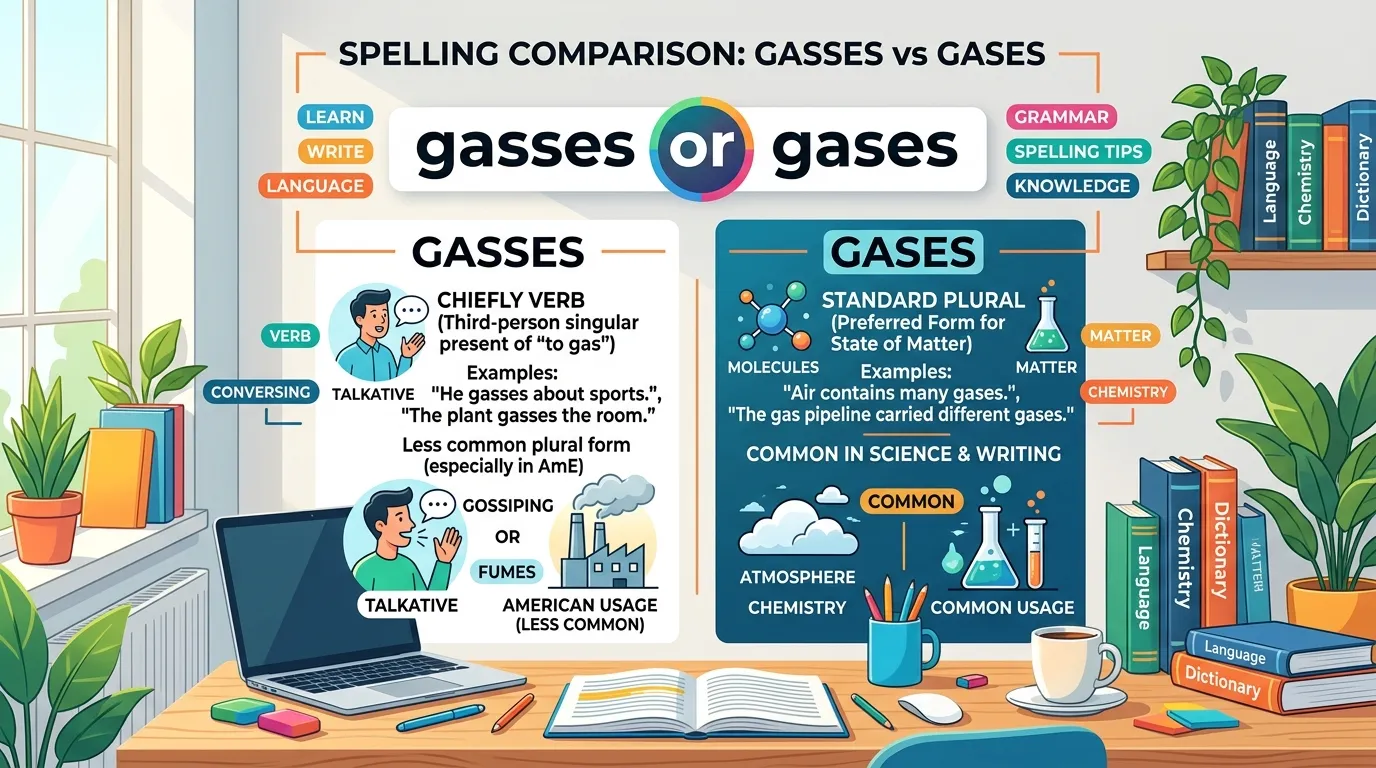
Have you ever wondered whether the correct plural of gas is gases or gasses? You’re not alone. This is a common spelling question, especially because both forms appear in writing.
Here’s the quick answer: gases is the correct and standard plural of gas.
Gasses is usually a verb, meaning to expose someone to gas or to chat excessively.
This confusion happens because the words look similar, but they serve different grammatical roles. Using the right form is important in academic, scientific, and everyday writing.
In most cases, if you mean more than one type or amount of gas, gases is the word you need.
Gasses or Gases – Quick Answer
The correct plural of gas is gases.
- Gases = more than one gas
- Gasses = a verb meaning exposes to gas or talks at length
Examples
- Oxygen and helium are common gases.
- The factory releases harmful gases.
- The officer gasses the area with tear gas. (verb)
For almost all everyday and scientific writing, gases is the correct choice.
The Origin of Gasses and Gases
The word gas was first used in the 17th century by Flemish chemist entity[“people”,”Jan Baptist van Helmont”,”Flemish chemist”]. He created it from the Greek word chaos to describe substances that were neither solid nor liquid.
As English evolved, the regular plural form became gases by adding -es, just as with words like bus → buses and box → boxes.
The form gasses developed later as a verb:
- to poison or expose with gas
- to fill with gas
- to chatter excessively (informal)
This is why both spellings exist, but they serve different grammatical roles.
British English vs American English Spelling
There is no spelling difference between British and American English in this case.
Both use:
- gases as the plural noun
- gasses as the verb form
Comparison Table
| Usage | British English | American English |
| Plural noun | gases | gases |
| Verb form | gasses | gasses |
Examples
- Scientists study atmospheric gases.
- The military gasses the chamber during testing.
The rule is the same worldwide.
Which Spelling Should You Use?
Choose the spelling based on the meaning you want.
Use gases when referring to multiple gases
- greenhouse gases
- industrial gases
- toxic gases
- noble gases
Examples:
- Greenhouse gases affect the climate.
- Hospitals use medical gases every day.
Use gasses only as a verb
Examples:
- The mechanic gasses the engine.
- The crowd was accidentally gassed.
Audience-Based Advice
| Audience | Best Choice |
| United States | gases |
| United Kingdom | gases |
| Canada | gases |
| Australia | gases |
| Global audience | gases |
| Scientific writing | gases |
Simple rule: If you mean the plural of gas, always use gases.
Common Mistakes with Gases or Gasses
Many writers mistakenly use gasses when they mean the plural noun.
Incorrect vs Correct
- ❌ The lab tested several harmful gasses.
- ✔ The lab tested several harmful gases.
- ❌ Greenhouse gasses trap heat.
- ✔ Greenhouse gases trap heat.
- ❌ Natural gasses are found underground.
- ✔ Natural gases are found underground.
Why This Happens
- Both spellings look valid.
- Spellcheck may not catch the error.
- The extra s seems logical.
But remember: plural noun = gases.
Gases and Gasses in Everyday Examples
Emails
- Please monitor the levels of compressed gases.
- The equipment handles several industrial gases.
News
- Greenhouse gases continue to rise globally.
- Toxic gases leaked from the plant.
Social Media
- Cutting greenhouse gases is essential.
- Some household products release harmful gases.
Formal Writing
- The experiment involved inert gases.
- Atmospheric gases play a key role in climate systems.
Gases vs Gasses – Google Trends & Usage Data
Search data shows that gases is overwhelmingly more popular than gasses.
People commonly search for:
- gasses or gases
- plural of gas
- is it gases or gasses
- greenhouse gases spelling
Why Interest Is High
- Students writing science assignments
- Professionals creating reports
- Writers checking grammar
- ESL learners improving vocabulary
Popular Countries
- entity[“country”,”United States”,”United States”]
- entity[“country”,”United Kingdom”,”United Kingdom”]
- entity[“country”,”Canada”,”Canada”]
- entity[“country”,”Australia”,”Australia”]
- entity[“country”,”India”,”India”]
This confusion is global, especially in scientific and academic contexts.
Gasses vs Gases: Comparison Table
| Feature | Gases | Gasses |
| Part of speech | Noun | Verb |
| Meaning | More than one gas | Exposes to gas / talks excessively |
| Common use | Very common | Rare |
| Example | Air contains many gases | The officer gasses the room |
| Recommended for plural | Yes | No |
FAQs
What is the correct plural of gas?
The correct plural of gas is gases.
Is gasses ever correct?
Yes. Gasses is correct as a verb, not as a plural noun.
Why is it gases and not gasses?
English spelling rules form the plural of gas as gases, similar to bus → buses.
How do you spell greenhouse gases?
The correct spelling is greenhouse gases.
Is gasses wrong in scientific writing?
Yes, if used as a plural noun. Scientific writing should use gases.
Do British and American English use different spellings?
No. Both use gases for the plural noun.
Can spellcheck confuse gases and gasses?
Yes. Since both are valid words, context matters.
Conclusion:
The confusion between gasses and gases is common, but the rule is simple.
Use gases when referring to more than one gas. This is the correct plural form in everyday, academic, and scientific writing.
Use gasses only as a verb, such as when describing exposure to gas or, informally, excessive talking.
There is no difference between British and American English. The spelling rule is the same everywhere.
A simple memory trick can help: Many gases, one person gasses.
Using the correct spelling will make your writing clearer, more accurate, and more trustworthy.