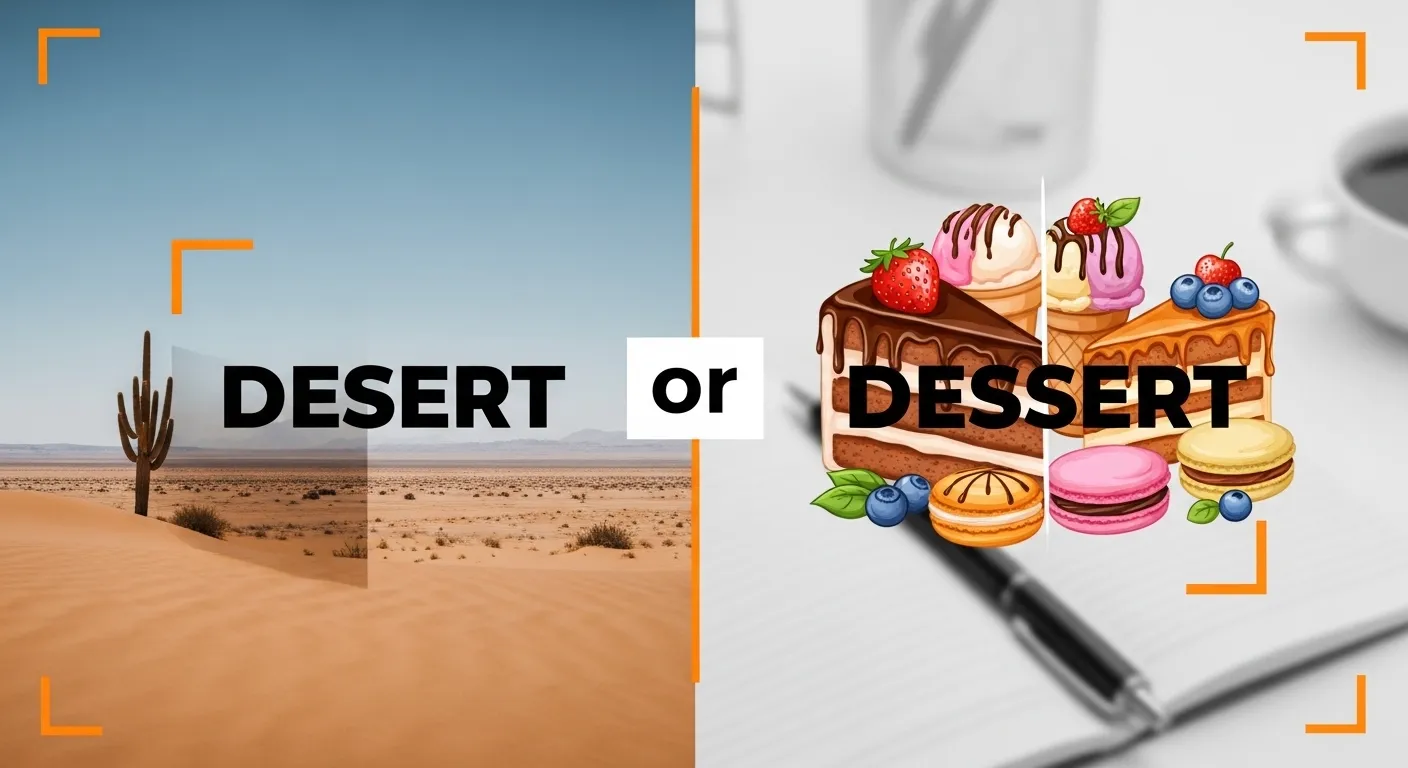
Have you ever wondered whether to use desert or dessert? You’re not alone. These two words look and sound similar, but they have completely different meanings.
Desert is a dry, sandy region, while dessert is a sweet dish usually served after a meal.
They differ by just one letter, many writers accidentally use the wrong word in emails, essays, social media posts, and professional documents.
In this guide, you’ll learn the difference between desert and dessert, discover where the confusion comes from, see real world examples, and pick up an easy memory trick to remember the correct spelling every time.
By the end, you’ll be able to use both words confidently and accurately in any situation.
Desert or Dessert – Quick Answer
Desert is usually a dry, sandy region with little rainfall. Example: “The Sahara Desert is the largest hot desert in the world.”
Dessert is a sweet dish eaten after a meal. Example: “I had chocolate cake for dessert.”
Easy Tip: Dessert has two S’s because you always want more sweet stuff.
The Origin of Desert and Dessert
Desert comes from the Latin word desertum, meaning “an abandoned place.” Its meaning has always referred to dry, barren land.
Dessert comes from the French word desservir, meaning “to clear the table.” Over time, it became associated with the sweet dishes served after meals.
The spelling differences exist because of their separate linguistic roots. One is Latin-based, the other French-based.
Meaning of Desert
Desert is a noun that refers to a dry region of land that receives very little rainfall and usually has sparse vegetation. It can also be a verb meaning to leave or abandon someone or something.
Examples:
- The desert was hot and dry.
- Camels are well adapted to life in the desert.
- He decided not to desert his team during difficult times.
Simple definition: Desert is a dry, sandy area with little rain, or it can mean to abandon someone or something.
Meaning of Dessert
Dessert is a noun that refers to a sweet food served at the end of a meal. Common desserts include cakes, ice cream, cookies, and puddings.
Examples:
- We had chocolate cake for dessert.
- Ice cream is my favorite dessert.
- The restaurant offers several delicious desserts.
Simple definition: Dessert is a sweet dish eaten after the main meal.
British English vs American English Spelling
Both words are spelled the same in British and American English. The key is knowing the correct word to use, not the spelling.
| Word | British English | American English | Meaning |
| Desert | Desert | Desert | Dry, barren land |
| Dessert | Dessert | Dessert | Sweet treat after a meal |
Note: Some confusion occurs in informal writing, but dictionaries and style guides agree on these spellings.
Which Spelling Should You Use?
- In the US: Use “dessert” for sweets and “desert” for dry lands.
- In the UK/Commonwealth: The rules are the same.
- Global Audience: Stick to these definitions to avoid confusion.
Tip: If unsure, remember: dessert = sweet = double S.
Common Mistakes with Dessert or Desert
- Incorrect: “I love the desert after dinner.”
Correct: “I love the dessert after dinner.” - Incorrect: “The Sahara is a dessert.”
Correct: “The Sahara is a desert.” - Confusing the words in casual texting or social media posts. Always double-check context.
- Using “dessert” when meaning something is abandoned or empty.
- Forgetting the double “s” in dessert, especially in handwriting.
Dessert and Desert in Everyday Examples
Emails:
- Wrong: “Looking forward to our desert tonight.”
- Right: “Looking forward to our dessert tonight.”
News Headlines:
- Correct: “Desert Storm Continues in Middle East”
- Correct: “Local Bakery Launches New Dessert Menu”
Social Media:
- “Just had the best chocolate dessert 🍰” ✅
- “I walked through the desert today 🏜️” ✅
Formal Writing:
- Use the words precisely according to their meaning to maintain professionalism.
Dessert vs Desert – Google Trends & Usage Data
According to Google Trends:
- “Dessert” is searched more frequently globally, particularly in the US, UK, and Australia.
- “Desert” spikes in searches when linked to geography, climate, or news events.
Insight: People mostly confuse these words when writing about food or travel.
Comparison Table: Desert vs Dessert
| Keyword Variation | Meaning | Example |
| Desert | Dry land, barren area | “The desert was hot and sandy.” |
| Dessert | Sweet treat after meals | “Chocolate mousse is my favorite dessert.” |
| Deserted (adj.) | Abandoned | “The town was deserted after the storm.” |
| Dessert menu | List of sweets | “The restaurant offers a dessert menu.” |
FAQs –
Q1: How do I remember the difference?
A: Dessert has two S’s → “more sweet stuff.” Desert has one S → dry land.
Q2: Can desert ever mean “abandon”?
A: Yes. “He deserted the army.” Here, it’s a verb, not the noun.
Q3: Are the spellings different in British and American English?
A: No, they are the same; the difference is in meaning, not spelling.
Q4: Is “dessert” only sweet food?
A: Mostly, yes. It refers to any sweet course after a meal.
Q5: Can “desert” be used metaphorically?
A: Yes. E.g., “He felt like he was in a desert of friendship.”
Q6: What is a common typo?
A: Writing “desert” when you mean “dessert,” especially in menus or recipes.
Q7: Which word is more searched online?
A: “Dessert” is more popular because food topics get higher searches.
Q8: Can “dessert” be used in non-food contexts?
A: Rarely, but sometimes “dessert” is used metaphorically to mean a reward or something enjoyable after effort.
Conclusion
Knowing the difference between desert and dessert is simple once you understand their meanings and origins. Desert refers to dry, barren lands, while dessert refers to sweet dishes after meals.
The spelling is the same in both British and American English, so context is key.
Remember the easy trick: dessert has two S’s for extra sweetness.
Avoid common mistakes in emails, social media, and formal writing to maintain professionalism. With this knowledge, you can write confidently, impress readers, and never confuse a chocolate cake with a sandy wasteland again.

I’m American writer known for precise, economical use of language and strong narrative voice. My work is frequently studied for sentence rhythm, word choice, and how meaning is shaped through grammar, making it valuable for close reading and English comparison studies.