Have you ever wondered whether the correct spelling is amoung or among? You’re not alone. Many writers get confused because the words look similar, but only one is correct in modern English.
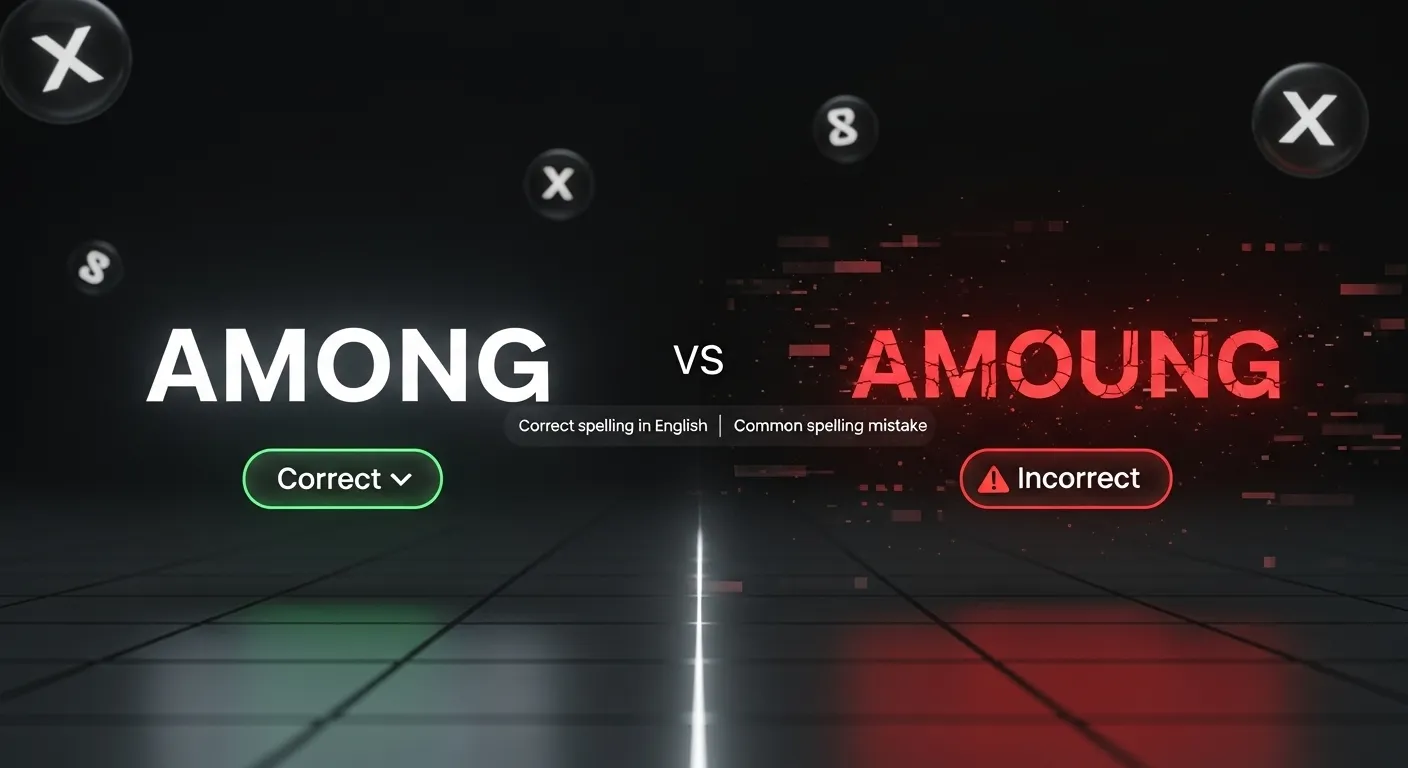
Among is the correct spelling, while amoung is a misspelling.
Unlike spelling differences such as British and American English, this is not a regional variation. Using the wrong form can make your writing look unprofessional.
In this guide, you’ll learn why the confusion happens, how to use among correctly, and how to avoid this common spelling mistake.
Amoung or Among – Quick Answer
The correct spelling is “among.”
“Amoung” is incorrect and not used in standard English.
✅ Correct:
- She was sitting among her friends.
- The prize was shared among the winners.
❌ Incorrect:
- She was sitting amoung her friends.
- The prize was shared amoung the winners.
👉 Simple rule:
Always use “among.” Never use “amoung.”
The Origin of Among or Amoung
The word “among” comes from Old English “gemang,” which means in a group or in the middle of.
Over time, the spelling changed:
- Old English: gemang
- Middle English: among
- Modern English: among
So where did “amoung” come from?
It is not a real historical variation. It likely appeared due to:
- Spelling mistakes
- Influence of words like “young” or “though”
- Typing errors in informal writing
English keeps many old spellings, but “amoung” was never standard. It has no place in dictionaries or formal writing.
British English vs American English Spelling
Unlike many English words, “among” does NOT change between British and American English.
Examples of words that DO change:
| British English | American English |
| Colour | Color |
| Favourite | Favorite |
| Centre | Center |
But for this keyword:
| Variation | British English | American English | Correct? |
| Among | ✅ Yes | ✅ Yes | ✔ Correct |
| Amoung | ❌ No | ❌ No | ✘ Incorrect |
👉 Important point:
There is no regional difference here. Both UK and US use “among.”
Which Spelling Should You Use?
The answer is simple for all audiences:
✔ Use “Among” if:
- You are writing in American English
- You are writing in British English
- You are writing for global readers
- You are writing emails, blogs, or academic content
❌ Never use “Amoung”:
- Not in formal writing
- Not in exams
- Not in professional communication
Quick Advice:
- For students → Always write among
- For bloggers → Use among for SEO and credibility
- For professionals → Avoid spelling errors like amoung
👉 Using the correct spelling improves trust and clarity.
Common Mistakes with Amoung or Among
Here are frequent errors people make:
1. Adding “u” by mistake
❌ Amoung
✔ Among
Reason: Influence from words like young or famous
2. Thinking it is a British spelling
❌ Amoung is British
✔ Among is used in both UK and US
3. Typing errors
❌ Amoung (common typo)
✔ Among
Tip: Always proofread your writing.
4. Confusing with “amongst”
✔ Amongst (correct but more formal, mostly British)
✔ Among (more common globally)
Example:
- She was among friends. ✔
- She was amongst friends. ✔ (formal)
Among or Amoung in Everyday Examples
Here is how “among” is used in real life:
📧 Emails:
- Please distribute the tasks among the team members.
- The responsibility is shared among all departments.
📰 News:
- The decision caused debate among experts.
- The issue is widely discussed among citizens.
📱 Social Media:
- This trend is popular among young people.
- The video went viral among users.
🏢 Formal Writing:
- Resources should be divided equally among participants.
- The survey was conducted among 500 students.
👉 Notice:
“Among” is used when talking about groups or multiple people/things.
Amoung or Among – Google Trends & Usage Data
📊 Popularity Insight:
- “Among” is widely searched and used globally.
- “Amoung” appears mainly as:
- A typo
- A spelling mistake in queries
🌍 Usage by Region:
- USA → “Among” is standard
- UK → “Among” and sometimes “amongst”
- Pakistan/India → “Among” is used in education and exams
📉 Key Insight:
Search engines often correct “amoung” → “among” automatically.
👉 This shows:
- “Among” is the accepted form
- “Amoung” has no real usage value
Comparison Table: Amoung vs Among
| Feature | Among | Amoung |
| Correct Spelling | ✔ Yes | ✘ No |
| Used in English | ✔ Yes | ✘ No |
| British English | ✔ Yes | ✘ No |
| American English | ✔ Yes | ✘ No |
| Found in Dictionary | ✔ Yes | ✘ No |
| Professional Writing | ✔ Yes | ✘ No |
FAQs
1. Is “amoung” ever correct?
No. “Amoung” is always incorrect in standard English.
2. Why do people write “amoung”?
It is usually a spelling mistake influenced by similar-looking words.
3. Is “among” British or American?
Both. It is used in all forms of English.
4. What is the difference between “among” and “amongst”?
Both are correct.
“Among” is more common.
“Amongst” is more formal and slightly old-fashioned.
5. Can I use “amoung” in informal writing?
No. It is still incorrect, even in casual writing.
6. How can I remember the correct spelling?
Think:
“Among” has no extra ‘u’.”
7. Is “among” used for more than two things?
Yes.
Use “among” for groups of three or more.
Example:
- Divide the cake among the children.
Conclusion:
The confusion between “amoung” or “among” is simple to clear up: only “among” is correct in English.
It is used in both British and American English and fits all types of writing from casual chats to formal documents.
“Amoung” is not a real word. It does not exist in dictionaries and is just a common spelling mistake.
To write clearly and professionally, always use “among.” This small correction improves your accuracy and makes your writing more credible and polished.