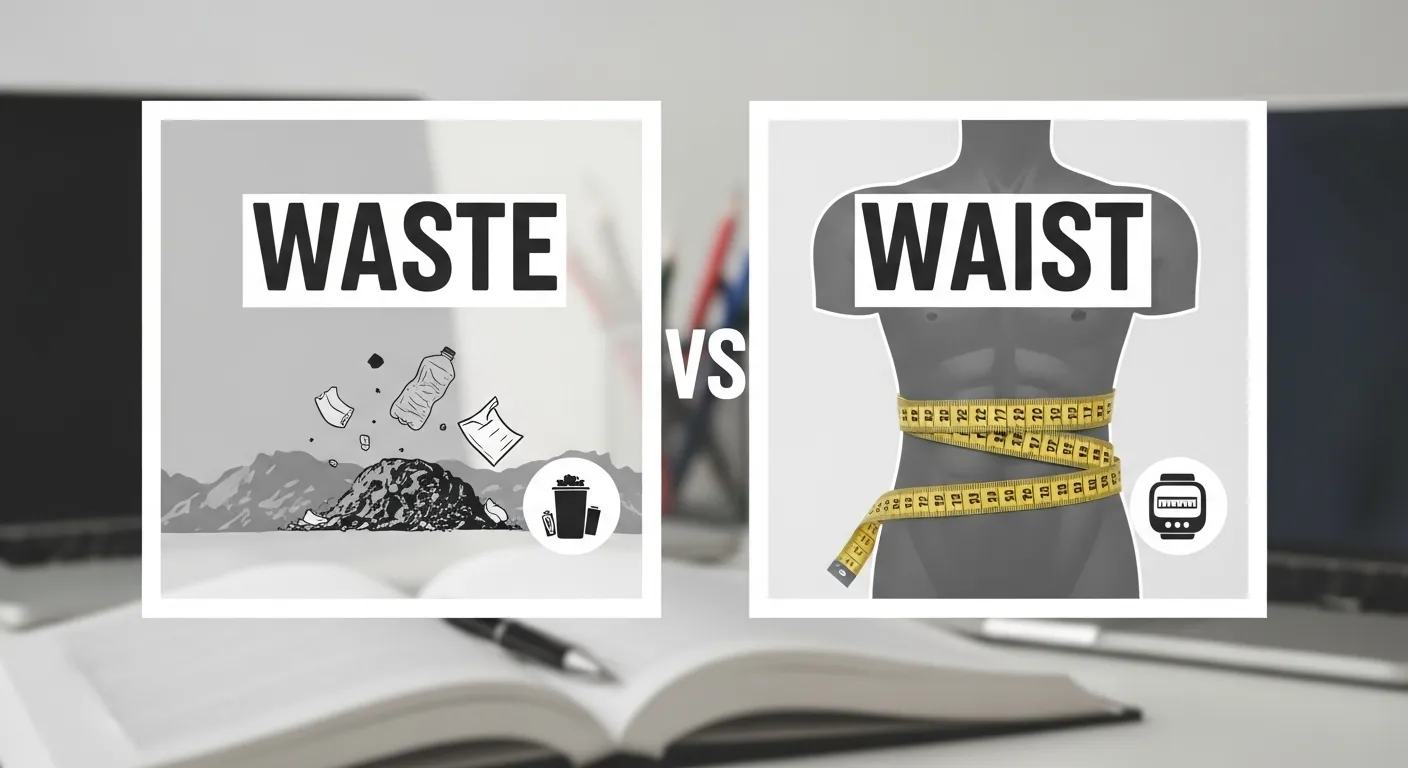
Confused between waste and waist? You’re not alone. These two words sound exactly the same, but they have very different meanings.
waste means to use something poorly or refers to unwanted material, while waist is the middle part of your body..
A small spelling mistake can completely change your sentence. For example, “watch your waist” is good advice, but “watch your waste” means something entirely different.
If you have ever wondered which word to use, this guide is for you. You will learn the meaning of each word, the key differences, and simple tricks to remember the correct spelling every time.
Waste or Waist – Quick Answer
Waste and waist are both correct words, but they mean completely different things.
- Waste means to use something carelessly, lose something, or unwanted material.
- Waist refers to the middle part of the human body, between the ribs and hips.
Simple Examples
- Do not waste your time on gossip.
- We should recycle household waste.
- Her dress fit perfectly around the waist.
- He tied the jacket around his waist.
A quick trick to remember:
- Waist has an “i”, just like your body is personal and individual.
- Waste has an “e”, like extra material or energy.
The Origin of Waste and Waist
Understanding the history of these words makes the difference easier to remember.
Origin of Waste
The word waste comes from the Old North French word waster, meaning “to spoil,” “to destroy,” or “to squander.” It later entered Middle English and kept the same basic meaning. Over time, it came to describe both careless use and unwanted leftovers.
Examples include:
- wasting money
- wasting time
- food waste
- industrial waste
Origin of Waist
The word waist appeared later in English, around the 14th century. It likely developed from older Germanic roots related to growth and the body’s middle section. It has always referred to the narrow part of the torso.
Examples include:
- waist measurement
- waistline
- high-waist jeans
Though they sound alike today, their histories are completely separate.
British English vs American English Spelling
Good news: there is no spelling difference between British and American English for these words.
Both forms use:
- waste for unwanted material or careless use
- waist for the body part
This makes them easier than words like “color/colour” or “organize/organise.” The challenge is not regional spelling. The challenge is choosing the right word based on meaning.
Comparison Table: British vs American Usage
| Meaning | British English | American English |
| Unwanted material | waste | waste |
| Use carelessly | waste | waste |
| Body middle section | waist | waist |
| Clothing measurement | waist | waist |
So whether you write for readers in the UK, the US, Canada, Australia, or anywhere else, the spelling stays the same.
Which Spelling Should You Use?
The correct choice depends entirely on what you mean.
Use Waste When You Mean:
- to use badly
- to lose something valuable
- garbage or leftover material
- unnecessary spending of time, money, or effort
Examples:
- Don’t waste water.
- That meeting was a waste of time.
- The factory reduced plastic waste.
Use Waist When You Mean:
- the middle part of the body
- clothing size or fit
- the narrow section of a garment
Examples:
- Her skirt sits at the waist.
- He measured his waist for new trousers.
- The belt wraps around the waist.
Audience-Based Advice
- US audience: Use the standard meanings above.
- UK audience: Same usage rules apply.
- Commonwealth countries: No changes needed.
- Global audience: These spellings are universally accepted.
Common Mistakes with Waist or Waste
Because these words sound the same, writers often swap them by mistake.
Common Error #1
❌ She has a small waste.
✅ She has a small waist.
Common Error #2
❌ Don’t waist your money.
✅ Don’t waste your money.
Common Error #3
❌ Tie the rope around your waste.
✅ Tie the rope around your waist.
Common Error #4
❌ Food waist is a global issue.
✅ Food waste is a global issue.
How to Avoid the Mistake
Ask yourself one question:
- Is it about the body? Use waist.
- Is it about loss, overuse, or garbage? Use waste.
Waist and Waste in Everyday Examples
These words appear often in daily communication.
In Emails
- Please avoid wasting company resources.
- The trousers are too tight around the waist.
In News Headlines
- Government launches plan to reduce food waste.
- Fitness experts focus on healthy waist size.
On Social Media
- Stop wasting your energy on negativity.
- These jeans hug the waist perfectly.
In Formal Writing
- Proper recycling reduces environmental waste.
- The garment features an adjustable waist.
Waist vs Waste – Google Trends & Usage Data
Search interest in “waste or waist” remains steady because many English learners and native speakers confuse these homophones.
Where the Confusion Is Most Common
- United States
- United Kingdom
- Canada
- Australia
- India
- Pakistan
Why People Search for It
Users usually want to know:
- which spelling is correct
- how to use each word in a sentence
- whether one spelling is British or American
- how to avoid embarrassing mistakes
Usage Contexts
Waste appears more often in:
- environmental topics
- business writing
- economics
- daily conversation
Waist appears more often in:
- fashion
- fitness
- health
- clothing retail
Waste vs Waist: Comparison Table
| Feature | Waste | Waist |
| Part of speech | Noun / Verb | Noun |
| Main meaning | Loss, misuse, garbage | Body middle section |
| Related topics | Environment, time, money | Clothing, health, fashion |
| Example | Don’t waste food | Measure your waist |
| Common confusion | Used instead of waist | Used instead of waste |
FAQs
1. Is it waste or waist of time?
The correct phrase is waste of time.
2. Is it around your waist or around your waste?
The correct phrase is around your waist because it refers to the body.
3. What does waste mean?
Waste means careless use, loss, or unwanted material.
4. What does waist mean?
Waist is the middle part of the body between the ribs and hips.
5. Are waste and waist pronounced the same?
Yes. They are homophones and sound exactly alike.
6. Is waist ever used as a verb?
No. Waist is almost always a noun.
7. Can waste be both a noun and a verb?
Yes. You can waste time (verb), or create waste (noun).
Conclusion
The difference between waste and waist is easy once you know the meaning. Waste is about loss, misuse, or unwanted material. Waist is the middle part of your body.
Simple rule: use waste for time, money, or garbage, and use waist for body shape or clothing.
Both British and American English use the same spellings, so there is no regional difference.
Choosing the right word makes your writing clearer, more accurate, and more professional.

I’m English language author writing emphasises clarity, structure, and close attention to language. My work is often examined for stylistic comparison, focusing on Grammar work, narrative control, and subtle thematic development.