Have you ever paused and wondered whether to write bare or bear? You’re not alone these words sound the same but mean very different things.
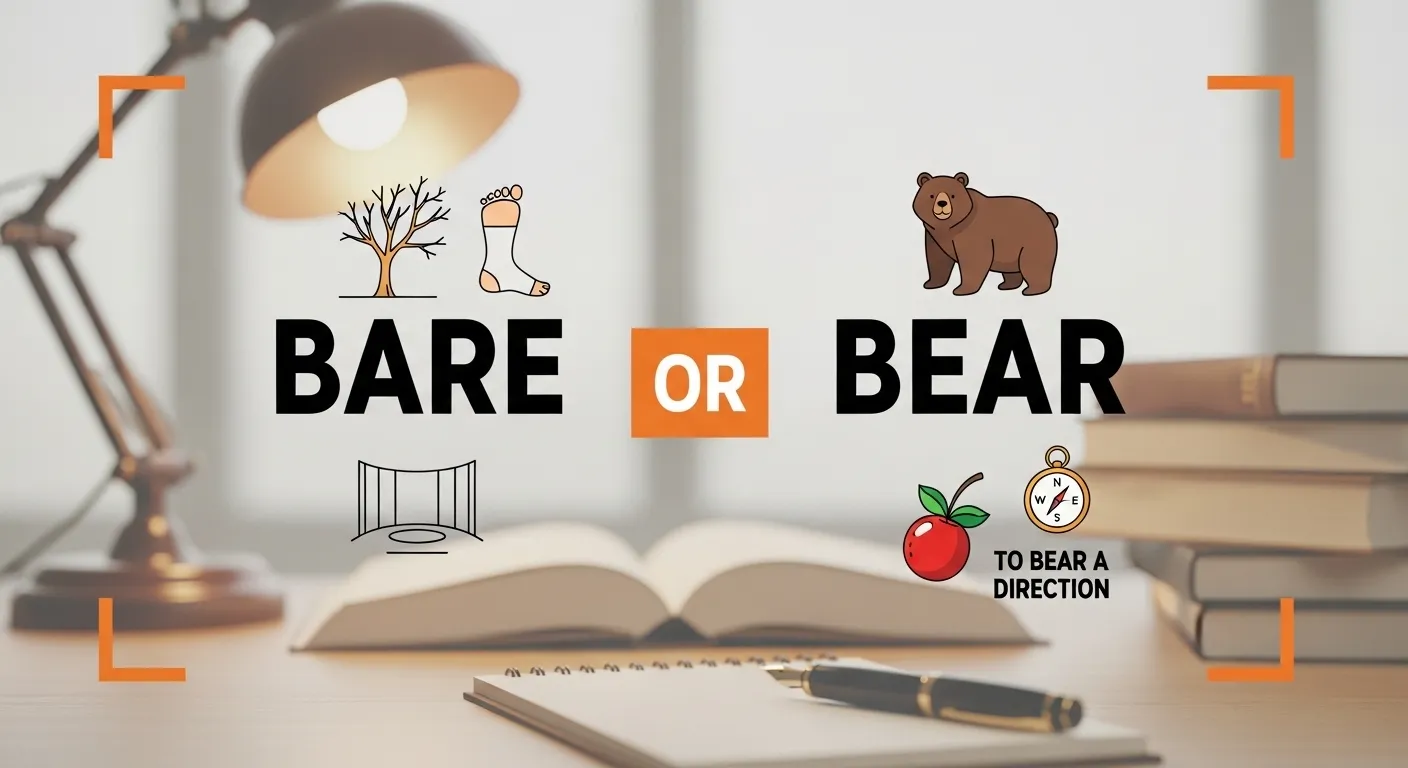
Bare describes something uncovered, empty, or naked, while bear can be an animal, mean to carry something, or endure a situation.
Getting it wrong can confuse readers or even change your sentence’s meaning.
This quick guide will show you exactly when to use bare and when to use bear, highlight common mistakes, and give real life examples so you always get it right.
Bare or Bear – Quick Answer
- Bare → means uncovered, naked, or empty.
Example: She walked on the bare floor without shoes. - Bear → has multiple meanings: an animal, to carry something, or to endure.
Examples:- Animal: The bear roamed the forest.
- Carry: Please bear this box to the car.
- Endure: I can’t bear the noise.
Quick tip: If you mean uncovered or naked, use bare. If it involves the animal or carrying/handling something, use bear.
The Origin of Bare and Bear
Bare comes from the Old English word bær, meaning naked or uncovered. Over time, it retained the spelling bare to describe exposure or emptiness.
Bear comes from the Old English word bera, meaning the brown one, referring to the animal. Over centuries, it developed additional meanings like carry or endure, which are now common in modern English.
The confusion arises because both words sound exactly alike (homophones) in most accents. English keeps historical spellings, so bare and bear have different roots, even though they sound the same.
British English vs American English Spelling
Both bare and bear are spelled the same in British and American English. Unlike other words with UK/US differences (like colour vs color), these words do not change.
| Word | Meaning | UK Usage | US Usage |
| Bare | Uncovered, naked, empty | ✔ | ✔ |
| Bear | Animal, carry, endure | ✔ | ✔ |
Note: The confusion is purely semantic (meaning) and pronunciation-based, not spelling-based.
Which Spelling Should You Use?
- United States: Use bare for uncovered or empty, bear for animals, carrying, or enduring.
- United Kingdom / Commonwealth countries: The same rule applies—meanings dictate usage, not spelling.
- Global writing: If your audience is international, ensure context makes it clear. For example:
- “Bare hands” → safe for everyone.
- “Bear responsibility” → universally correct.
Tip: If you’re unsure, read the sentence aloud. Listening helps distinguish the correct word by meaning.
Common Mistakes with Bear and Bare
- Incorrect: I can’t bare the pain.
Correct: I can’t bear the pain. - Incorrect: He saw a bear floor.
Correct: He saw a bare floor. - Incorrect: She bore a grizzly bear. (wrong meaning if talking about carrying)
Correct: She saw a grizzly bear. - Confusing bear as a verb with bare as an adjective:
- Bear = action or noun (animal)
- Bare = descriptive, uncovered
Bear vs Bare in Everyday Examples
Emails:
- “Please ensure the bare essentials are included in the report.”
- “I cannot bear the delay in response.”
News headlines:
- “Bear sighted in downtown park”
- “Bare minimum standards met in safety report”
Social media:
- “Went for a walk with bare feet!”
- “Can’t bear Mondays… anyone else?”
Formal writing:
- “The bare walls reflected the harsh lighting.”
- “The committee must bear the consequences of their decisions.”
Bear or Bare – Google Trends & Usage Data
According to Google Trends:
- Bear is more frequently searched in relation to the animal and phrases like “bear market” or “bear with me.”
- Bare spikes during topics related to fashion, minimalism, or home decor, e.g., “bare walls” or “bare feet.”
Popular countries:
- US: Bear slightly higher due to idioms and animal references.
- UK: Both used evenly depending on context.
Trends observation: Knowing the audience helps determine which word fits best.
Comparison Table: Bare vs Bear
| Word Variant | Type | Example Usage |
| Bare | Adjective | The room had bare walls. |
| Barely | Adverb | He barely finished on time. |
| Bear | Noun | A bear crossed the road. |
| Bear | Verb | I cannot bear the noise. |
| Bearing | Noun/Verb | His bearing was confident. |
| Barefoot | Adjective | She walked barefoot on sand. |
FAQs
1. Is it “bare” or “bear” for uncovered?
- Always use bare. Example: “The room was bare.”
2. Can “bear” mean both animal and action?
- Yes, it can mean an animal, to carry something, or endure. Context matters.
3. Are bare and bear spelled differently in British English?
- No, the spelling is the same in UK and US English.
4. How can I remember the difference?
- Bare = adjective (uncovered)
- Bear = noun or verb (animal, carry, endure)
5. Can “bare” ever be a verb?
- No, “bare” is only an adjective. Using it as a verb is incorrect.
6. Is “bare with me” correct?
- No, the correct phrase is “bear with me” (meaning: please be patient).
7. Do idioms use bear or bare?
- Mostly bear: “bear the cost,” “bear in mind,” “bear witness.”
Conclusion
Bare and bear sound the same but mean very different things.
Bare = uncovered or empty;
bear = animal, carry, or endure.
Context is key. Watch out for idioms like “bear with me” or “bare minimum.” Using the right word makes your writing clear, professional, and easy to understand whether in emails, posts, or articles.
Mastering bare vs bear keeps your English sharp and mistake free.