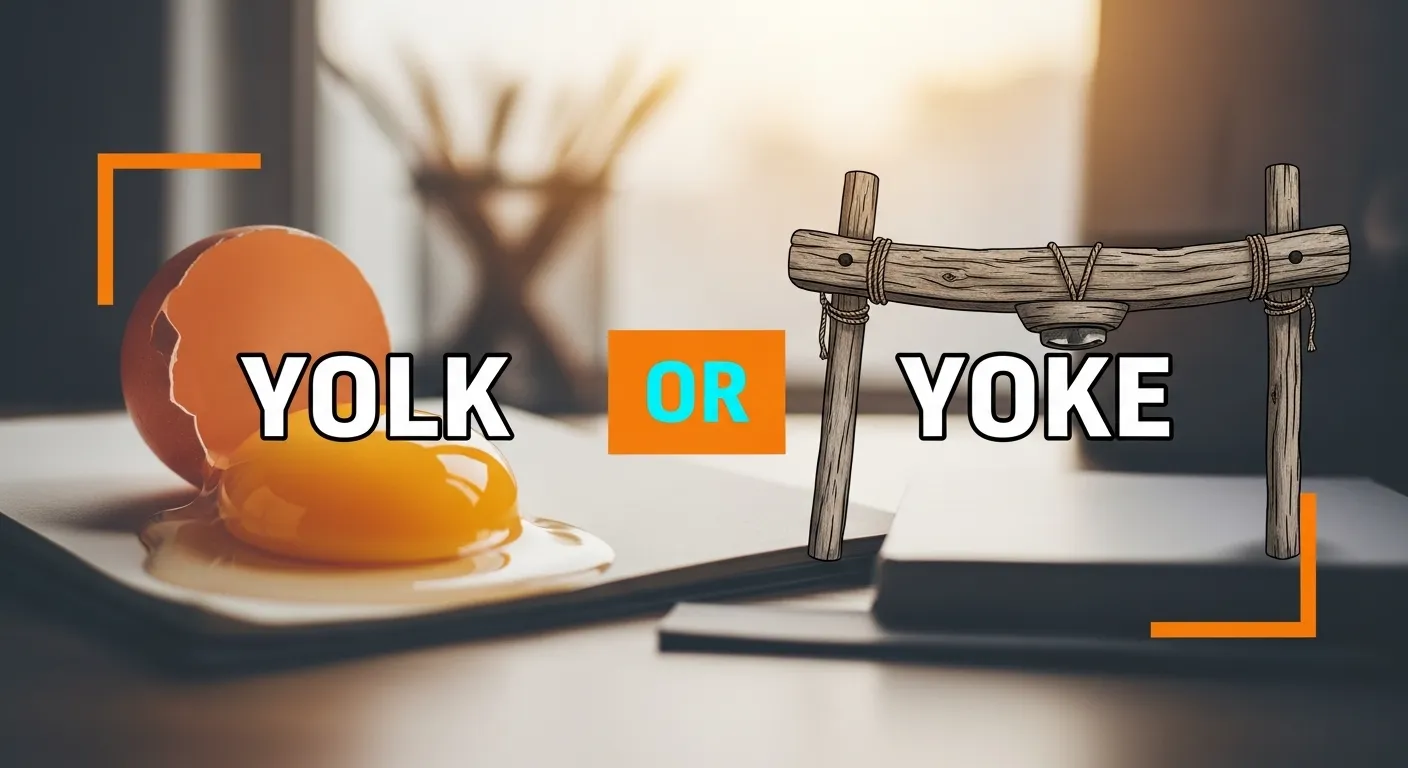
Yolk or yoke? It’s a common mix up because both words sound exactly the same but their meanings are completely different.
- Yolk = the yellow part of an egg 🥚
- Yoke = a wooden bar for animals or a symbol of burden/control
Even a small mistake like writing “egg yoke” instead of “egg yolk” can look unprofessional. The confusion happens because English has many homophones words that sound alike but differ in meaning and spelling.
Simple tip:
Think yolk = yellow = egg
Think yoke = control or burden
Once you remember this, you won’t mix them up again.
Yolk or Yoke – Quick Answer
Yolk and yoke are different words with different meanings:
- Yolk = The yellow part inside an egg
- Yoke = A wooden bar used to join animals or a burden/control
Examples:
- I like eggs with a soft yolk. ✅
- The farmer used a yoke to control the oxen. ✅
❌ Incorrect:
- I ate the egg yoke.
- The oxen pulled a heavy yolk.
👉 Simple rule:
If you’re talking about eggs → use yolk
If you’re talking about control, burden, or farming → use yoke
The Origin of Yolk and Yoke
Understanding the origin makes the difference easier to remember.
Yolk
- Comes from Old English “geolca”
- Related to the word yellow
- Refers to the yellow center of an egg
Yoke
- Comes from Old English “geoc”
- Means joining, linking, or control
- Used for farming tools or metaphorical burden
Why the Confusion Exists
Both words evolved from similar-sounding Old English roots. Over time, spelling changed, but pronunciation stayed the same. That’s why today they sound identical but mean different things.
British English vs American English Spelling
Good news: there is no spelling difference between British and American English for these words.
Both regions use:
- Yolk (egg)
- Yoke (tool or burden)
Comparison Table
| Word | Meaning | British English | American English |
| Yolk | Yellow part of an egg | Yolk | Yolk |
| Yoke | Tool or symbol of burden/control | Yoke | Yoke |
👉 Unlike words like color/colour, these remain the same worldwide.
Which Spelling Should You Use?
Choosing between yolk and yoke depends entirely on meaning, not region.
Use Yolk when:
- Talking about food
- Referring to eggs
- Writing recipes or cooking content
Example:
The egg yolk adds richness to the cake.
Use Yoke when:
- Talking about farming tools
- Describing control or burden
- Using metaphorical language
Example:
He broke free from the yoke of oppression.
Audience Based Advice
- US audience → Follow meaning (same spelling)
- UK/Commonwealth → Same usage rules
- Global audience → Use correctly based on context
👉 There is no regional variation only meaning matters.
Common Mistakes with Yoke or Yolk
Here are frequent errors people make:
1. Mixing meanings
❌ Egg yoke
✅ Egg yolk
2. Using yolk for burden
❌ The yolk of responsibility
✅ The yoke of responsibility
3. Assuming spelling changes by region
❌ “Yolk is American, yoke is British”
✅ Both are used globally
4. Spellcheck confusion
Spellcheck may not catch the error because both words are correct—just used wrongly.
5. Writing quickly
Typing fast often leads to choosing the wrong homophone.
👉 Tip: Always reread sentences where meaning matters.
Yoke and Yolk in Everyday Examples
1. Emails
- Please separate the egg yolk before mixing.
- He felt the yoke of pressure at work.
2. News Writing
- Rising food demand increases egg yolk consumption.
- Citizens protested against the yoke of strict laws.
3. Social Media
- “Runny yolk is the best!”
- “Breaking the yoke of routine life.”
4. Academic Writing
- The egg yolk contains nutrients and fats.
- The term yoke symbolizes control in literature.
5. Formal Writing
- The chef carefully removed the yolk.
- The nation struggled under colonial yoke.
Yoke vs Yolk – Google Trends & Usage Data
Popularity by Context
- Yolk
- Common in cooking, recipes, and nutrition
- Frequently searched by food lovers and students
- Yoke
- Used in history, religion, and literature
- Often appears in metaphorical or symbolic writing
Popularity by Country
- Yolk searches are high in:
- United States
- United Kingdom
- India
- Pakistan (due to cooking content)
- Yoke searches are common in:
- Academic regions
- Religious or literary contexts
Insight
Most people search “yolk or yoke” because:
- They hear the word but don’t know spelling
- They want to avoid writing mistakes
Comparison Table: Yolk vs Yoke
| Feature | Yolk | Yoke |
| Type | Noun | Noun |
| Meaning | Egg center | Tool or burden |
| Context | Food, cooking | Farming, metaphor |
| Origin | Old English (yellow-related) | Old English (joining/control) |
| Example | Egg yolk is yellow | Oxen wear a yoke |
| Pronunciation | /yoʊk/ | /yoʊk/ |
FAQs
1. Are yolk and yoke pronounced the same?
Yes, they are pronounced exactly the same.
2. What is the main difference between yolk and yoke?
Yolk is part of an egg, while yoke is a tool or symbol of burden.
3. Can yolk mean burden?
No, that meaning belongs only to yoke.
4. Is there any spelling difference in British English?
No, both words are spelled the same in British and American English.
5. Why do people confuse yolk and yoke?
Because they sound identical but have different meanings.
6. How can I remember the difference easily?
Think:
Yolk → Yellow → Egg
Yoke → Control → Burden
7. Is “egg yoke” ever correct?
No, it is always incorrect. The correct term is “egg yolk.”
Conclusion
The confusion between yolk and yoke is common, but easy to fix.
Quick reminder:
- Yolk = the yellow part of an egg 🥚
- Yoke = a tool or a symbol of burden/control
They sound the same but have completely different meanings.
There’s no US vs UK difference just focus on context. Even small mistakes can hurt your writing.
Get it right, and your writing instantly looks clearer and more professional.

I’m English language author writing emphasises clarity, structure, and close attention to language. My work is often examined for stylistic comparison, focusing on Grammar work, narrative control, and subtle thematic development.