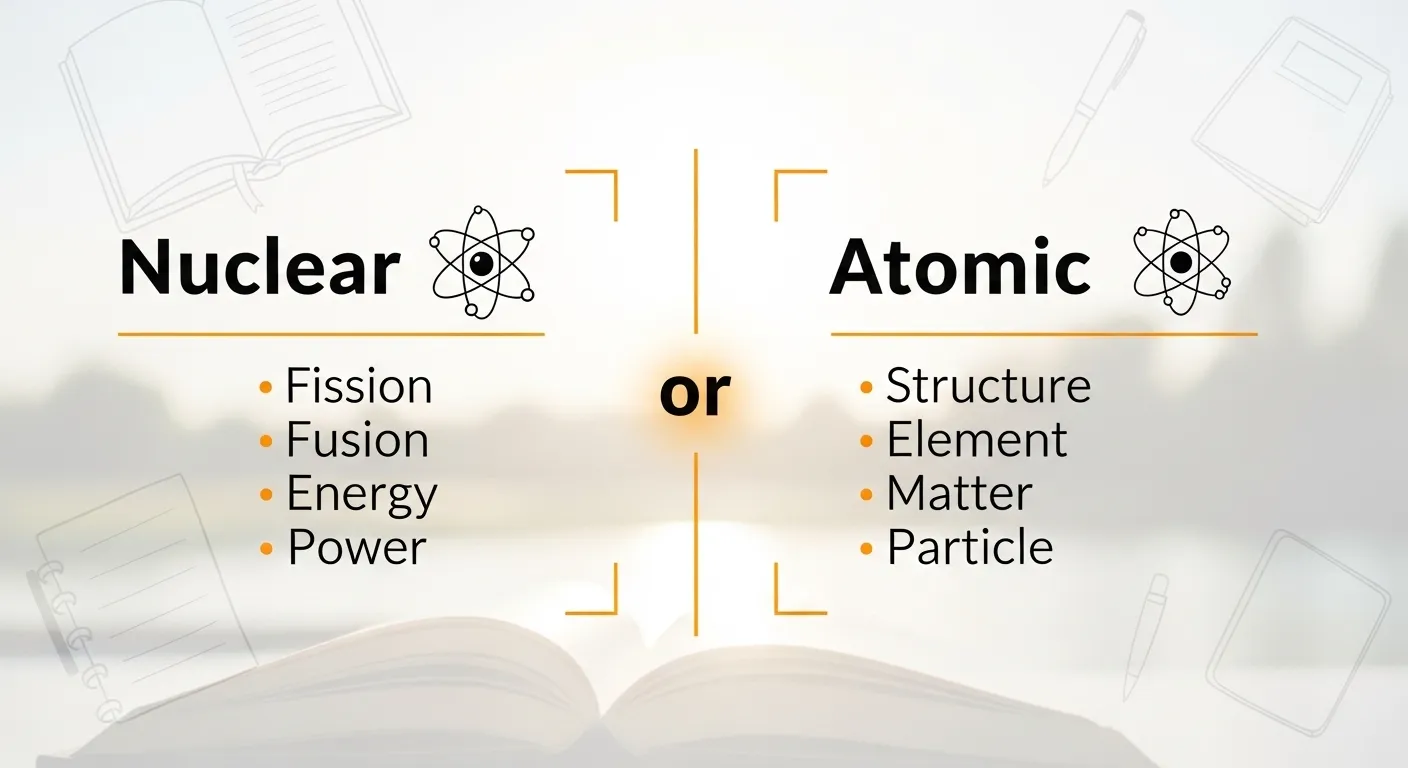
Confused between “nuclear” and “atomic”? Here’s the quick answer: atomic relates to the whole atom, while nuclear refers only to the nucleus (center).
Many people mix them up because both are used in science, energy, and weapons. But using the wrong word can change your meaning.
In this guide, you’ll learn the difference, correct usage, and simple examples to avoid mistakes.
Nuclear or Atomic – Quick Answer
Nuclear and atomic are related but not the same.
- Atomic = relates to the whole atom
- Nuclear = relates to the nucleus (center of the atom)
Simple Examples
- Atomic energy → energy from atoms
- Nuclear energy → energy from the nucleus
- Atomic structure → entire atom
- Nuclear reaction → reaction inside the nucleus
👉 Quick tip:
Use atomic for general atom topics.
Use nuclear for reactions, energy, or the atom’s core.
The Origin of Nuclear or Atomic
Understanding the roots of these words makes everything easier.
Atomic
- Comes from the Greek word “atomos”
- Meaning: “indivisible” or “cannot be cut”
- Early scientists believed atoms could not be divided
Later, science proved atoms can be split. But the word stayed.
Nuclear
- Comes from the Latin word “nucleus”
- Meaning: “kernel” or “core”
- Refers to the center of an atom
Why the Confusion Exists
- Both words are used in physics and chemistry
- Both appear in energy and weapon topics
- Media often uses them interchangeably
👉 But in science, they have different meanings.
British English vs American English Spelling
Good news: there is no spelling difference between nuclear and atomic in British and American English.
Both regions use the same spelling and meaning.
Examples
- US: nuclear energy, atomic bomb
- UK: nuclear energy, atomic bomb
Comparison Table
| Term | British English | American English | Meaning |
| Nuclear | Nuclear | Nuclear | Related to nucleus |
| Atomic | Atomic | Atomic | Related to atom |
👉 Unlike words like “colour/color,” these stay the same worldwide.
Which Spelling Should You Use?
Since there is no spelling difference, the real question is about usage.
Use “Atomic” when:
- Talking about the whole atom
- Explaining basic science
- Teaching beginners
Example:
- Atomic structure explains how atoms are built
Use “Nuclear” when:
- Talking about energy or power
- Describing reactions
- Discussing weapons or physics
Example:
- Nuclear energy powers cities
Audience-Based Advice
- US audience: Both are fine, follow context
- UK/Commonwealth: Same rule applies
- Global writing: Use the scientifically correct term
👉 Always choose based on meaning, not region.
Common Mistakes with Atomic or Nuclear
Many people use these words incorrectly. Here are common mistakes:
❌ Mistake 1: Using atomic instead of nuclear
- Wrong: Atomic power plant
- Correct: Nuclear power plant
👉 Power plants use nuclear reactions.
❌ Mistake 2: Using nuclear for general atom topics
- Wrong: Nuclear structure of oxygen
- Correct: Atomic structure of oxygen
👉 This refers to the whole atom, not just the nucleus.
❌ Mistake 3: Thinking they are identical
- Wrong idea: Nuclear = Atomic
- Correct: Nuclear is a part of atomic
👉 Nuclear is more specific.
❌ Mistake 4: Mixing them in the same sentence
- Confusing: Atomic nuclear energy
- Better: Nuclear energy
👉 Keep it simple and clear.
Atomic vs Nuclear in Everyday Examples
Let’s see how these words appear in real life.
In Emails
- “We studied atomic structure today.”
- “The report covers nuclear energy risks.”
In News
- “The country is expanding nuclear power plants.”
- “Scientists discovered new atomic behavior.”
On Social Media
- “This documentary explains atomic theory so well!”
- “Nuclear energy is cleaner than fossil fuels.”
In Academic Writing
- Atomic: used in chemistry and theory
- Nuclear: used in physics and engineering
In Daily Conversation
- “Atomic science is fascinating.”
- “Nuclear weapons are dangerous.”
👉 Context decides the correct word.
Nuclear or Atomic – Google Trends & Usage Data
Both keywords are popular, but used differently.
General Trends
- Nuclear is more searched in:
- News topics
- Energy discussions
- Politics
- Atomic is more searched in:
- Education
- Science learning
- Basic concepts
Popularity by Region
- USA: Nuclear dominates (energy, defense topics)
- UK: Similar trend
- Global: Nuclear is more common in modern usage
Why Nuclear Is More Popular
- Nuclear energy is widely discussed
- Nuclear weapons are global topics
- Media prefers the term “nuclear”
👉 Atomic is more technical and educational.
Comparison Table: Nuclear vs Atomic
| Feature | Nuclear | Atomic |
| Meaning | Related to nucleus | Related to whole atom |
| Scope | Specific (center only) | Broad (entire atom) |
| Usage | Energy, weapons, reactions | Structure, theory, basics |
| Field | Physics | Chemistry & Physics |
| Common Phrase | Nuclear energy | Atomic structure |
FAQs
1. Are nuclear and atomic the same?
No. Nuclear refers to the nucleus, while atomic refers to the whole atom.
2. Which is correct: nuclear energy or atomic energy?
Both exist, but nuclear energy is the correct modern term.
3. Why is it called an atomic bomb?
Historically, it was named before people clearly separated nuclear and atomic terms.
4. Can I use atomic instead of nuclear?
Not always. It depends on context. For energy, use nuclear.
5. Is atomic outdated?
Not outdated, but less common in modern energy discussions.
6. Which word is more scientific?
Both are scientific, but nuclear is more precise for reactions.
7. Which is more common in media?
Nuclear is more common, especially in news and global topics.
Conclusion
Nuclear vs atomic is simple. Atomic refers to the whole atom, while nuclear focuses on the nucleus.
There is no spelling difference worldwide. Use atomic for structure and basic science, and nuclear for energy and reactions. Choosing the right word keeps your writing clear and professional.