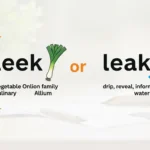
Have you ever wondered whether to write “leek” or “leak”? Here’s the quick answer: a leek is a green vegetable, while a leak is when water, gas, or information escapes.
This mix up happens often because they sound the same. People search for this to avoid mistakes in emails, articles, or social media.
In this guide, you’ll learn the meanings, origins, correct usage, and common errors so you’ll never confuse leek with leak again.
Leek or Leak – Quick Answer
The simplest way to remember:
- Leek → A green vegetable related to onions.
Example: “I cooked soup with fresh leeks.” - Leak → An escape of liquid, gas, or information.
Example: “There is a leak in the water pipe.”
Example: “The company suffered an information leak.”
Tip: If it grows in the garden → leek. If it escapes or spills → leak.
The Origin of Leek and Leak
Both words have distinct histories:
- Leek comes from Old English lēac, meaning “onion or garlic plant.” It has always been a food term in English.
- Leak comes from Old English lēacian, meaning “to drip or flow.” Its sense later extended to secret information escaping.
The spelling confusion arises because English pronunciation evolves faster than spelling. Both words sound identical in modern English, but their origins are separate, which is why context is crucial.
Why People Confuse Leek and Leak
Many writers and students mix up leek and leak because they sound identical. This often leads to humorous or confusing mistakes in emails, blogs, and social media.
Knowing the difference helps avoid misunderstandings and ensures your writing looks professional, precise, and easy to read.
British English vs American English Spelling
In this case, there is no regional spelling difference. Both British and American English use:
- Leek for the vegetable.
- Leak for escape or spill.
However, pronunciation and usage in idioms may differ slightly. Here’s a comparison table:
| Word | Meaning | UK Usage Example | US Usage Example |
| Leek | Vegetable | “Add chopped leeks to stew.” | “I love leek soup.” |
| Leak | Escape of liquid/information | “The roof has a leak.” | “The pipe has a leak.” |
Note: Always double-check context to avoid mistakes; pronunciation alone isn’t enough.
Which Spelling Should You Use?
- For American English → Use leek for the vegetable and leak for escape or spill.
- For British/Commonwealth English → Same as US. Context matters.
- For global writing → Stick to the standard definitions. Avoid confusing readers with misused words.
Remember: spelling does not change, but context decides which word fits.
Common Mistakes with Leak or Leek
Many errors occur because of sound-alike spelling:
- Wrong: “There’s a leek in the roof.”
Correct: “There’s a leak in the roof.” - Wrong: “I love a fresh leak in salad.”
Correct: “I love a fresh leek in salad.” - Wrong: “The document got leeks online.”
Correct: “The document got leaked online.”
Tip: If it’s about vegetables → leek. If it’s about escaping water, gas, or secrets → leak.
Leak and Leek in Everyday Examples
Emails:
- Correct: “Please fix the leak in the office kitchen.”
- Correct: “We bought fresh leeks for the team lunch.”
News Articles:
- “The government faced a major information leak yesterday.”
- “Leek prices are rising in local markets.”
Social Media:
- “Oops, my water bottle leaked in my bag.”
- “Trying a new leek recipe tonight!”
Formal Writing:
- “The pipeline leak must be repaired immediately.”
- “Roasted leek enhances the flavor of this dish.”
Leak vs Leek – Google Trends & Usage Data
Google Trends shows:
- Searches for leak spike during storms, plumbing issues, or news scandals.
- Searches for leek increase in winter months and around food holidays.
Top countries searching “leak”: US, UK, Canada, Australia.
Top countries searching “leek”: UK, Ireland, Netherlands.
This shows context drives search intent. People need quick clarification because spelling errors can mislead.
Comparison Table: Leek vs Leak
| Word | Meaning | Example | Part of Speech |
| Leek | Vegetable | “Add leek to soup.” | Noun |
| Leak | Escape of liquid/info | “The roof has a leak.” | Noun/Verb |
FAQs:
1. Is “leek” ever used for water or pipes?
No, always refers to the vegetable.
2. Can “leak” mean vegetable in slang?
No, it’s never used that way.
3. Are “leak” and “leakage” the same?
Similar meaning, but “leakage” often refers to quantity or process.
4. How to remember the difference?
Vegetable → leek. Escape → leak. Think garden vs dripping.
5. Is this confusion common in professional writing?
Yes, especially in blogs, emails, and online articles.
6. Can I use “leak” metaphorically?
Yes, for secret information or minor accidents.
7. Do British and American English differ in pronunciation?
Slightly, but spelling stays the same. Context is more important.
Conclusion
Understanding the difference between leek and leak is simple. Leek is the green vegetable you cook, while leak refers to water, gas, or secret information escaping. Misusing them can confuse readers in emails, articles, and social media.
There’s no British vs American spelling difference, but usage depends on context.
Quick tip: if it grows in the garden → leek; if it escapes → leak.
Using them correctly improves clarity, professionalism, and prevents mistakes. Keep this guide handy your writing will stay precise, clear, and professional.

I’m American writer known for precise, economical use of language and strong narrative voice. My work is frequently studied for sentence rhythm, word choice, and how meaning is shaped through grammar, making it valuable for close reading and English comparison studies.