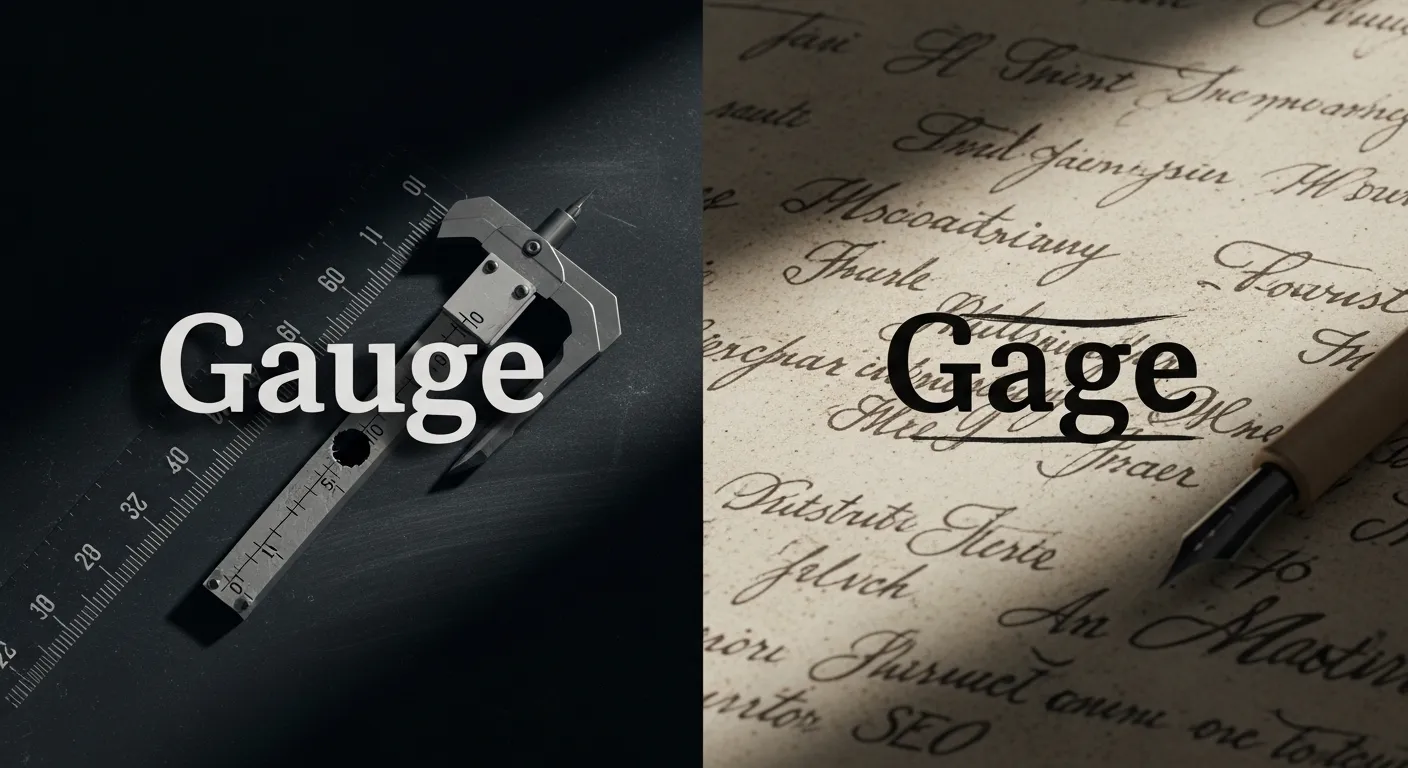
Spelling mistakes can weaken your writing, and one common confusion is gauge or gage.
Many writers see both spellings online like tire pressure gauge versus gage height and wonder which is correct.
People search for this to ensure their writing is accurate in blogs, reports, or school papers.
In modern English, gauge is standard, while gage is rare and used only in specific contexts.
Gauge or Gage – Quick Answer
Gauge is the correct and standard spelling in modern English.
Gage is rare and mostly used in technical or historical contexts.
Examples:
✅ Correct (standard English)
- Check the fuel gauge.
- We need to gauge customer interest.
- The rain gauge shows 2 inches.
⚠ Rare or technical use
- The river gage was recorded at 10 feet. (technical hydrology term)
In almost all writing, use gauge.
The Origin of Gage or Gauge
The word comes from Old French gauge and gage. Both forms entered Middle English. Over time, gauge became the dominant spelling.
In early English, spelling was not fixed. Writers used different forms. But as dictionaries developed, gauge became the standard form.
Why does gage still exist?
- In engineering and hydrology (river measurement), gage is sometimes used.
- In old legal language, gage meant a pledge or guarantee.
- In some American place names, gage appears.
Still, modern dictionaries list gauge as the main spelling.
British English vs American English Spelling
Unlike words like color/colour or center/centre, gauge is spelled the same in both British and American English.
There is no regional difference here.
However, in the United States, some technical agencies (like weather or river departments) may use gage in official terms such as stream gage.
Comparison Table
| Context | British English | American English | Recommended Spelling |
| General writing | Gauge | Gauge | Gauge |
| Verb form | Gauge | Gauge | Gauge |
| Engineering | Gauge | Gauge (sometimes gage) | Gauge |
| River measurement | Gauge | Gage (technical use) | Gauge (unless official term) |
| Everyday communication | Gauge | Gauge | Gauge |
Conclusion: Both UK and US prefer gauge. The spelling does not change by country.
Which Spelling Should You Use?
If your audience is US-based:
Use gauge in blogs, business writing, school work, and websites.
Only use gage if you are writing an official technical term.
If your audience is UK or Commonwealth:
Always use gauge.
If your audience is global:
Use gauge. It is clear and professional.
Simple Rule:
If you are unsure → Choose gauge.
Common Mistakes with Gauge or Gage
Here are frequent errors writers make:
1. Using gage in normal writing
❌ We need to gage the results.
✅ We need to gauge the results.
2. Thinking it is a British vs American difference
❌ UK uses gauge, US uses gage.
✅ Both countries mainly use gauge.
3. Confusing noun and verb forms
Gauge works as both a noun and a verb.
Noun:
- The pressure gauge is broken.
Verb:
- Let’s gauge customer feedback.
4. Misspelling in SEO content
Using gage instead of gauge may reduce search visibility because most users search for gauge.
Gauge or Gage in Everyday Examples
Here is how the word appears in daily communication.
In Emails
- Please gauge client interest before the meeting.
- Check the temperature gauge.
In News
- The fuel gauge showed empty.
- Officials monitored the river gage. (technical)
On Social Media
- Hard to gauge the mood today.
- My gas gauge is lying again.
In Formal Writing
- The study aimed to gauge public opinion.
- Engineers checked the pressure gauge.
In all normal contexts, gauge is correct.
Gauge or Gage – Google Trends & Usage Data
Search data shows that gauge is far more popular worldwide.
- High search volume in the US, UK, Canada, Australia.
- Used in automotive, engineering, weather, and business topics.
- Dominates SEO keywords like:
- tire pressure gauge
- rain gauge
- fuel gauge
- gauge meaning
- tire pressure gauge
The spelling gage appears mostly in:
- Technical US government documents
- Hydrology terms like “stream gage”
For digital marketing and blogging, gauge is the clear winner.
Keyword Comparison Table
| Word | Type | Meaning | Common Usage | Popularity |
| Gauge | Noun & Verb | Measure or estimate | Everyday English | Very High |
| Gage | Noun | Technical or historical term | Limited technical use | Low |
FAQs:
1. Is gage incorrect?
Not fully incorrect, but rare. Gauge is the standard spelling.
2. Is gauge British and gage American?
No. Both countries prefer gauge.
3. Why do some US agencies use gage?
It is a traditional technical spelling used in hydrology.
4. Can gauge be used as a verb?
Yes. Example: We need to gauge the impact.
5. Which spelling should I use for SEO?
Use gauge. It has higher search volume.
6. Is gage outdated?
Mostly yes, except in technical contexts.
7. What about gauge in engineering?
Gauge is correct in engineering writing.
Conclusion:
The confusion between gauge or gage is easy to solve once you understand modern usage. While both spellings exist, gauge is the standard form in today’s English.
It works as both a noun and a verb. It appears in daily speech, academic writing, business reports, and online content.
The spelling gage survives in limited technical or historical uses, especially in American hydrology terms like stream gage.
But outside those narrow fields, it looks outdated or incorrect.
For students, bloggers, marketers, and professionals, the rule is simple: Always use gauge unless you have a technical reason not to.
Choosing the correct spelling improves clarity, credibility, and SEO performance.
Now you can write with confidence and never second-guess this word again.