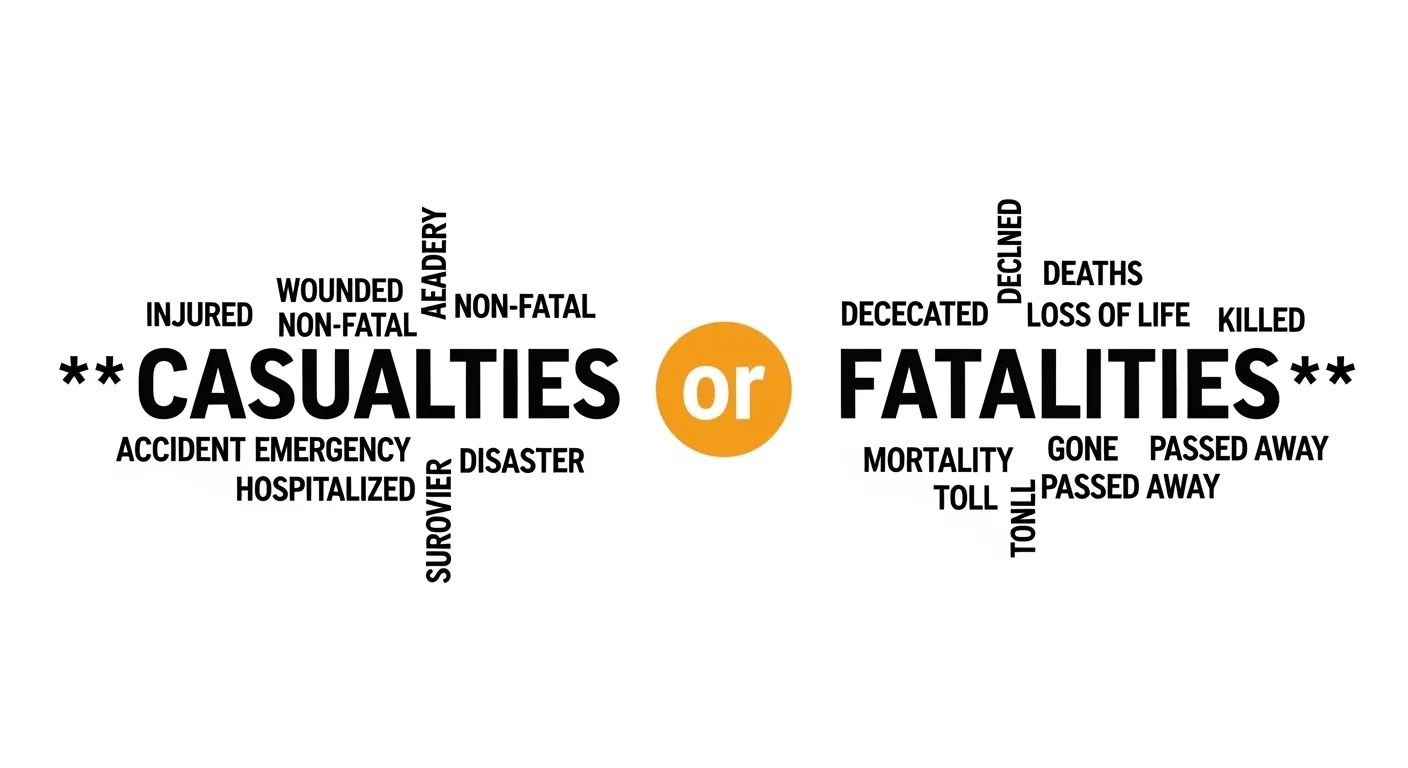
In news, reports, and social media, casualties or fatalities are often mentioned, but they’re not the same.
Casualties include everyone affected injured, missing, or dead while fatalities mean only deaths. Using the wrong term can confuse readers.
This guide will help you understand the difference, see real examples, avoid mistakes, and use each word correctly for clear, professional writing.
Casualties or Fatalities – Quick Answer
Quick Answer:
- Casualties = all affected individuals (injured, missing, or dead)
- Fatalities = people who have died
Casualties
- Broad term covering injuries, deaths, and missing persons
- Used in accidents, disasters, or conflicts
Examples:
- “The earthquake caused over 200 casualties, including injuries and deaths.”
- “Casualties from the car accident were treated at the hospital.”
Fatalities
- Specifically refers to deaths
- Highlights the ultimate outcome
Examples:
- “The hurricane resulted in 50 fatalities.”
- “Fatalities from the collision were confirmed by authorities.”
Simple Rule
- All affected = casualties
- Only deaths = fatalities
The Origin of Casualties or Fatalities
Origin of Casualty
- Comes from Latin “casualitas”, meaning “chance” or “accident”
- Initially referred to losses in military or accidents
- Expanded to include all affected individuals
Origin of Fatality
- Comes from Latin “fatalitas”, meaning “death” or “fate”
- Originally related to inevitable death
- Modern usage specifically denotes deaths
Key Insight
- Casualty = affected, including injuries
- Fatality = death only
British English vs American English Spelling
Both words are spelled the same in British and American English. However, usage can vary slightly in style or preference.
Comparison Table
| Word | British English | American English | Usage Focus |
| Casualties | Casualties | Casualties | Injured, dead, or missing |
| Fatalities | Fatalities | Fatalities | Deaths only |
Examples
British English:
- “The train crash resulted in 30 casualties.”
- “Fatalities were reported after the flood.”
American English:
- “The hurricane caused many casualties, including injuries and deaths.”
- “The accident led to several fatalities.”
Which Spelling Should You Use?
Audience-Based Advice
- US Audience: Use casualties and fatalities as one word each.
- UK/Commonwealth: Same spellings; focus on context rather than changing spelling.
- Global Audience: Both are widely accepted; stay consistent throughout your writing.
Tip: Focus on meaning, not spelling. Ensure you distinguish between injuries (casualties) and deaths (fatalities).
Common Mistakes with Fatalities or Casualties
Mistake 1: Using fatalities for all affected
Incorrect:
- “The earthquake caused 200 fatalities, including injuries.”
Correct:
- “The earthquake caused 200 casualties, including injuries and deaths.”
Mistake 2: Using casualties for deaths only
Incorrect:
- “There were 50 casualties in the collision.” (if all were deaths)
Correct:
- “There were 50 fatalities in the collision.”
Mistake 3: Confusing context
- Casualties = broader context, including missing and injured
- Fatalities = strictly death
Quick Tip
- Injury + death + missing = casualties
- Death only = fatalities
Casualties or Fatalities in Everyday Examples
News Reports
- “The storm caused over 100 casualties, with 20 fatalities reported so far.”
- “Road accidents resulted in several fatalities this month.”
Social Media
- “Prayers for the casualties of the earthquake.”
- “Authorities confirmed 10 fatalities after the crash.”
Professional Writing
- “Emergency services responded quickly to casualties.”
- “Fatalities were investigated by the safety board.”
Fatalities vs Casualties – Google Trends & Usage Data
Search interest in casualties or fatalities spikes during:
- Natural disasters
- Accidents and collisions
- Military conflicts
Usage by Country
| Country | Usage Trend |
| United States | High in news and safety reporting |
| United Kingdom | Common in journalism and emergency reports |
| India | Increasing with disaster coverage |
| Australia | Frequently used in media and official reports |
Trend Insight: Searches peak during major events involving injuries or deaths.
Comparison Table: Casualties vs Fatalities
| Feature | Casualties | Fatalities |
| Meaning | All affected (injured, dead, missing) | Only deaths |
| Scope | Broader | Narrow |
| Context | Accidents, disasters, conflicts | Death reporting, accidents |
| Example | “200 casualties, 50 fatalities” | “50 fatalities confirmed” |
| Usage Tip | Use when including injured | Use when only deaths are counted |
FAQs
1. Are casualties and fatalities the same?
No. Casualties include injuries and deaths. Fatalities refer only to deaths.
2. Can a single event have both casualties and fatalities?
Yes. For example, a car crash can injure 20 people (casualties) and result in 3 deaths (fatalities).
3. Which term is more serious?
Fatalities are more serious because they refer to death, while casualties include all affected.
4. Are missing people considered casualties?
Yes. Casualties include injured, dead, and missing individuals.
5. Can fatalities occur without casualties?
No. Deaths are always part of casualties, but casualties may exist without fatalities.
6. Is it correct to say “casualties only”?
No. Casualties can include injuries and deaths, so “only” should clarify the type if needed.
7. Are these terms used in military contexts?
Yes. Military reports often distinguish between casualties (all affected soldiers) and fatalities (deaths).
Conclusion
The difference between casualties or fatalities is clear once you understand scope and context. Casualties include everyone affected injured, missing, or dead.
Fatalities refer strictly to deaths. Using the correct term ensures accuracy, clarity, and professionalism in news reporting, academic writing, or official communication.
Remember the simple rule: all affected = casualties, deaths only = fatalities. Applying this rule helps avoid confusion, improves readability, and strengthens your writing.
If You reporting accidents, disasters, or conflicts, distinguishing these terms shows attention to detail and responsibility in communication. Accurate word choice also helps readers understand the severity of events quickly and clearly.

I’m English language author writing emphasises clarity, structure, and close attention to language. My work is often examined for stylistic comparison, focusing on Grammar work, narrative control, and subtle thematic development.