Many people search for “thought or tought” because the words look alike and sound almost the same.
When we speak quickly, the “gh” in thought is silent. This makes some people think the spelling should be tought. But here is the clear truth: only thought is correct in modern English.
Small spelling mistakes can make your writing look careless. In emails, blog posts, school work, or business content, even one wrong letter can reduce trust.
That’s why students, writers, and professionals often check this word on Google before publishing or sending their work.
If you feel unsure, don’t worry. This guide gives you a quick answer, simple explanation, clear examples, and expert tips.
In just a few minutes, you will know the correct spelling — and you won’t confuse it again.
Thought or Tought – Quick Answer
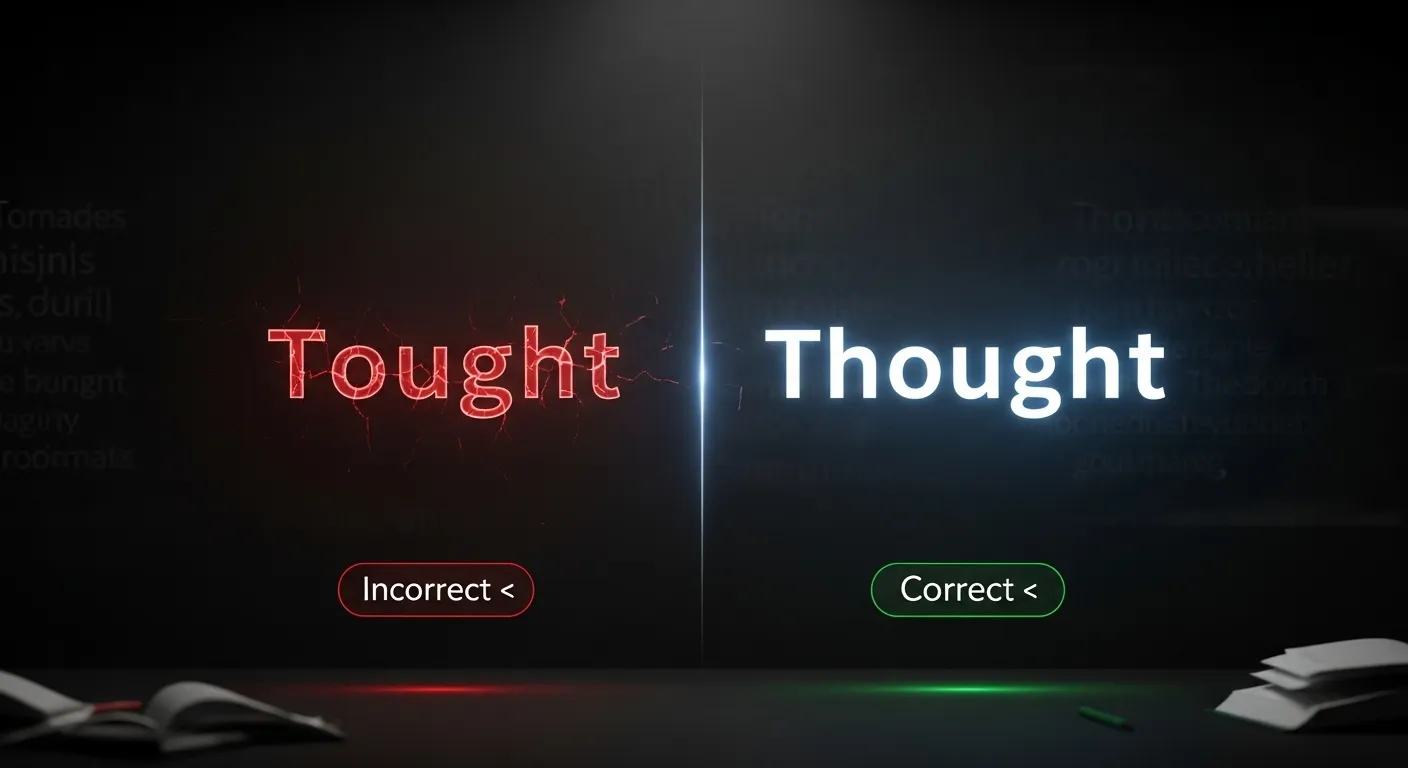
The correct spelling is thought.
Tought is not a real English word.
✅ Correct:
- I thought about you yesterday.
- She thought the test was easy.
- That is an interesting thought.
❌ Incorrect:
- I tought about you.
- He tought it was late.
Thought is the past tense of the verb think. It can also be a noun.
Tought is simply a spelling mistake.
The Origin of Thought or Tought
The word thought comes from Old English þōhte, which was the past tense of þencan (to think). Over time, spelling changed, but the silent “gh” stayed in many English words.
English keeps many old spellings. That is why we have words like:
- through
- though
- enough
- daughter
The “gh” was once pronounced. Today, it is silent in most cases. This confuses learners.
There has never been a standard English word spelled tought. The mistake likely happens because:
- People spell based on sound.
- The silent “gh” feels unnecessary.
- Fast typing causes errors.
So, while thought has deep history, tought has none.
British English vs American English Spelling
Good news: There is no difference between British and American English for this word.
Both countries use the same spelling: thought.
Unlike words such as:
- Oxford University Press style prefers colour
- Merriam-Webster style prefers color
The word thought stays the same everywhere.
Comparison Table
| Version | British English | American English | Correct? |
| thought | ✔ Yes | ✔ Yes | ✅ Correct |
| tought | ✘ No | ✘ No | ❌ Incorrect |
There is no regional debate. If you see tought, it is simply wrong.
Which Spelling Should You Use?
The answer is simple:
Always use thought.
If your audience is in the United States:
Use thought.
If your audience is in the UK:
Use thought.
If your audience is global:
Still use thought.
There is no situation where tought is correct.
If you write blogs, websites, academic papers, product descriptions, or emails, always check for this typo. It can make your writing look careless.
Common Mistakes with Thought or Tought
Here are frequent errors people make:
1. Spelling by sound
People hear “thawt” and write tought.
2. Confusing with “taught”
Many confuse thought with taught (past tense of teach).
Example:
- She taught the class.
- I thought about the class.
They sound similar but have different meanings.
3. Missing the silent “gh”
Writers often remove letters that seem unnecessary.
Wrong: I thout it was good.
Correct: I thought it was good.
4. Auto-correct errors
Fast typing can create spelling mistakes.
5. ESL learner confusion
English keeps historical spelling patterns. This makes learning harder.
Tought or Thought in Everyday Examples
Let’s see how thought works in real life.
1. In Emails
- I thought we agreed on Monday.
- I thought you might like this update.
2. In News Writing
- The minister thought the policy would succeed.
- Analysts thought markets would rise.
3. On Social Media
- Just thought I would share this.
- Random thought of the day!
4. In Academic Writing
- The philosopher thought deeply about ethics.
- This thought shaped modern theory.
5. In Business Writing
- We thought the strategy was effective.
- That is an important thought for growth.
Notice: tought never appears in professional writing.
Thought Vs Tought – Google Trends & Usage Data
Search data shows that:
- Thought is searched worldwide.
- “Thought meaning,” “past tense of think,” and “deep thoughts” are common queries.
- “Tought” appears mostly as a misspelling.
Countries where spelling confusion is common:
- United States
- India
- Pakistan
- Philippines
This pattern shows that learners and fast typists often make the error.
In books, newspapers, and dictionaries, only thought appears.
Comparison Table – Keyword Variations
| Word | Meaning | Correct? | Example |
| thought | Past of think / idea | ✅ Yes | I thought about you. |
| tought | No meaning | ❌ No | Incorrect spelling |
| taught | Past of teach | ✅ Yes | She taught English. |
| think | Present verb | ✅ Yes | I think you’re right. |
This table helps avoid confusion.
FAQs
1. Is “tought” ever correct?
No. It is not a real English word.
2. Why do people spell thought as tought?
Because the “gh” is silent, and people spell by sound.
3. Is this a British vs American difference?
No. Both use thought.
4. What is the difference between thought and taught?
- Thought = past of think.
- Taught = past of teach.
5. Can thought be a noun?
Yes.
Example: That is a good thought.
6. Why does English keep silent letters?
English keeps old spellings from history.
7. How can I avoid this mistake?
- Use spell check.
- Read slowly before publishing.
- Remember: think → thought.
Conclusion:
The confusion between thought or tought is common, but the answer is simple. Thought is the only correct spelling.
It works as the past tense of think and also as a noun meaning an idea. The spelling has deep roots in Old English, which explains the silent “gh.”
Even though it may look strange, it is the correct and accepted form in all English-speaking countries.
There is no British or American variation. There is no alternative spelling. If you write tought, it is a mistake.
This error often happens because people spell by sound or confuse it with “taught.” Understanding the difference helps you write clearly and professionally.
Whether you are writing emails, blog posts, academic papers, or business content, always double-check your spelling. Small details build trust.
Now you know the rule: thought is correct, tought is wrong.