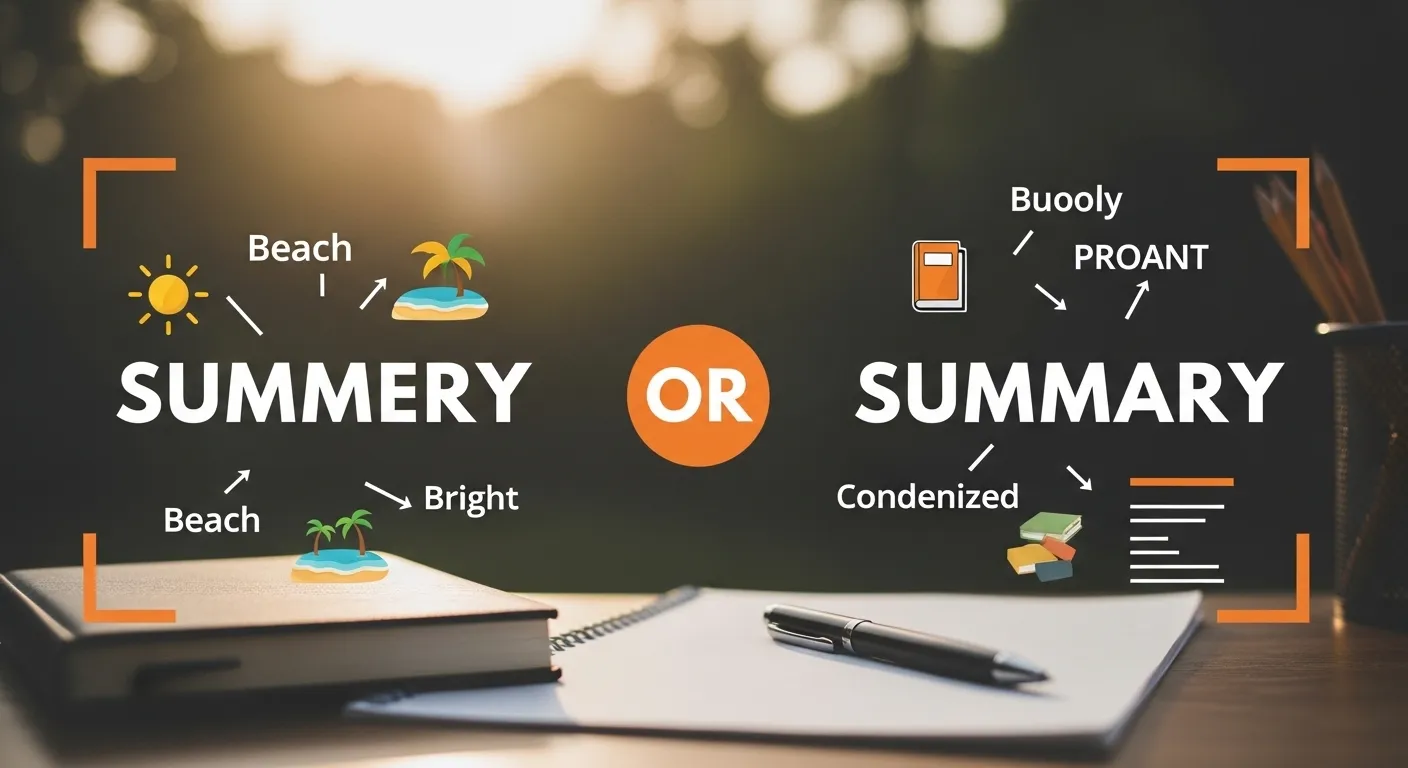
Many people wonder: “summery or summary?” The answer is simple.
Summary is correct when you mean a short version of something,
while summery describes something that feels like summer.
Confused? You’re not alone these words differ by just one letter, but the meaning is completely different. Using the wrong one can make your writing look careless, whether it’s an email, school paper, or blog post.
This guide will quickly show you the difference, explain when to use each word, and give easy examples so you never mix them up again.
Summery or Summary – Quick Answer
Summary is the correct spelling when you mean a short version of something.
Summery is also a real word, but it has a different meaning. It describes something that feels like summer.
Examples:
- ✅ I wrote a summary of the book.
- ❌ I wrote a summery of the book.
- ✅ She wore a light, summery dress.
- ❌ She wore a light, summary dress.
So the answer is simple:
- Use summary for a short explanation.
- Use summery to describe something related to summer.
Most people searching this keyword actually mean summary.
The Origin of Summery or Summary
Understanding word history helps reduce mistakes.
Origin of Summary
The word summary comes from the Latin word summarium, which means “a brief statement.” It entered English in the 14th century. It always referred to a short account of something long.
For example:
- A book summary
- A meeting summary
- A news summary
The spelling has stayed stable over time.
Origin of Summery
The word summery comes from the word summer. It simply means “like summer.” It describes weather, clothes, colors, or feelings.
Examples:
- A summery breeze
- A summery smell
- A summery outfit
These two words have different roots and meanings. They are not spelling variations of the same word.
British English vs American English Spelling
Unlike words such as color/colour or judgment/judgement, there is no spelling difference between British and American English for summary.
Both countries use:
- ✅ summary
- ❌ Not “summery” for a short version
The same applies to summery. It is spelled the same in both varieties of English.
Comparison Table
| Word | Meaning | British English | American English |
| Summary | Short version of text | Summary | Summary |
| Summery | Like summer | Summery | Summery |
There is no regional difference here. The confusion is about meaning, not location.
Which Spelling Should You Use?
Your choice depends on meaning, not audience.
If You Are Writing for the US
Use summary for:
- Essays
- Reports
- Emails
- Articles
Use summery only when describing summer vibes.
If You Are Writing for the UK or Commonwealth
The rule is the same. There is no variation.
If You Are Writing for a Global Audience
Always choose the word based on meaning:
- Need a short explanation? → Summary
- Talking about summer style? → Summery
For professional writing, 99% of the time, you need summary.
Common Mistakes with Summary or Summery
Here are frequent errors people make:
1. Using “summery” instead of “summary”
❌ Please send me a summery of the report.
✅ Please send me a summary of the report.
2. Spell-check confusion
Sometimes autocorrect changes the word if typed incorrectly.
3. Pronunciation confusion
Both words sound very similar:
/ˈsʌməri/
This makes typing errors common.
4. Mixing noun and adjective
- Summary = noun
- Summery = adjective
Wrong:
❌ The summary weather was beautiful.
Correct:
✅ The summery weather was beautiful.
Summary vs Summery in Everyday Examples
Let’s see how these words appear in real life.
In Emails
Correct:
- “Here is a quick summary of today’s meeting.”
Incorrect:
- “Here is a quick summery of today’s meeting.”
In News Articles
Correct:
- “The report includes a short summary at the top.”
On Social Media
Correct:
- “Can someone give me a summary of this movie?”
For fashion posts:
- “Loving this bright, summery look!”
In Academic Writing
Correct:
- “The introduction provides a brief summary of the research.”
Using the wrong word in formal writing looks unprofessional.
Summery or Summary – Google Trends & Usage Data
Search data shows that “summary” is searched far more often than “summery.”
Why?
Because:
- Students need summaries.
- Businesses create executive summaries.
- Bloggers write article summaries.
- News sites publish summaries.
“Summery” is used less often. It appears mostly in lifestyle, travel, and fashion content.
In English-speaking countries like:
- United States
- United Kingdom
- Canada
- Australia
“Summary” dominates in search volume.
Most searches for “summery or summary” come from spelling confusion.
Comparison Table: Summery vs Summary
| Feature | Summary | Summery |
| Part of Speech | Noun | Adjective |
| Meaning | Short version of something | Like summer |
| Used in School | Yes | Rare |
| Used in Business | Yes | No |
| Used in Fashion | No | Yes |
| Commonly Misspelled | Yes | Yes |
| Same in UK & US | Yes | Yes |
This table makes the difference clear.
FAQs:
1. Is “summery” a wrong spelling?
No. It is a correct word, but it has a different meaning.
2. Which spelling is correct for a short version of a text?
Summary is correct.
3. Is there a British spelling difference?
No. Both British and American English use the same spelling.
4. Why do people confuse these words?
They sound almost identical and differ by only one letter.
5. Can I use “summery” in formal writing?
Only if you are describing something related to summer.
6. How do I remember the difference?
Think of this trick:
- Sum → Summary → Adding up information
- Summer → Summery → Like summer
7. Is “summery” common?
It is less common than “summary” and used mostly in lifestyle writing.
Conclusion:
The confusion between summery or summary is common, but the rule is simple. These words are not spelling variations of the same term. They have different meanings and different uses.
Use summary when you mean a short version of a longer text, speech, meeting, or report. This word is essential in academic, business, and online writing. It is the word most people actually need.
Use summery only when describing something that feels like summer, such as weather, clothing, colors, or mood.
There is no British or American spelling difference. The spelling remains the same worldwide. The key is meaning.
If you remember one thing, remember this:
- Writing about information? → Summary
- Writing about sunshine vibes? → Summery
Choose carefully, and your writing will stay clear, correct, and professional.