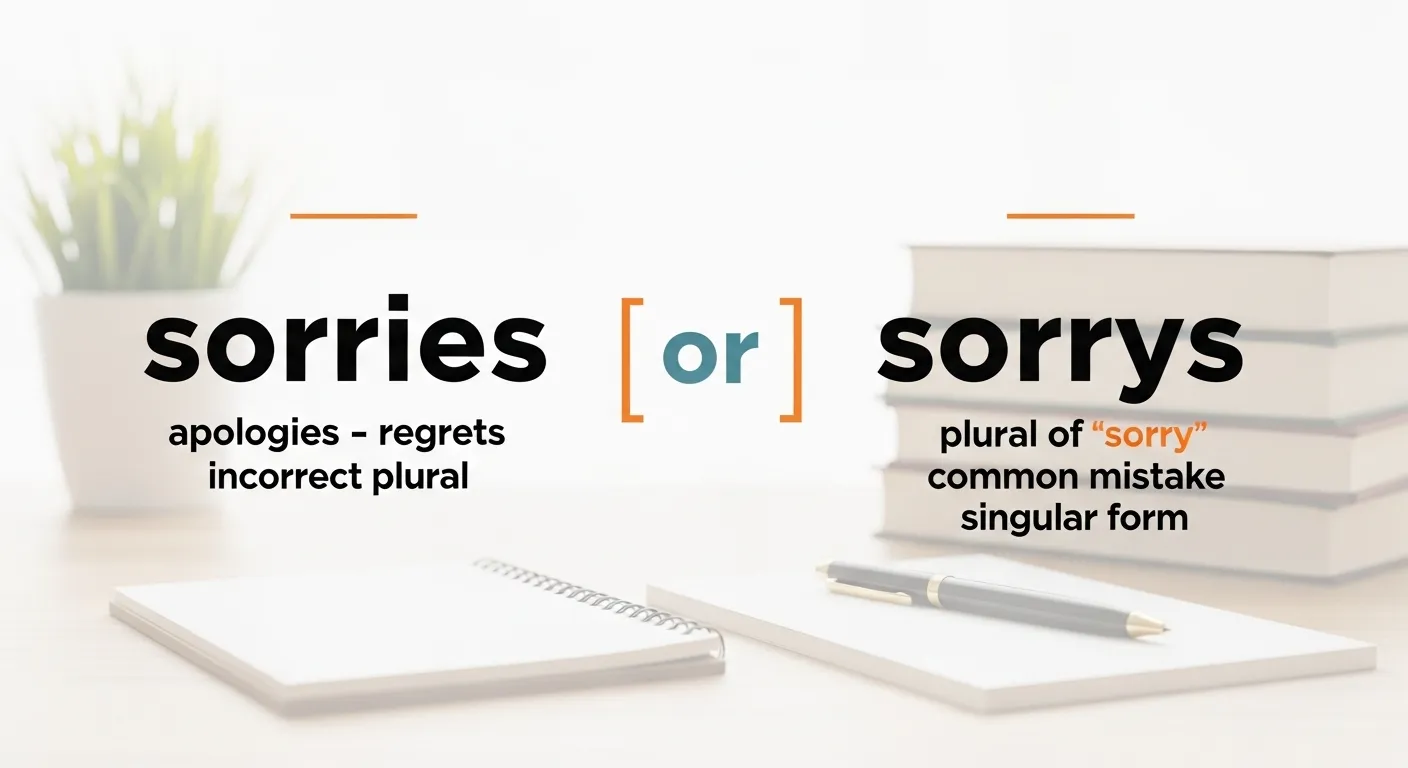
Many writers, students, and professionals often wonder: should the plural of sorry be sorries or sorrys? It’s a small word, but the confusion is real.
English plurals aren’t always simple, and choosing the wrong form can make your writing look careless especially in emails, social media, or formal content.
People search for “sorries or sorrys” because they want quick, reliable guidance. Is sorry an adjective or a noun? How do you make it plural correctly?
This article answers these questions, shows the correct spelling, explains the history, compares British vs American usage, and gives clear examples.
By the end, you’ll confidently use sorries in every situation never sorrys and write with clarity and professionalism.
Sorrys or Sorries – Quick Answer
The correct plural spelling is sorries.
Sorrys is incorrect and should not be used.
Why?
When a noun ends in -y and is preceded by a consonant, English changes -y to -ies in the plural.
Examples:
- one sorry → two sorries
- many apologies → many sorries
- repeated expressions of regret → repeated sorries
❌ Sorrys
✅ Sorries
This rule is consistent across modern English.
The Origin of “Sorries”
The word sorry comes from Old English sārig, meaning distressed, grieved, or full of sorrow. Originally, sorry was used mainly as an adjective, describing a person’s emotional state.
Over time, English speakers began using sorry as a noun, especially in informal speech:
- “No sorries needed.”
- “He offered many sorries.”
As English evolved, standard pluralization rules were applied to this noun form. Because sorry ends in a consonant + y, the plural followed the -ies rule, becoming sorries.
The spelling sorrys never gained acceptance in dictionaries or style guides. It appears occasionally in casual writing but is considered a spelling error.
British English vs American English Spelling
Good news: there is no difference between British and American English for this word.
Both varieties agree completely.
Comparison Table: British vs American Usage
| Feature | British English | American English |
| Singular | sorry | sorry |
| Plural | sorries | sorries |
| “sorrys” accepted? | ❌ No | ❌ No |
| Formal usage | Rare but correct | Rare but correct |
| Informal usage | Common in speech | Common in speech |
✔ Sorries is standard everywhere
✘ Sorrys is incorrect everywhere
Which Spelling Should You Use?
Your choice is simple, but your context matters.
Use sorries when:
- Writing informally but correctly
- Referring to multiple apologies
- Writing dialogue, fiction, or casual content
- Wanting grammatically sound English
Audience-based advice:
- US audience → Use sorries
- UK audience → Use sorries
- Global audience → Use sorries
- Professional or academic writing → Prefer apologies, but sorries is still correct if used
If your writing is formal, consider replacing the noun sorries with apologies, but never use sorrys.
Common Mistakes with Sorries or Sorrys
Many mistakes happen because writers apply the wrong plural rule.
Mistake 1: Adding only “s”
❌ He offered many sorrys.
✅ He offered many sorries.
Mistake 2: Treating “sorry” like a regular noun
Writers assume all nouns just add -s, but -y nouns follow a different rule.
Mistake 3: Avoiding the plural completely
Some writers awkwardly rewrite sentences to avoid choosing:
❌ He said sorry again and again
✅ He gave many sorries.
Mistake 4: Using “sorrys” in professional writing
This can harm credibility, especially in blogs, articles, or business communication.
Sorries or Sorrys in Everyday Examples
Seeing real examples helps fix the rule in your mind.
Emails
- “Please accept my sorries for the delay.”
- “Many sorries for the inconvenience caused.”
News & Journalism
- “The company issued repeated sorries after the incident.”
Social Media
- “So many sorries, I was offline all day!”
- “No sorries, mistakes happen.”
Formal Writing
- “The speaker offered multiple sorries, though a formal apology followed.”
Spoken English (Converted to Writing)
- “No sorries needed, we understand.”
Sorries or Sorrys – Google Trends & Usage Data
Search data shows that “sorries or sorrys” is a frequently searched phrase, especially by:
- ESL learners
- Content writers
- Students
- Bloggers
Why the confusion is common:
- Sorry is mostly an adjective
- Its noun form feels informal
- Plural nouns ending in -y confuse learners
Usage by region:
| Region | Common Search | Preferred Form |
| United States | sorries or sorrys | sorries |
| United Kingdom | sorries plural | sorries |
| Australia | sorry plural | sorries |
| Global ESL | lent vs leant–style confusion | sorries |
Search trends show “sorrys” spikes during grammar-related searches, but authoritative usage always supports sorries.
Comparison Table: Keyword Variations
| Form | Correct? | Usage | Recommendation |
| sorry | ✅ | Singular | Use freely |
| sorries | ✅ | Plural noun | Use confidently |
| sorrys | ❌ | Nonstandard | Avoid |
| apologies | ✅ | Formal plural | Preferred in formal writing |
FAQs:
1. Is “sorrys” ever correct?
No. Sorrys is not accepted in standard English.
2. Why does “sorry” become “sorries”?
Because nouns ending in consonant + y change -y to -ies in the plural.
3. Is “sorries” informal?
It is informal but grammatically correct.
4. Should I avoid “sorries” in formal writing?
You can use it, but “apologies” sounds more formal.
5. Do British and American English differ here?
No. Both use sorries.
6. Can “sorry” be a noun?
Yes. Informally, sorry functions as a noun.
7. What is the safest choice in professional emails?
Use apologies, but sorries is still correct.
Conclusion:
The confusion between sorries and sorrys is understandable, but the rule is clear and consistent.
Sorries is the only correct plural form of sorry. The spelling sorrys breaks standard English pluralization rules and should be avoided in all types of writing.
Understanding why this happens makes the rule easy to remember. When a noun ends in a consonant followed by -y, English replaces -y with -ies. This applies to many common words, and sorry follows the same pattern.
There is no difference between British and American English here, which makes the choice even simpler.
In everyday writing, dialogue, social media, and informal communication, sorries is natural and correct. In professional or academic contexts, you may choose apologies for a more formal tone but if you do use sorries, you can do so confidently.
Language clarity builds trust. By choosing sorries and avoiding sorrys, you ensure your writing looks polished, modern, and grammatically correct every time.

I’m English language author writing emphasises clarity, structure, and close attention to language. My work is often examined for stylistic comparison, focusing on Grammar work, narrative control, and subtle thematic development.