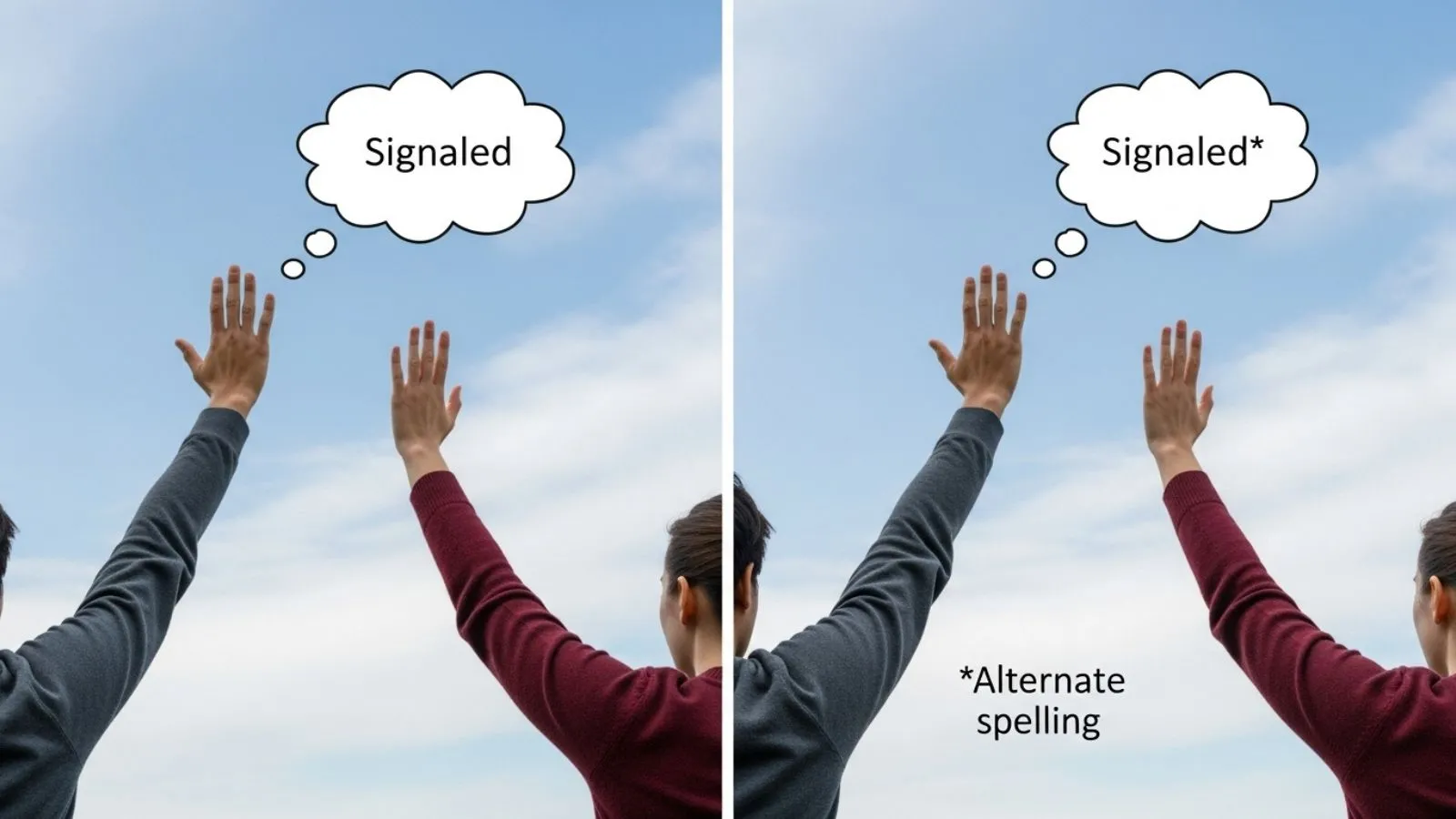
Ever wondered whether it’s signalled or signaled? You’re not alone. Writers, students, bloggers, editors, and professionals around the world frequently pause at this exact spelling choice.
Both spellings are correct, but they are used in different varieties of English. It’s a regional spelling difference.
Spellcheck sometimes accepts both versions, online articles use different forms, and style guides vary by region. All of this makes the confusion even worse.
The key to choosing the right one lies in understanding British English vs American English rules, and more importantly, knowing who your audience is.
Once you understand that, the confusion disappears completely.
Signalled or Signaled – Quick Answer
Signalled → Correct in British English, Canadian English, Australian English, and other Commonwealth countries.
Signaled → Correct in American English.
Example sentences:
- British English: She signalled for a taxi outside the station.
- American English: He signaled that he was ready to start the meeting.
✅ Quick tip: Always follow your audience’s English standard. This instantly improves clarity and professionalism.
The Origin of Signaled / Signalled
The word signal comes from the Latin signum, meaning “sign,” “mark,” or “indication.” It entered the English language in the 14th century and later evolved into a verb meaning to send a sign or message.
In early English, spelling was far from standardized. Writers often spelled words based on sound or personal preference. Over time, spelling rules became more structured—but British and American English developed differently.
British English preserved many traditional spelling rules, including consonant doubling. American English, influenced heavily by Noah Webster, aimed to simplify spelling, often removing extra letters when pronunciation stayed the same.
This historical split explains why signalled appears in British texts, while signaled dominates American writing.
British English vs American English Spelling Rules
The main reason for the confusion lies in consonant doubling rules.
British English Rule
If a verb ends in:
- a single vowel + single consonant,
the final consonant is doubled before adding -ed or -ing.
Examples:
- travel → travelled
- signal → signalled
- cancel → cancelled
American English Rule
American English usually does not double the consonant unless the stress falls on the final syllable.
Examples:
- travel → traveled
- signal → signaled
- cancel → canceled
Comparison Table
| Country / Region | Correct Spelling |
| United Kingdom | signalled |
| Australia | signalled |
| Canada | signalled |
| New Zealand | signalled |
| United States | signaled |
| Global / International | signaled (US-safe choice) |
Which Spelling Should You Use?
Your choice should always depend on who will read your content.
- US audience:
Always use signaled. It matches American English standards and expectations. - UK / Commonwealth audience:
Use signalled to stay consistent with British spelling rules. - Global or mixed audience:
Signaled is generally the safer option, especially for websites, apps, and international publications.
💡 Pro tip: Many professional publications and academic journals specify a style guide. Always follow that guide first.
Common Mistakes with Signalled / Signaled
Writers often make avoidable mistakes with these spellings.
1. Mixing both variants in one document
❌ He signalled and then signaled again.
✅ Choose one spelling and stay consistent.
2. Using American spelling in British context
❌ She signaled for help. (UK article)
✅ She signalled for help.
3. Forgetting similar word patterns
Words like cancelled / canceled, labelled / labeled, and travelling / traveling follow the same rules.
📌 Remember: Consistency matters more than the variant itself.
Signalled / Signaled in Everyday Writing
These spellings appear everywhere in daily communication.
Emails
- “I signaled my approval to the manager yesterday.” (US)
- “She signalled her intent to join the project.” (UK)
News articles
- “The official signaled the start of the ceremony.” (US)
- “The pilot signalled the landing successfully.” (UK)
Social media
- “Just signaled my best friend to meet up!”
- “He signalled the group to move forward.”
Formal writing
Academic papers, reports, and legal documents strictly follow regional style guides.
Signalled or Signaled in SEO and Online Writing
In SEO and digital content, spelling choices can affect search visibility and user trust.
Most global searches favor American English spellings, simply because the internet is dominated by US-based content. This is why many international websites prefer signaled even when writers are based outside the US.
However, if your website targets:
- UK traffic → signalled improves relevance
- US traffic → signaled performs better
- Mixed traffic → signaled is usually safest
Search engines understand both spellings, but matching user expectations improves engagement and credibility.
Signalled or Signaled – Google Trends & Usage
Search data clearly shows regional preferences:
- US searches strongly favor signaled
- UK, Canada, Australia, and New Zealand prefer signalled
- Social media and forums reflect the same pattern
This confirms that choosing the right variant by region improves readability and professionalism.
FAQs:
1. Is signalled or signaled correct?
Both are correct. The choice depends on regional English.
2. Should I double the “l”?
Only in British and Commonwealth English.
3. Which is more common globally?
Signaled, due to American English dominance online.
4. Can I mix both in one document?
❌ No. Always stay consistent.
5. Does pronunciation change?
No. Both are pronounced the same.
Conclusion
The choice between signalled and signaled isn’t about right or wrong—it’s about audience and consistency.
- Use signalled for British and Commonwealth readers
- Use signaled for American or international audiences
Once you understand the rule, this spelling choice becomes effortless. Mastering these small differences helps you write with confidence, avoid mistakes, and communicate clearly with readers worldwide.
Understanding these spelling differences helps you write confidently, avoid errors, and connect effectively with readers worldwide.

I’m American writer known for precise, economical use of language and strong narrative voice. My work is frequently studied for sentence rhythm, word choice, and how meaning is shaped through grammar, making it valuable for close reading and English comparison studies.