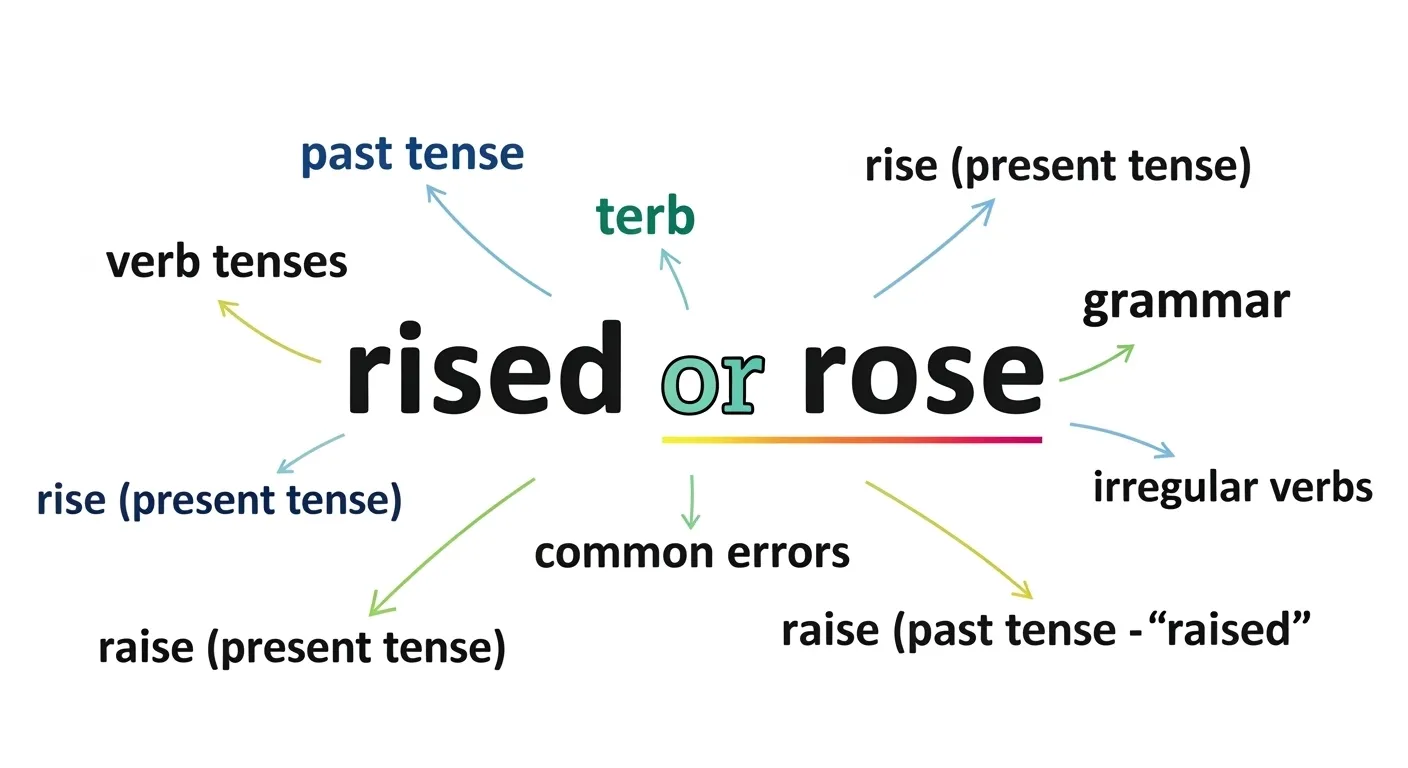
Many writers search for “rised or rose” because they want to know which form is correct. Sentences like “Prices rised last year” often look wrong, but the reason is not always clear.
This confusion happens because rise is an irregular verb and does not follow standard “-ed” patterns.
The issue matters for students, professionals, and non native speakers who want their writing to look correct and polished. Using the wrong past tense can weaken emails, essays, reports, and online content.
This guide clears the confusion by explaining the correct form, why the mistake is common, and how to use the right word confidently in everyday and professional writing.
Rised or Rose – Quick Answer
“Rose” is correct. “Rised” is incorrect and not a real English word.
- ✅ Correct: The sun rose early today.
- ❌ Incorrect: The sun rised early today.
The verb rise is irregular. Its forms are:
- Present: rise
- Past simple: rose
- Past participle: risen
Examples:
- Prices rose sharply last year.
- Water levels have risen after the storm.
Rised is never correct in standard English.
The Origin of Rose or Rised
To understand why “rised” is wrong, we need to look at the history of the word rise.
The verb rise comes from Old English “rīsan”, meaning to get up, ascend, or stand. It has always been an irregular verb, even centuries ago. Because of this, it never followed the regular “-ed” past tense pattern.
Over time, English kept these forms:
- rise → rose → risen
Unlike newer verbs that adopt regular endings, older verbs like rise, go, come, and see kept their unique past forms.
So, “rised” never developed historically, which is why it is not accepted in modern English.
British English vs American English Spelling
Here’s the good news: British English and American English are the same for this verb.
Both use:
- rose (past tense)
- risen (past participle)
There is no regional spelling difference like colour/color or learnt/learned.
Comparison Table
| Form | British English | American English | Correct? |
| rise | rise | rise | ✅ |
| rose | rose | rose | ✅ |
| risen | risen | risen | ✅ |
| rised | rised | rised | ❌ |
If you see “rised”, it is a grammar error, not a regional variant.
Which Spelling Should You Use?
Your choice is simple because there is only one correct option.
- US audience → Use rose
- UK audience → Use rose
- Global or international audience → Use rose
- Academic, professional, or formal writing → Use rose
There is no situation where “rised” is acceptable.
If you want your writing to look professional and correct, always choose rose.
Common Mistakes with Rised or Rose
Many mistakes happen because writers treat rise like a regular verb.
❌ Mistake 1: Adding “-ed”
- The temperature rised quickly. ❌
- The temperature rose quickly. ✅
❌ Mistake 2: Mixing rose and risen
- Prices have rose. ❌
- Prices have risen. ✅
❌ Mistake 3: Confusing rise with raise
- They rose the prices. ❌
- They raised the prices. ✅
Tip:
- Rise = happens by itself
- Raise = someone causes it
Rised or Rose in Everyday Examples
Emails
- ✅ Sales rose significantly this quarter.
- ❌ Sales rised significantly this quarter.
News
- ✅ Inflation rose to record levels.
- ❌ Inflation rised to record levels.
Social Media
- ✅ Gas prices rose again today.
- ❌ Gas prices rised again today.
Formal Writing
- ✅ The demand rose steadily over the years.
- ❌ The demand rised steadily over the years.
Rised or Rose – Google Trends & Usage Data
Search data shows that “rised or rose” is a common grammar query worldwide. This tells us two things:
- People frequently make this mistake.
- English learners want confirmation before writing.
Usage by Region
- United States: Searches spike in academic and ESL contexts.
- United Kingdom: Common among students and exam preparation.
- India, Pakistan, Philippines: High interest due to ESL learning.
- Global content writers: Search before publishing articles.
In real-world usage:
- Rose appears millions of times in books, news, and academic papers.
- Rised appears mostly in error-correction searches, not in published content.
Comparison Table: Rised vs Rose
| Word | Meaning | Correct Usage | Example |
| rose | Past tense of rise | ✅ Yes | The sun rose early. |
| rised | — | ❌ No | Incorrect in all contexts |
FAQs:
1. Is “rised” ever correct?
No. “Rised” is not a correct English word.
2. Why do people say “rised”?
Because they assume rise is a regular verb. It is not.
3. What is the past tense of rise?
The past tense of rise is rose.
4. What is the past participle of rise?
The past participle is risen.
5. Is there any difference between British and American English?
No. Both use rose and risen.
6. Can I use “rose” in formal writing?
Yes. Rose is correct and professional in all contexts.
7. How can I remember the correct form?
Think: rise → rose → risen (like write → wrote → written).
Conclusion:
The confusion between rised and rose is common, but the rule is simple: rose is the only correct past tense of rise. Rised is not a valid English word.
This verb is irregular in both British and American English, with no regional exceptions. Using rose keeps writing clear, professional, and accurate. Remember the correct forms: rise, rose, risen.

I’m American writer known for precise, economical use of language and strong narrative voice. My work is frequently studied for sentence rhythm, word choice, and how meaning is shaped through grammar, making it valuable for close reading and English comparison studies.