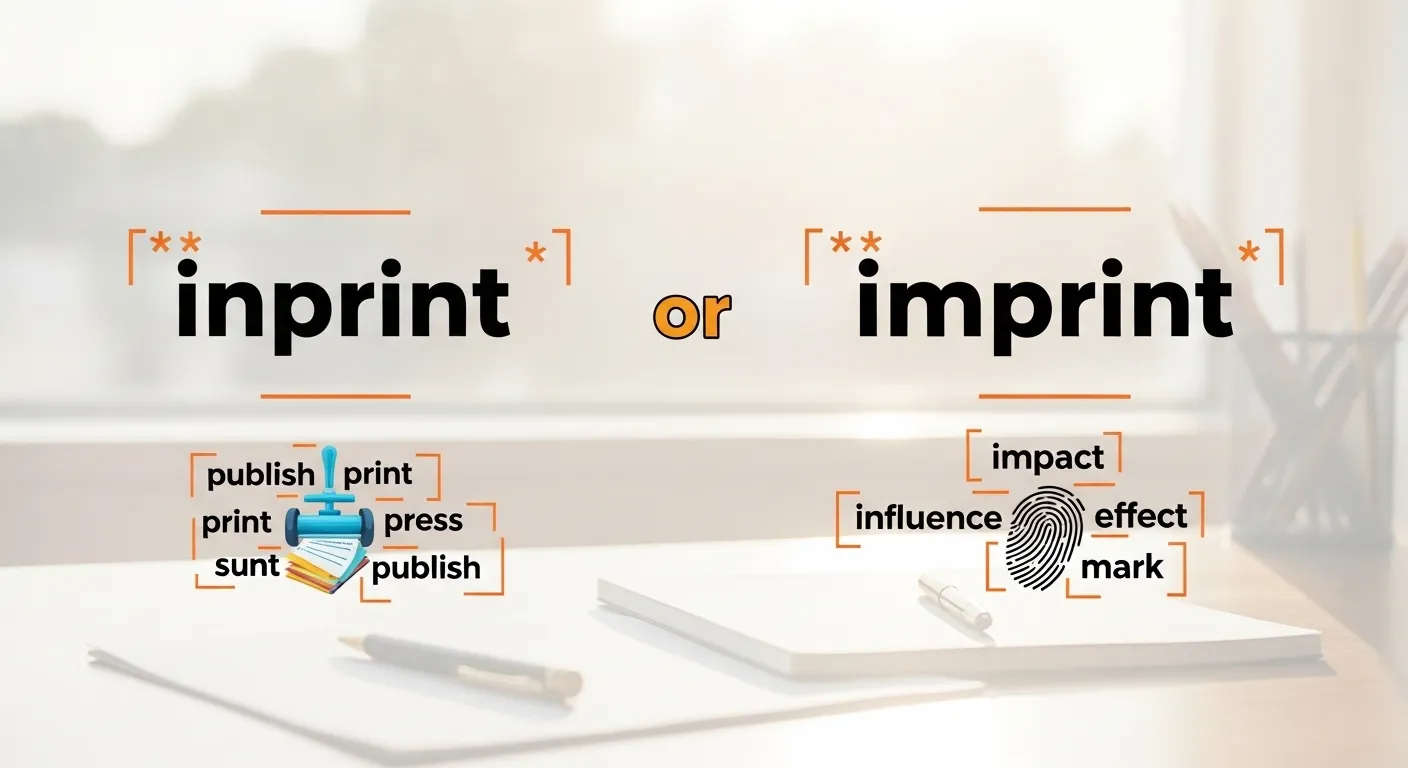
Imprint means to leave a mark, impression, or lasting effect (e.g., “The memory is imprinted in my mind”).
The correct spelling is “imprint”.
“Inprint” is not correct in standard English.
Use imprint in all writing emails, exams, blogs, and business documents to stay clear and professional. You will learn the correct spelling, its meaning, origin, grammar rules, usage differences, and real life examples.
By the end, you will never confuse imprint vs inprint again, and you will use the word confidently in both formal and informal writing.
Imprint or Inprint – Quick Answer
The correct spelling is imprint.
“Inprint” is incorrect in modern English and should not be used in writing.
Meaning of “imprint”:
- To press a mark or design on a surface
- To leave a lasting effect in memory or behavior
- To publish something under a publisher’s name (in publishing context)
Examples:
- The logo was imprinted on the box.
- Childhood experiences can imprint the mind.
- The book is published under an imprint of a major company.
👉 Simply put:
✔ imprint = correct
❌ inprint = wrong spelling
The Origin of Imprint
The word imprint comes from Latin roots:
- “imprimere” = to press into or press upon
- From “in-” (into) + “premere” (to press)
It entered Middle English through Old French as empreinte, meaning a mark or impression.
Over time, English standardized the spelling as imprint, keeping the “m” to reflect its original Latin structure.
Why “inprint” appeared
The mistake “inprint” likely comes from:
- Mishearing the word
- Breaking it into “in + print”
- Assuming it follows modern phonetic spelling rules
But historically and linguistically, “imprint” is the only correct form.
British English vs American English Spelling
Good news: there is no difference between British and American spelling for this word.
Both use:
✔ imprint
❌ inprint (incorrect in both)
Why confusion still exists:
- Similar pronunciation
- Influence of digital typing errors
- Auto-correct mistakes
- Misinterpretation of “in + print”
Comparison Table
| Feature | British English | American English | Correct Form |
| Spelling | imprint | imprint | imprint |
| Meaning | same | same | imprint |
| Usage | formal/informal | formal/informal | imprint |
| “Inprint” usage | incorrect | incorrect | not accepted |
👉 Conclusion: Both regions use the same spelling.
Which Spelling Should You Use?
The answer is simple: always use imprint.
Use “imprint” if you are:
- Writing academic essays
- Creating business content
- Writing blogs or SEO articles
- Preparing official documents
- Posting on professional platforms like LinkedIn
Avoid “inprint” in all cases because:
- It is not recognized in dictionaries
- It reduces writing credibility
- It may be flagged as a spelling error
Quick rule:
If you see “inprint,” replace it with “imprint” immediately.
Common Mistakes with Imprint and Inprint
Here are the most common errors people make:
1. Writing “inprint” instead of “imprint”
❌ The design was inprinted on the paper
✔ The design was imprinted on the paper
2. Confusing “imprint” with “print”
❌ I will imprint the document
✔ I will print the document
3. Wrong tense usage
❌ The mark is imprinting on memory
✔ The mark is imprinted on memory
4. Misuse in publishing
❌ This book is under inprint of the company
✔ This book is under an imprint of the company
5. Overthinking spelling variations
People assume:
- inprint = British spelling
- imprint = American spelling
This is false.
Imprint in Everyday Examples
Let’s see how imprint is used in real life:
1. Emails
- “Please ensure the logo is imprinted on all packaging materials.”
2. Academic Writing
- “Early childhood experiences can deeply imprint personality development.”
3. Social Media
- “That moment left an imprint on my life forever.”
4. Business / Branding
- “The company publishes books under multiple imprints.”
5. News Writing
- “The disaster left a lasting imprint on the region’s economy.”
6. Daily Conversation
- “That song is imprinted in my memory.”
Inprint or Imprint – Google Trends & Usage Data
Search behavior shows strong global interest in this keyword due to confusion.
Key observations:
- Highest searches come from:
- India
- Pakistan
- Bangladesh
- Middle East regions
- Moderate searches:
- United States
- United Kingdom
- Main reason for search:
- Spelling confusion (“inprint vs imprint”)
- Grammar checking
- Academic writing help
Why “inprint” appears in searches:
- Auto-suggestions
- Typing errors
- Phonetic misunderstanding
- Learning English as a second language
Insight:
Search engines often show “Did you mean imprint?” when users type “inprint,” confirming that it is not a valid form.
Comparison Table: Imprint vs Inprint
| Word | Status | Meaning | Usage Level | Correct? |
| imprint | Standard word | To leave mark or impression | Formal + informal | ✔ Yes |
| inprint | Misspelling | No meaning in standard English | Not used | ❌ No |
FAQs
1. Is “inprint” a correct word?
No, “inprint” is not a correct English word. The correct spelling is “imprint.”
2. Why do people write “inprint” instead of “imprint”?
It happens due to pronunciation confusion and typing errors.
3. Is “imprint” used in British and American English?
Yes, both use the same spelling: “imprint.”
4. What does “imprint” mean in simple words?
It means to leave a mark, impression, or lasting effect.
5. Can “imprint” be used in business writing?
Yes, it is commonly used in publishing, branding, and marketing.
6. Is “inprint” accepted in any dictionary?
No, major dictionaries do not recognize “inprint.”
7. What is an example of “imprint” in a sentence?
“The experience left a strong imprint on his memory.”
Conclusion
Understanding the difference between imprint and inprint is key for clear, professional writing. The correct word is always imprint, meaning to leave a mark or lasting impression. It comes from Latin, meaning “to press into.”
“Inprint” is incorrect in both British and American English, even though it is commonly seen in online searches and casual typing.
Using imprint correctly makes your writing more polished, credible, and professional whether in emails, exams, blogs, or business content.
In short, imprint is the only standard form that leaves a correct mark in language.