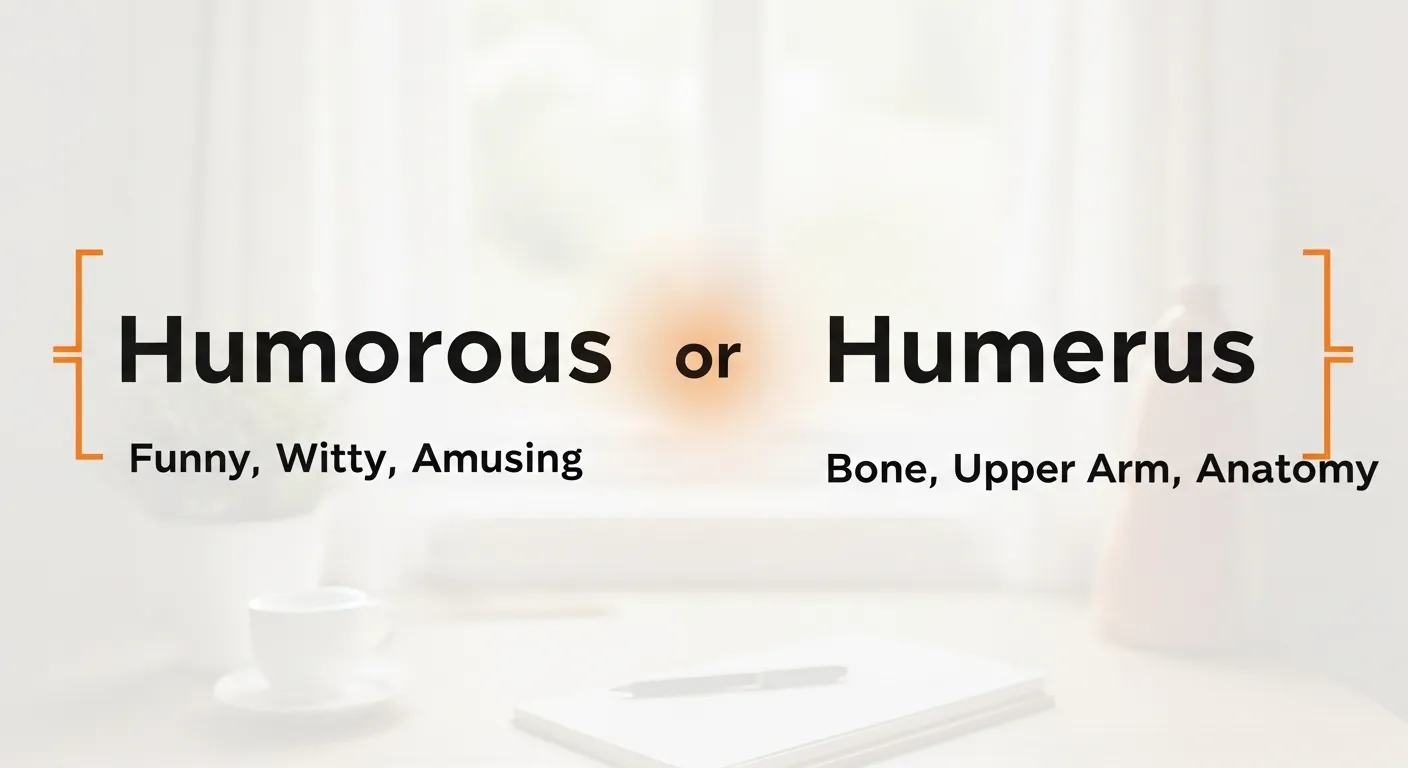
Confused between Humorous and Humerus? You’re not alone!
Humorous means funny or entertaining, while humerus is the upper arm bone. Using the wrong word can make emails, social media posts, or school work awkward.
In this guide, we’ll quickly show you the difference, common mistakes, and how to use each word correctly so you always get it right.
Humorous or Humerus – Quick Answer
- Humorous – An adjective meaning funny or entertaining.
- Example: “She told a humorous story that made everyone laugh.”
- Humerus – A noun referring to the upper arm bone in the human body.
- Example: “He fractured his humerus while playing football.”
Quick Tip: If you’re describing laughter, comedy, or fun, use humorous. If you’re talking about anatomy, bones, or medical topics, use humerus.
The Origin of Humorous or Humerus
- Humorous: Derived from the Latin word humor, meaning fluid or liquid, in the 14th century it referred to temperament and mood. By the 17th century, it evolved to mean “funny” or “amusing.”
- Humerus: Comes from the Latin humerus, meaning “shoulder” or “upper arm.” Its use in English dates back to the 14th century in medical texts.
The confusion exists because these words are homophones: they sound alike but have entirely different meanings. Over time, their spellings remained distinct, but pronunciation stayed similar, which is why many people type the wrong one online.
British English vs American English Spelling
The good news: spelling doesn’t change much between the US and UK for these words. Both humorous and humerus are spelled the same way in British and American English.
| Word | British English | American English | Meaning |
| Humorous | Humorous | Humorous | Funny, amusing |
| Humerus | Humerus | Humerus | Upper arm bone |
Key Takeaway: Unlike some other words, there’s no regional spelling difference here. Confusion comes purely from pronunciation and context.
Which Spelling Should You Use?
- For US audiences: Use humorous for anything funny, humerus for anatomy.
- For UK/Commonwealth audiences: The same rule applies. No regional spelling difference.
- Global usage: If you write for an international audience, clarity is most important. Consider context cues to avoid misunderstanding.
Pro Tip: When writing online or in emails, reading your sentence aloud helps. If it’s about jokes, laughter, or fun, you’re thinking humorous. If it’s about bones or medicine, it’s humerus.
Common Mistakes with Humerus or Humorous
- Mistake: “That was a humerus story!”
- Correction: “That was a humorous story!”
- Mistake: “The comedian broke his humorous.”
- Correction: “The comedian broke his humerus.”
- Mixing up in academic or medical writing: Using humorous in anatomy papers is a serious error.
Tip: Remember the simple mnemonic:
- Humor → Humorous → Funny
- Humerus → Bone → Arm
Humorous or Humerus in Everyday Examples
- Emails:
- Correct: “I shared a humorous anecdote in the meeting.”
- Incorrect: “I shared a humerus anecdote in the meeting.”
- News Headlines:
- Correct: “Humorous signs attract tourists in downtown London.”
- Social Media Posts:
- Correct: “Check out this humorous meme!”
- Formal Writing:
- Correct: “The patient suffered a fracture in the humerus.”
Humerus vs Humorous – Google Trends & Usage Data
Search trends show that humorous is far more commonly searched than humerus, likely because everyday conversation, entertainment, and content creation are more frequent than anatomy discussions.
Key insights:
- Most searches for humorous come from students, writers, and social media users.
- Humerus searches spike in medical, sports, or health contexts.
- Top countries searching for humorous: US, UK, Canada, Australia.
- Top countries searching for humerus: US, India, UK, Canada (mostly medical-related queries).
Comparison Table: Humorous vs Humerus
| Feature | Humorous | Humerus |
| Part of Speech | Adjective | Noun |
| Meaning | Funny, amusing | Upper arm bone |
| Common Usage | Stories, jokes, emails, media | Medicine, anatomy, health |
| Spelling | Same in US & UK | Same in US & UK |
| Pronunciation | /ˈhjuː.mə.rəs/ | /ˈhjuː.mə.rəs/ |
| Common Mistake | Using in anatomy context | Using in humor/funny context |
FAQs:
- Q: Are humorous and humerus pronounced the same?
A: Yes, they are homophones, but context determines the meaning. - Q: Can I use humerus in a joke?
A: Only if you are punning on the arm bone. Otherwise, use humorous. - Q: Is there a US vs UK spelling difference?
A: No, both words are spelled the same in British and American English. - Q: Which word is more commonly searched online?
A: Humorous is searched much more frequently than humerus. - Q: How do I remember the difference?
A: Humorous → funny; Humerus → arm bone. Simple mnemonic: “Humor = funny, Humerus = bone.” - Q: Can “humerus” be used metaphorically?
A: Rarely, usually in puns, like “That pun was humerus!” - Q: Are there any other confusing pairs like this?
A: Yes, like “affect vs effect” or “complement vs compliment.” - Q: Humorous or Humerus, which is the correct spelling?
A: Both are spelled correctly, but they mean different things. Humorous describes something funny or entertaining, while humerus is the upper arm bone. Use the word that matches your context.
Conclusion
Choosing between humorous and humerus is easy once you know the difference:
humorous = funny, humerus = arm bone.
Use this simple tip: Humor → funny, Humerus → bone.
Whether writing emails, social posts, or papers, the right word keeps your writing clear, professional, and mistake free. Pause, think laughter or arm? Now you’ll always get it right.