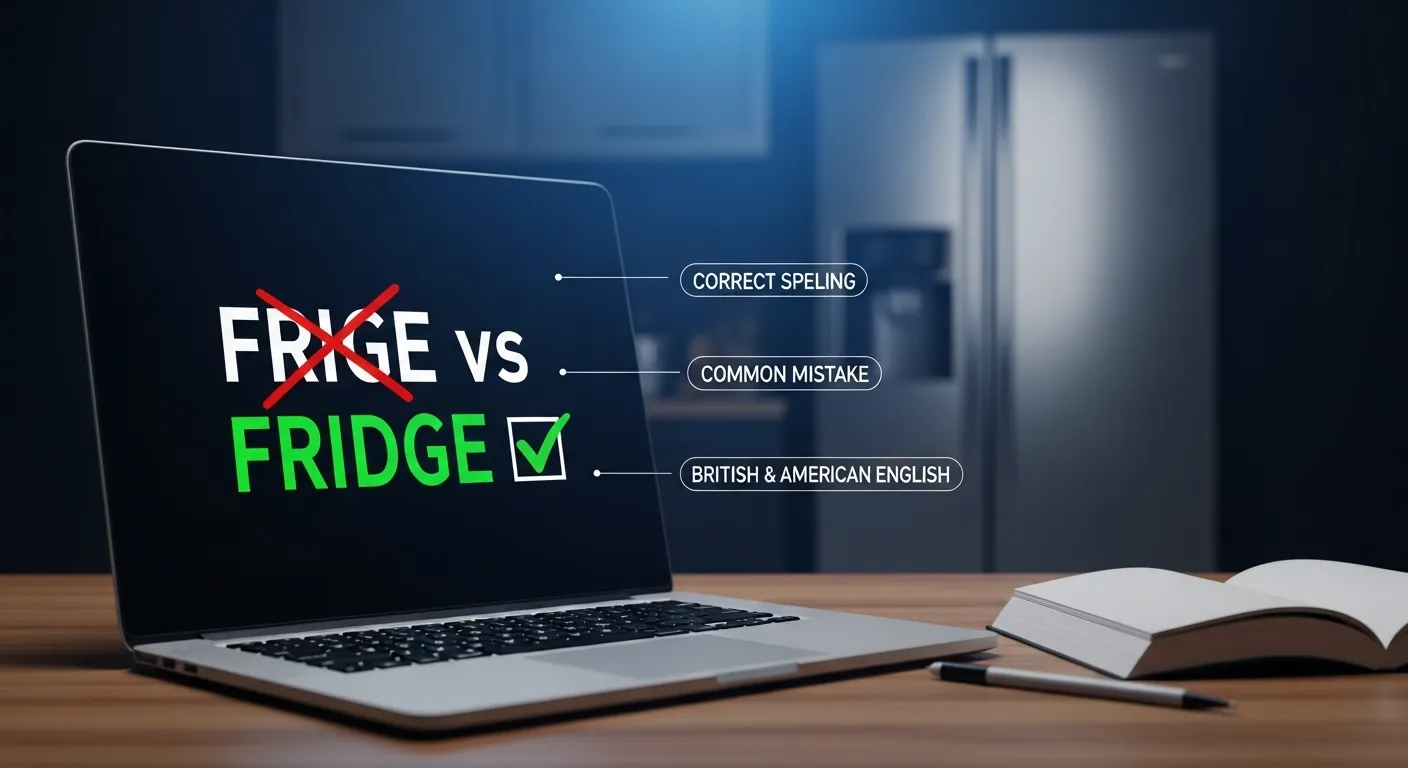
Many people search for frige or fridge because both spellings look possible. They sound the same. But only one is correct.
English spelling can be tricky. Some shortened words keep their original spelling. Others change slightly. That is where the confusion starts.
If you are writing an email, school assignment, blog post, or even a quick social media caption, the wrong spelling can make your writing look careless.
Small mistakes can reduce trust. People want to be sure they are using the correct word.
The quick answer is simple: Fridge is correct. Frige is wrong.
In this short guide, you will learn why fridge has a d, where the word comes from, common mistakes people make, and how to remember the correct spelling easily.
Frige or Fridge – Quick Answer
Fridge is correct.
Frige is wrong.
Example:
- ✅ The milk is in the fridge.
- ❌ The milk is in the frige.
The correct spelling is fridge because it comes from the word refrigerator. The “d” keeps the soft “j” sound.
Think of it like this:
- refrigerate
- refrigerator
- fridge
The “d” helps keep the same sound.
The Origin of Frige or Fridge
The word fridge is a short form of refrigerator.
The word refrigerator comes from Latin:
- refrigerare meaning “to make cold”
In the early 1900s, people began shortening “refrigerator” in speech. At first, some wrote “frige.” But English spelling rules require a “d” after “i” to keep the soft “j” sound.
Compare:
- rage
- ridge
- bridge
- fridge
Without the “d,” the word might look like it should rhyme with “strike” or “grime.” The “d” protects the sound.
So “fridge” became the accepted spelling. “Frige” slowly disappeared.
British English vs American English Spelling
Good news: there is no difference between British and American English here.
Both use fridge.
Unlike words such as:
- color / colour
- center / centre
- judgment / judgement
The word fridge stays the same everywhere.
Comparison Table
| Region | Correct Spelling | Incorrect Spelling |
|---|---|---|
| United States | fridge | frige |
| United Kingdom | fridge | frige |
| Canada | fridge | frige |
| Australia | fridge | frige |
| Global English | fridge | frige |
There is no version of English where “frige” is correct.
Which Spelling Should You Use?
Always use fridge.
If Your Audience Is:
- 🇺🇸 US readers → Use fridge
- 🇬🇧 UK readers → Use fridge
- 🌍 Global readers → Use fridge
In formal writing, you may prefer:
- refrigerator (formal)
- fridge (casual)
Example:
Formal report:
“The refrigerator must be cleaned weekly.”
Casual email:
“Please check the fridge.”
Both are correct. Choose based on tone.
Common Mistakes with Frige or Fridge
Here are common errors:
1. Dropping the “d”
❌ frige
✅ fridge
2. Overthinking the spelling
Some think:
“If we shorten refrigerator, we remove letters, so frige makes sense.”
But English spelling protects sound, not logic.
3. Using it in formal writing incorrectly
In legal or technical manuals, use “refrigerator.”
Example:
- Technical guide: “Install the refrigerator at least 2 inches from the wall.”
- Text message: “Put it in the fridge.”
Frige or Fridge in Everyday Examples
Here is how the word appears in daily life.
In Emails
“Hi,
I left your lunch in the fridge.”
In News
“The power outage caused food in the fridge to spoil.”
On Social Media
“Midnight snack from the fridge again 😂”
In Formal Writing
“The refrigerator maintains a temperature of 4°C.”
In Advertising
“Smart fridge with energy-saving features.”
Frige or Fridge – Google Trends & Usage Data
Search data shows that:
- “fridge” is searched millions of times yearly.
- “frige” is mostly searched by people checking spelling.
Countries where “fridge” is most popular:
- United States
- United Kingdom
- Canada
- Australia
The incorrect spelling appears mainly in quick typing or by children learning English.
In professional content, “frige” has almost zero accepted usage.
Comparison Table: Frige vs Fridge
| Feature | Fridge | Frige |
|---|---|---|
| Correct spelling | ✅ Yes | ❌ No |
| Used in US | ✅ Yes | ❌ No |
| Used in UK | ✅ Yes | ❌ No |
| Found in dictionary | ✅ Yes | ❌ No |
| Safe for professional writing | ✅ Yes | ❌ No |
| Based on refrigerator | ✅ Yes | ❌ No |
FAQs About Frige or Fridge
1. Is “frige” ever correct?
No. It is always incorrect in standard English.
2. Why does fridge have a “d”?
The “d” keeps the soft “j” sound, like in “bridge” and “ridge.”
3. Is fridge informal?
Yes. It is informal. “Refrigerator” is more formal.
4. Do Americans spell it differently?
No. Americans and British both use “fridge.”
5. Can I use fridge in academic writing?
It is better to use “refrigerator” in academic or scientific writing.
6. Why do people search “frige”?
Because it sounds the same as fridge. English spelling can be confusing.
7. Is fridge a slang word?
No. It is a standard shortened form.
Conclusion:
The confusion between frige or fridge is simple to solve. The correct spelling is fridge. The word comes from “refrigerator,” and the letter “d” protects the soft sound. Without the “d,” the spelling breaks English pronunciation rules.
There is no British or American difference here. Both use “fridge.” The incorrect spelling “frige” does not appear in dictionaries and should not be used in professional writing.
If you are writing something formal, use “refrigerator.” If you are writing casually, “fridge” is perfectly fine.
Spelling matters. Small mistakes reduce trust. Now you know the right form, you can write with confidence every time.

I’m American writer known for precise, economical use of language and strong narrative voice. My work is frequently studied for sentence rhythm, word choice, and how meaning is shaped through grammar, making it valuable for close reading and English comparison studies.