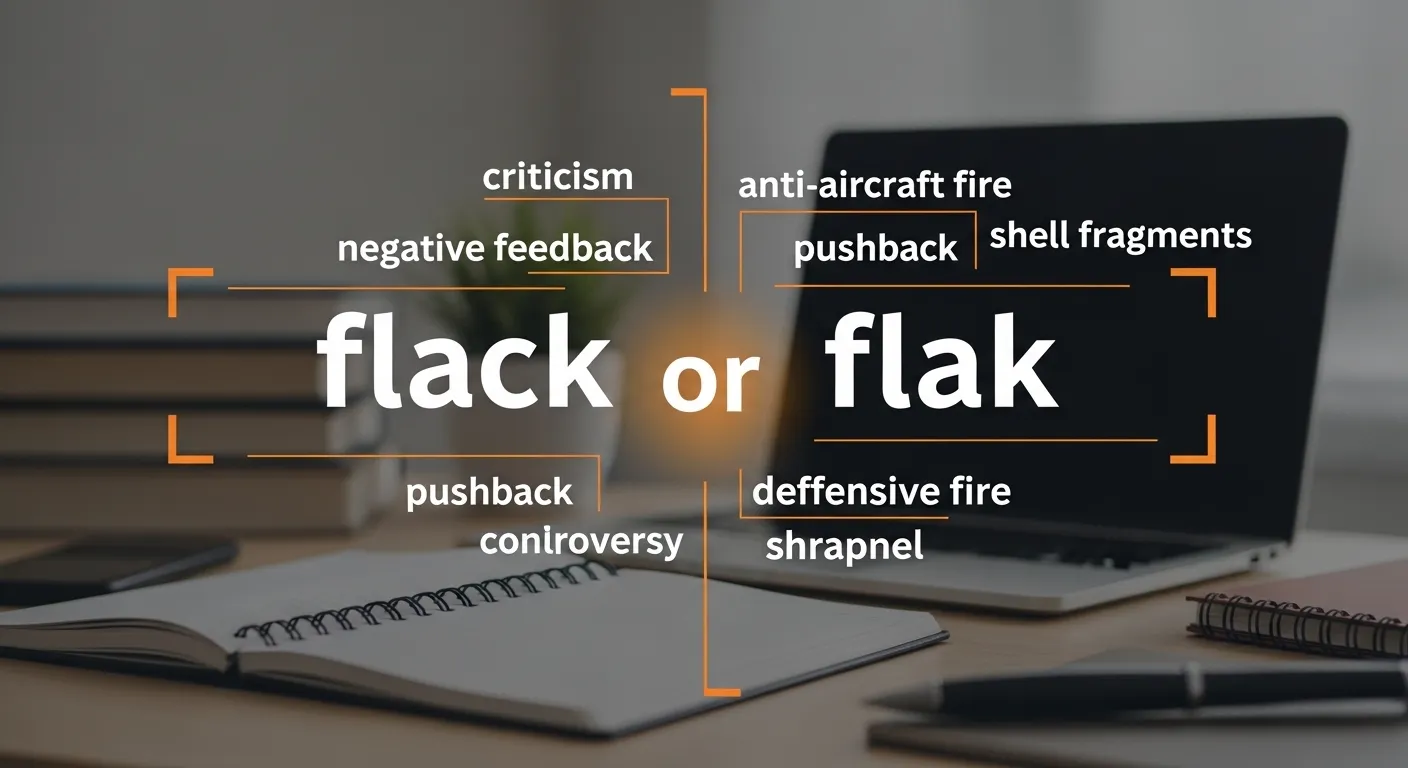
People often wonder: “flack or flak?” Both spellings appear in writing, but which one is correct?
Here’s the quick answer: “flack or flak”
- Flak (with a “k”) → Correct when talking about criticism.
- Flack (with a “c”) → Only correct when referring to a publicist.
This guide clears the confusion. You’ll learn the correct spelling, its meaning, origin, and when to use each form.
With clear examples and simple rules, you’ll never hesitate about whether to write flak or flack again.
Flack or Flak – Quick Answer
Quick Answer: The correct spelling is “flak” most of the time.
Flack is used only as a slang term for publicity agent or person giving press coverage.
Examples:
- The company got a lot of flak for the new policy. (correct — negative criticism)
- She works as a flack for the movie star. (correct — publicity agent)
- He received flack from news sites. (informal but common)
- He received flak from news sites. (standard)
So:
- Flak → criticism or anti‑aircraft fire (literal or figurative)
- Flack → publicist (rare, specific)
Most people who search “flack or flak” want to know which spelling to use when talking about criticism.
The Origin of Flack or Flak
Where These Words Came From
The confusion starts in history. The word “flak” has roots in German.
- Flak (with “k”) came from the German word Fliegerabwehrkanone → flieger (aircraft) + abwehr (defense) + kanone (cannon).
→ Flak meant anti‑aircraft fire in wartime.
Because soldiers used the word so much, it moved into English as flak meaning heavy criticism (like being shot at with words). Over time, writers and speakers used flack too — sometimes by mistake.
Why Spelling Differences Exist
The confusion exists because:
- English borrowed a foreign word (Fliegerabwehrkanone).
- Learners sometimes assumed a “c” fits English spelling patterns.
- Some writers mistakenly wrote “flack” instead of “flak.”
- Flack also existed as a word with a separate meaning (publicist).
So there are two paths:
- One spelling with a standard meaning
- One spelling used but often mistaken
The result: people search “flack or flak” to know which is correct.
British English vs American English Spelling
Generally:
- Both British and American English use flak for criticism.
- Flack as criticism is informal and discouraged in formal writing.
Comparison Table
| Meaning | US English | UK English | Notes |
| Criticism or strong comments | flak ✔ | flak ✔ | Preferred spelling |
| Publicist or PR person | flack ✔ | flack ✔ | Limited to this meaning |
| Figurative criticism | flak ✔ | flak ✔ | Most common |
| Incorrect spelling for criticism | flack ✘ | flack ✘ | Not standard |
Examples in US vs UK
- US: She took flak from reporters. (correct)
- US: She took flack from reporters. (informal, avoid)
- UK: He got flak over the policy. (correct)
- UK: He got flack over the policy. (informal, avoid)
Key point: Flak is correct for criticism everywhere. Flack is only correct as a noun meaning publicist.
Which Spelling Should You Use?
Audience‑Based Advice
Here’s simple guidance on choosing between flack and flak:
1. If your reader is American (US):
Use flak for criticism.
Use flack only if referring to a publicist.
2. If your reader is British/Commonwealth:
Use flak for criticism.
Use flack only for a publicist (rare).
3. If your reader is global / unknown audience:
Always use flak for criticism. It’s widely accepted and avoids errors.
4. If writing formally (school, business, media):
Stick to flak for all criticism.
Common Mistakes with Flak or Flack
Many people make the same errors. Here are the top mistakes and how to fix them.
Mistake 1: Using “flack” for criticism
- ❌ He got flack for the announcement.
- ✅ He got flak for the announcement.
Rule: Use flak when talking about criticism.
Mistake 2: Misspelling in professional writing
- ❌ She received flack in the annual report.
- ✅ She received flak in the annual report.
Tip: If it means negative feedback, use flak.
Mistake 3: Using flack instead of publicist meaning
- ❌ He is a flak for the singer.
- ✅ He is a flack for the singer. (correct — only when a person)
Rule: For persons in publicity, use flack.
Mistake 4: Assuming “flak” and “flack” are the same
- ❌ Both spellings have equal meaning.
- ✅ Flak and flack have different meanings.
Remember:
- Flak → criticism or literal anti‑aircraft fire
- Flack → publicist
Flak vs Flack in Everyday Examples
To learn the right usage, see how people use these words in real writing.
1. Emails
- Thanks for your feedback — we’ve taken flak on this topic. ✅
- Our team had to handle PR flack after the press interview. ✅
2. News Headlines
- CEO takes flak for controversial tweet. ✅
- Marketing flack responds to crisis. ✅
3. Social Media
- He got flak on Twitter for that post. ✅
- She is a flack for brand ambassadors. ✅
4. Formal Writing
- The proposal received significant flak. ✅
- Avoid “flack” as criticism.
5. Spoken English
- I took a lot of flak for my opinion. (common)
Flack or Flak – Google Trends & Usage Data
While we can’t embed live trends, here’s what general patterns show:
1. Global Search Interest
- Searches for “flak” are usually higher than “flack” when referring to criticism.
- People search “flack or flak?” to clarify spelling.
2. Regional Differences
- English‑speaking countries (US, UK, Canada, Australia) all prefer flak for criticism.
- Flack appears more often when discussing public relations jobs.
3. Context Matters
- If someone writes “flack” in news, it’s likely referring to a publicist.
- If someone writes “flak” in news, it’s likely about criticism.
4. Why This Trend Happens
- Because “flak” is common in idioms (“take flak”, “get flak”).
- Because dictionaries list flak as the main form for criticism.
Flack vs Flak – Side‑By‑Side Comparison
| Feature | Flak | Flack |
| Meaning (criticism) | Yes ✔ | No ✘ |
| Meaning (publicist) | No ✘ | Yes ✔ |
| Accepted in formal writing | Yes ✔ | Only for PR meaning ✔ |
| Common in everyday speech | Yes ✔ | Sometimes |
| Origin | German (anti‑aircraft) | English slang |
| Preferred standard form | Yes | Specific use only |
FAQs
1. Which is correct: flack or flak?
Answer: For criticism, flak is correct. If you mean a publicity agent, use flack.
2. Can you say “get a lot of flak”?
Answer: Yes. She got a lot of flak for her post. This is the normal expression.
3. Is “flack” ever correct?
Answer: Yes — when talking about a seasoned PR person or publicist.
4. Why do people spell flak as flack?
Answer: Because English speakers assume a “c” fits the pattern of words like “attack,” and because the two words sound the same.
5. Is one spelling American and the other British?
Answer: No. Both British and American prefer flak for criticism.
6. Can I use either spelling in formal writing?
Answer: For criticism, stick to flak. Use flack only for the publicist meaning.
7. What does “taking flak” mean?
Answer: It means receiving criticism or negative feedback.
Conclusion
When it comes to “flack or flak”, the choice is simple: use flak (with a “k”) for criticism, and flack (with a “c”) only for a publicist or PR person.
In formal writing, business content, or global communication, flak is the safest and most widely accepted option.
By following this rule, you keep your writing clear, professional, and mistake-free. With this guide, you now understand not just the correct spelling, but also the meaning, history, and real life usage.