English has many words that sound the same but mean very different things. Cue and queue are one of the most common examples.
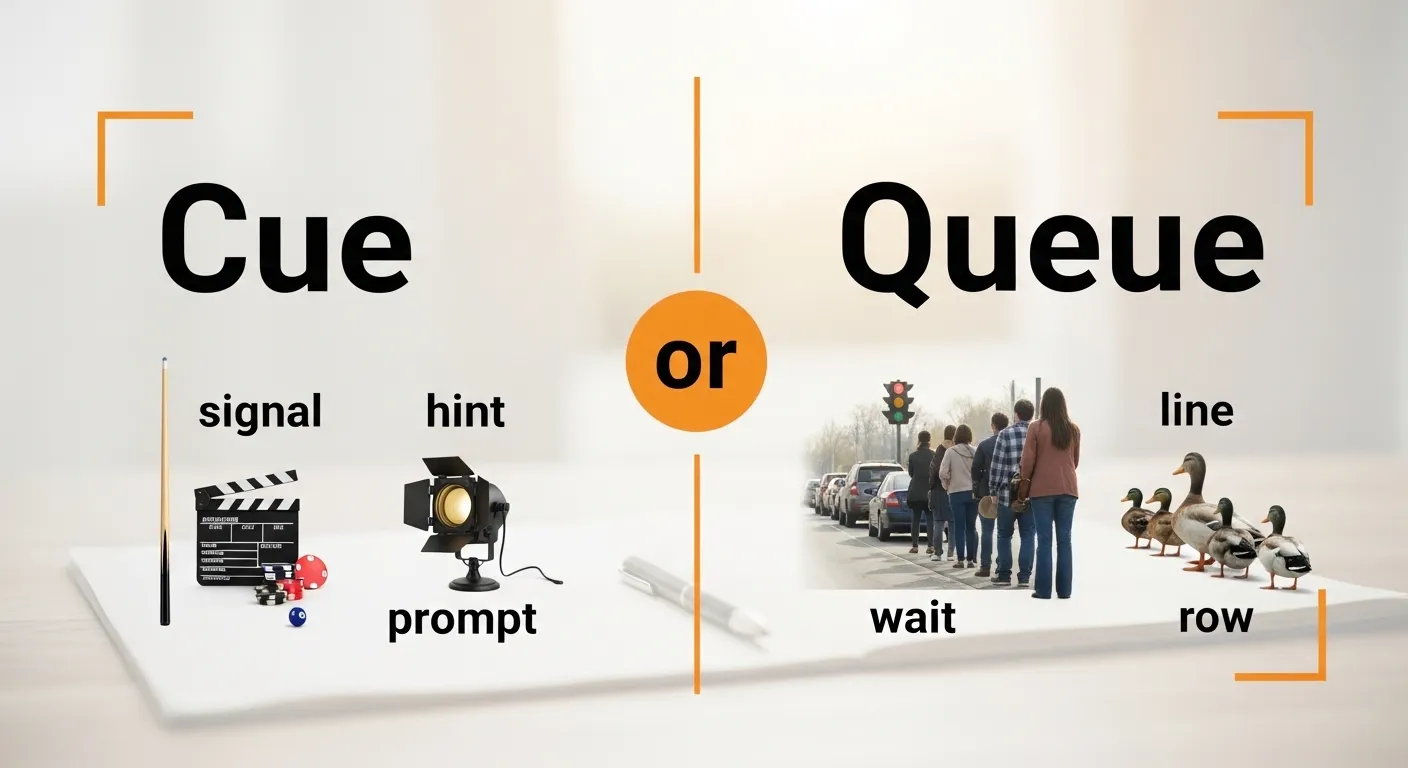
The difference is simple: cue is a signal or prompt to start something, while queue is a line of people or things waiting their turn.
Many people confuse them in writing like saying “Please wait in the cue” instead of queue because they sound identical.
In this guide, you’ll quickly learn how to use cue and queue correctly, avoid common mistakes, and understand their meanings in everyday English.
Cue or Queue – Quick Answer
The difference between cue and queue is simple.
| Word | Meaning | Example |
| Cue | A signal to start an action | The actor waited for his cue. |
| Queue | A line of people or items waiting | We stood in a queue at the ticket counter. |
Cue Meaning
Cue refers to a signal, hint, or prompt that tells someone when to begin an action.
Examples:
- The actor waited for his cue to enter the stage.
- The teacher gave a cue for students to start the test.
- When the music starts, that is your cue to dance.
Queue Meaning
Queue refers to a line of people, cars, or tasks waiting for their turn.
Examples:
- We joined the queue at the bank.
- There was a long queue outside the cinema.
- The system placed the request in a processing queue.
In simple terms:
- Cue = signal or prompt
- Queue = line or waiting list
The Origin of Cue or Queue
Understanding the history of these words explains why they sound the same but have different meanings.
Origin of Cue
The word cue comes from the Latin word quando, meaning “when.” In theater scripts, actors needed signals to know when to speak or enter the stage. Over time, the abbreviation Q was used to mark these signals. Eventually, this developed into the modern word cue.
In theater and performance, a cue tells actors, musicians, or performers when to begin their action.
Example:
- The lighting cue tells the technician when to turn on the lights.
Today, cue is used beyond theater. It can mean any signal or hint to start something.
Examples:
- social cues
- visual cues
- verbal cues
Origin of Queue
The word queue comes from the French word “queue,” which means tail. The idea of a “tail” was used to describe people standing one behind another in a line.
In the 18th century, English speakers adopted the word queue to describe a line of people waiting for service.
Examples:
- a queue at a bus stop
- a queue outside a store
- a queue in computer processing
Interestingly, most of the letters in queue are silent, which is why it sounds the same as cue.
British English vs American English Spelling
Unlike some English words, cue and queue do not change spelling between British and American English. Both forms remain the same worldwide.
However, the usage frequency differs slightly.
In British English, the word queue is used very often because British speakers commonly say “queue” instead of “line.”
In American English, people usually say line instead of queue in everyday conversation.
Spelling Comparison Table
| Word | British English | American English | Meaning |
| Cue | Cue | Cue | Signal to start something |
| Queue | Queue | Queue | Line of people waiting |
Example Sentences
British English:
- People waited in a queue outside the shop.
American English:
- People waited in a line outside the store.
Both are correct, but usage style differs.
Which Spelling Should You Use?
Choosing between cue or queue depends on the meaning you want to express.
Use Cue When Referring to a Signal
Use cue when talking about a sign or prompt that tells someone to begin an action.
Examples:
- The speaker waited for a cue before starting.
- The music was the dancer’s cue to move.
This word appears often in:
- theater
- music
- psychology
- communication
Use Queue When Referring to a Line
Use queue when describing a line of people, cars, or tasks waiting their turn.
Examples:
- Customers stood in a queue outside the bank.
- Your request is in the support queue.
Audience-Based Advice
| Audience | Preferred Usage |
| United States | Cue and Queue (queue less common in daily speech) |
| United Kingdom | Cue and Queue both widely used |
| Australia / Canada | Same spelling and meaning |
| Global audience | Use based on context |
Always choose the word that matches the meaning of your sentence.
Common Mistakes with Queue or Cue
Because these words sound identical, writers often confuse them.
Mistake 1
Incorrect:
- Please stand in the cue.
Correct:
- Please stand in the queue.
Explanation:
This sentence refers to a line, so queue is correct.
Mistake 2
Incorrect:
- The actor waited for his queue.
Correct:
- The actor waited for his cue.
Explanation:
Actors wait for signals, not lines.
Mistake 3
Incorrect:
- The computer placed the task in a cue.
Correct:
- The computer placed the task in a queue.
Explanation:
Computers process tasks in a queue.
Quick Memory Trick
Remember:
- Cue = signal
- Queue = line
Cue or Queue in Everyday Examples
Seeing real-world examples makes the difference easier to understand.
In Emails
Example:
- Please wait in the queue until your number is called.
Example:
- The manager will give you a cue to begin the presentation.
In News Writing
Example:
- Hundreds of people waited in a queue for concert tickets.
Example:
- The referee gave the cue to start the race.
In Social Media
Example:
- The coffee shop has a huge queue today!
Example:
- That was my cue to leave the party.
In Professional Writing
Example:
- The IT system processes requests in a queue.
Example:
- A visual cue helps users understand the interface.
Queue vs Cue– Google Trends & Usage Data
Search data shows that many users are confused about cue or queue.
Common searches include:
- cue vs queue meaning
- cue or queue difference
- what does queue mean
- cue meaning in English
Usage by Context
| Context | Most Common Word |
| Theater and acting | Cue |
| Conversations | Cue |
| Waiting lines | Queue |
| Computer systems | Queue |
Popular Search Countries
The confusion between these words is common in many English-speaking regions:
- United States
- United Kingdom
- Canada
- Australia
- India
This shows that cue and queue confusion is a global language issue.
Cue vs Queue: Comparison Table
| Feature | Cue | Queue |
| Word Type | Noun / Verb | Noun |
| Meaning | Signal or prompt | Line of people or tasks |
| Usage Area | Theater, communication | Waiting lines, computing |
| Example | Wait for your cue | Join the queue |
| Pronunciation | /kyoo/ | /kyoo/ |
FAQs
1. Are cue and queue homophones?
Yes. Cue and queue are homophones, meaning they sound the same but have different meanings and spellings.
2. What does cue mean?
A cue is a signal or prompt telling someone when to begin an action.
Example:
- The music was her cue to start dancing.
3. What does queue mean?
A queue is a line of people, vehicles, or tasks waiting for their turn.
Example:
- Customers waited in a queue at the store.
4. Is queue used in computing?
Yes. In computing, a queue is a list of tasks waiting to be processed.
Example:
- The printer queue contains several documents.
5. Why is queue spelled with many letters?
The spelling comes from the French word queue, meaning tail.
6. Can cue be used as a verb?
Yes.
Example:
- The teacher cued the students to start reading.
7. Which word should I use in writing?
Use cue for signals and queue for lines or waiting lists.
Conclusion
The confusion between cue or queue is common because they sound the same, but their meanings are different. Cue signals someone to start, while queue is a line of people or tasks waiting their turn.
Spelling is the same in British and American English, though Americans often say “line” instead of queue.
Remember this simple trick: cue = signal, queue = line. Using the right word makes your writing clear, professional, and easy to understand.