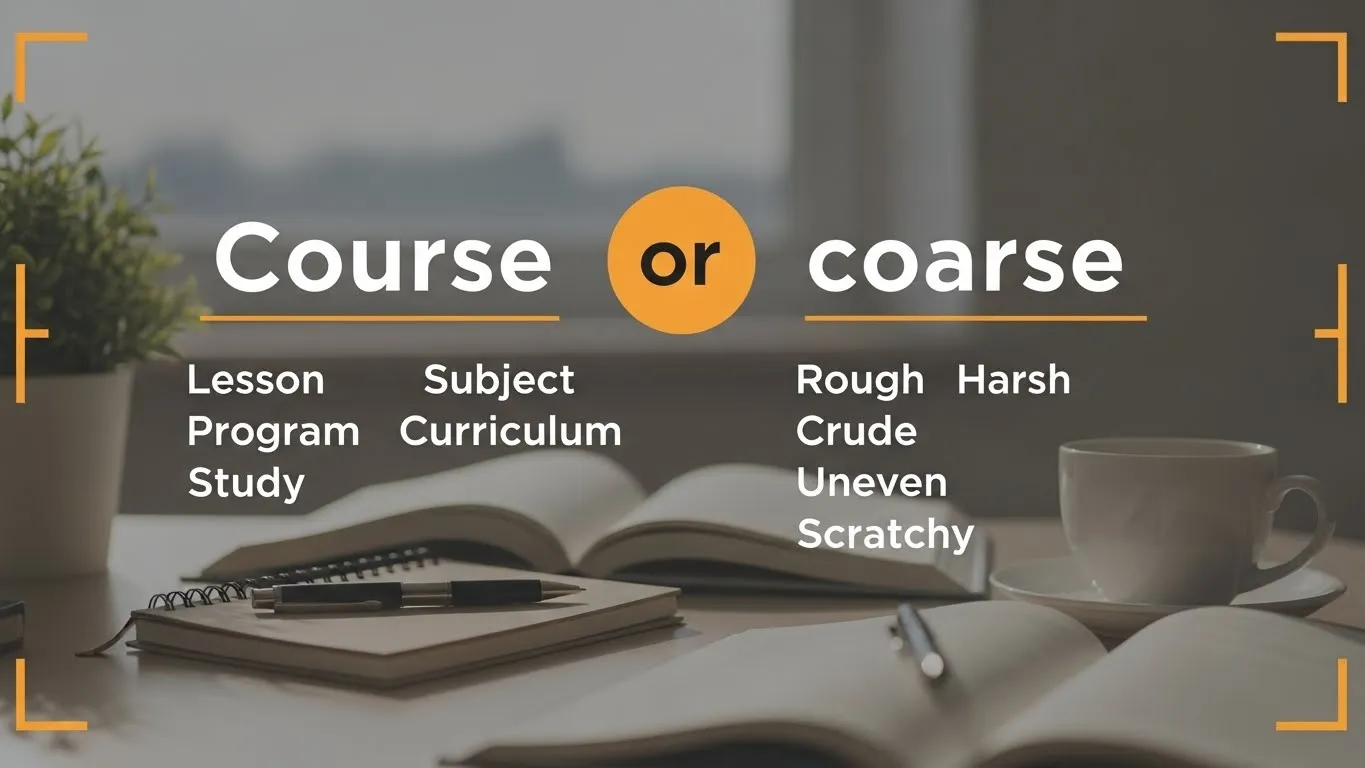
The confusion between course and coarse is common because the words look similar and sound exactly the same.
A single wrong letter can change the meaning and make writing look careless.People often mix them up in exams, emails, blogs, and professional writing.
Course relates to learning, direction, or meals, while coarse describes roughness or texture.
This guide clears the confusion with simple explanations and clear examples so you’ll always choose course or coarse with confidence.
Course or Coarse – Quick Answer
Course and coarse are both correct English words, but they have very different meanings.
- Course refers to learning, direction, progression, or a part of a meal.
- She enrolled in an online course.
- The ship changed its course.
- She enrolled in an online course.
- Coarse describes something rough, uneven, or crude.
- The fabric feels coarse.
- He used coarse language.
- The fabric feels coarse.
👉 Rule to remember:
If you are talking about education, direction, or sequence, use course.
If you are describing texture, roughness, or lack of refinement, use coarse.
The Origin of Coarse or Course
Understanding the origin of course or coarse explains why they look and sound alike.
Origin of Course
The word course comes from the Latin cursus, meaning a running or a path. It entered English through Old French and kept the idea of movement, progression, or sequence. Over time, its meaning expanded to include:
- A path or direction
- A series of lessons
- A stage in a meal
Origin of Coarse
Coarse comes from Old French coars or cours, meaning rough or ordinary. Its meaning stayed focused on texture and quality, especially things that are not smooth or refined.
Why the Confusion Exists
Both words evolved from similar French roots and became homophones in English. While pronunciation stayed the same, spelling and meaning split into two clear paths one abstract (course) and one descriptive (coarse).
British English vs American English Spelling
Unlike many spelling debates, course or coarse does not change between British and American English. Both varieties use the same spelling and meaning.
| Feature | British English | American English |
| Course | ✔ Course | ✔ Course |
| Coarse | ✔ Coarse | ✔ Coarse |
| Pronunciation | Same | Same |
| Meaning | Same | Same |
👉 Key point:
This is not a regional spelling issue. The confusion is purely about meaning, not geography.
Which Spelling Should You Use?
Choosing between course or coarse depends entirely on context, not audience location.
Use course if your audience includes:
- Students and teachers
- Professionals and academics
- Online learners
- Writers discussing progress, direction, or structure
Examples:
- This course lasts six weeks.
- He stayed the course despite challenges.
Use coarse if your audience includes:
- Fashion or textile readers
- Engineers or material experts
- Writers describing behavior or language
Examples:
- The sandpaper is very coarse.
- She disliked his coarse jokes.
👉 Global rule:
No matter where your audience is—US, UK, or international—the meanings stay the same.
Common Mistakes with Course or Coarse
Here are the most frequent errors and how to fix them:
I signed up for a writing coarse.
✅ I signed up for a writing course.
The meal had three coarses.
✅ The meal had three courses.
He took a course towel.
✅ He took a coarse towel.
Her speech was course and rude.
✅ Her speech was coarse and rude.
👉 Tip:
If replacing the word with class makes sense, use course.
If replacing it with rough makes sense, use coarse.
Course or Coarse in Everyday Examples
Emails
- I completed the training course last week.
- The material felt coarse to the touch.
News
- The government changed course on the policy.
- Residents complained about coarse sand on the beach.
Social Media
- Just finished my online course!
- This sweater looks nice but feels coarse.
Formal Writing
- The course outlines the program objectives.
- The report criticized the coarse tone of the debate.
Course or Coarse – Google Trends & Usage Data
Search data shows that course is far more commonly used than coarse. This is because:
- Education-related searches dominate online content
- Online courses, training programs, and certifications are popular globally
Usage patterns by context:
- Course → Education, navigation, career growth, meals
- Coarse → Textiles, materials, behavior, speech
By country:
- US, UK, Canada, Australia, India → Same usage patterns
- Higher searches for course in academic and professional contexts
- Coarse appears more in technical or descriptive writing
👉 Insight:
People usually search course or coarse when writing professionally and want to avoid embarrassment.
Course or Coarse – Comparison Table
| Feature | Course | Coarse |
| Part of speech | Noun / Verb | Adjective |
| Meaning | Learning, direction, sequence | Rough, crude, uneven |
| Related ideas | Class, path, progress | Texture, quality |
| Common fields | Education, navigation | Materials, behavior |
| Frequency | Very high | Moderate |
FAQs:
1. Are course and coarse interchangeable?
No. They have completely different meanings and cannot replace each other.
2. Is coarse ever used for education?
No. Education always uses course, never coarse.
3. Does pronunciation differ?
No. They sound exactly the same, which causes confusion.
4. Can coarse describe behavior?
Yes. Coarse language or coarse humor is correct.
5. Is course a verb?
Yes. Example: Tears coursed down her face.
6. Is this a US vs UK spelling issue?
No. Both spellings are the same in all English varieties.
7. Which word is more common online?
Course is much more common due to education and training searches.
Conclusion:
The difference between course and coarse is all about meaning.
Course relates to learning, direction, or progress, while coarse describes roughness or lack of refinement.
A quick check helps: learning or direction → course; texture or behavior → coarse.
Mastering this rule keeps your writing clear, confident, and correct.
Learn More About:
Rode or Road: What’s the Difference?
Citing or Siting – Which One is Correct?

I’m English language author writing emphasises clarity, structure, and close attention to language. My work is often examined for stylistic comparison, focusing on Grammar work, narrative control, and subtle thematic development.