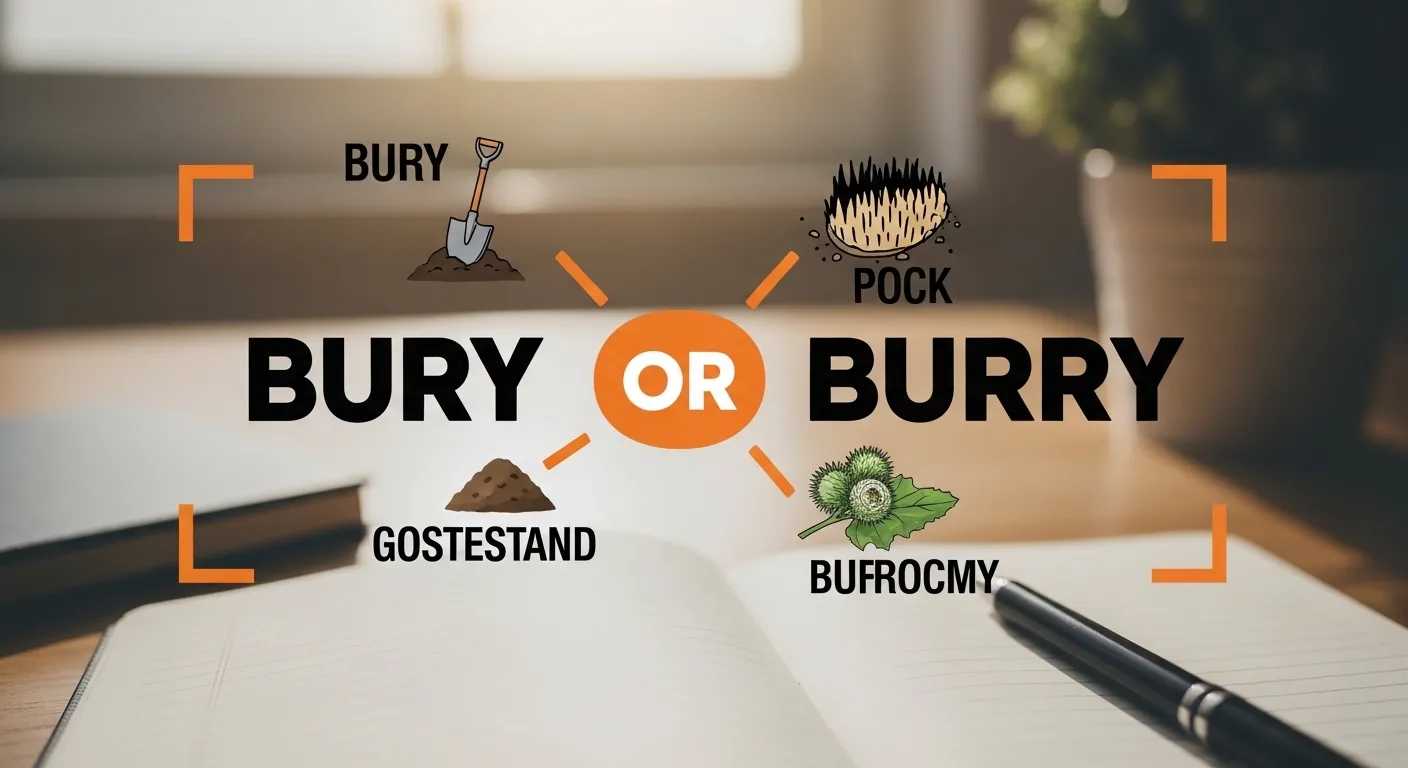
Are you wondering whether to write “bury” or “burry”? The answer is simple: always use “bury” when you mean to place something under the ground or hide it.
Many people type “burry” by mistake because the words sound the same, but using the wrong spelling can make your writing look unprofessional.
This quick guide will show you the correct spelling, why “burry” is usually wrong, and how to use bury confidently in emails, social media, and formal writing.
Bury or Burry – Quick Answer
The short and simple answer is:
- Bury ✅ – Correct spelling. Means to place something under the ground, hide, or conceal.
Example: “We will bury the time capsule in the garden.” - Burry ❌ – Incorrect spelling in modern English.
Note: “Burry” does appear in very rare cases as an adjective, meaning “covered with burrs,” but this is not common in everyday writing.
Example of correct use in context:
- Correct: “He decided to bury his mistakes and move on.”
- Incorrect: “He decided to burry his mistakes and move on.”
So, if you are unsure, always default to bury.
The Origin of Bury or Burry
The word bury comes from Old English “byrgan”, meaning “to inter” or “to cover with earth.” Over centuries, its spelling evolved, but it retained the single r in modern English.
The confusion arises because English is inconsistent. Some words double consonants before adding suffixes (like hurry → hurried), so people sometimes assume bury → burry is correct. However, this is not the case.
The rare use of burry as an adjective comes from “burr”, meaning a rough, prickly seed pod. For example:
- “The dog got burry after running through the field.”
Despite this, in the most common verb form meaning “to place in the ground,” bury is universally correct.
British English vs American English Spelling
Many users wonder if bury or burry depends on the English variant they follow. The truth is simple:
| Aspect | British English | American English | Notes |
| Correct spelling | bury | bury | Same in both versions |
| Incorrect spelling | burry | burry | Considered wrong in both |
| Rare adjective form | burry (covered in burrs) | burry (covered in burrs) | Very uncommon usage |
Key takeaway:
There is no difference between UK and US spelling for this word. Both follow the same rule.
Example sentences:
- UK: “They decided to bury the old letters in the garden.”
- US: “They decided to bury the old letters in the backyard.”
Which Spelling Should You Use?
If you want to write correctly for any audience:
- Use “bury” – This is standard everywhere.
- Avoid “burry” – It is usually seen as a typo.
- Rare exceptions – Only use “burry” when describing something covered in burrs, like plants or clothing textures.
Audience-based advice:
- US readers: Always “bury” in blogs, emails, academic work.
- UK/Commonwealth readers: Same rule; “bury” is standard.
- Global audience: Use “bury” to stay professional and clear.
Pro tip: Spellcheck alone may not catch “burry” because some programs treat it as a valid word. Manual checking is crucial.
Common Mistakes with Burry or Bury
Here are the most frequent errors people make:
| Mistake | Why it’s wrong | Correct form |
| burry the treasure | Doubles “r” unnecessarily | bury the treasure |
| burried the letter | Wrong past tense formation | buried the letter |
| burry your feelings | Incorrect verb spelling | bury your feelings |
| buryed the evidence | Mixing rules with “-ed” suffix | buried the evidence |
| burry (used alone) | Confuses adjective vs verb | use “burry” only for burr-covered items |
Tip: Remember, the verb always uses a single r. Past tense: bury → buried.
Burry vs Bury in Everyday Examples
Here’s how bury is used in different contexts:
1. Emails:
- “Please bury this sensitive information in the archive folder.”
2. News articles:
- “Authorities will bury the unknown victim according to local customs.”
3. Social media posts:
- “I just need to bury all the negative comments and move on.”
4. Academic/formal writing:
- “The ancient civilizations buried their treasures in secret locations.”
Note: Using burry in these contexts would be incorrect and noticed by readers.
Bury or Burry – Google Trends & Usage Data
According to Google Trends and usage data:
- Bury is searched significantly more than burry worldwide.
- Top countries searching for “bury”: United States, United Kingdom, Canada, Australia.
- “Burry” searches are rare, mostly due to spelling mistakes or niche botanical contexts.
Observations:
- Most users type burry by mistake when trying to spell bury.
- SEO and content creators should stick to bury for higher credibility.
Comparison Table: Bury vs Burry
| Variation | Correct? | Example |
| bury | ✅ Correct | “We will bury the letter in the box.” |
| burry | ❌ Incorrect (verb) | “We will burry the letter in the box.” |
| buried | ✅ Correct past tense | “She buried the secret long ago.” |
| burried | ❌ Incorrect | “She burried the secret long ago.” |
| burry (adjective) | ✅ Rare/Uncommon | “The jacket was burry after the hike.” |
FAQs
1. Is “burry” ever correct?
Yes, but only as an adjective meaning “covered with burrs.” As a verb meaning “to place in the ground,” it is incorrect.
2. What is the past tense of “bury”?
The past tense is buried. Do not write “burried” or “burryed.”
3. Do Americans spell it differently than the British?
No. Both US and UK English use bury with one “r.”
4. Why do people type “burry” so often?
Many assume English doubles consonants like “hurry → hurried,” leading to the mistake.
5. Can I use “burry” in casual writing?
Not if you mean “to place under the ground.” Only acceptable if describing something with burrs.
6. Is “bury or burry” a common Google search?
Yes, people search it to confirm spelling for emails, essays, and professional writing.
7. How can I remember the correct spelling?
Think: “bury your treasure, don’t burry it.” Single “r” for the action of placing under ground.
Conclusion
Confused between bury or burry? Remember: use bury to mean “place under the ground” and buried for past tense.
Burry is almost always wrong.
Stick to this rule, and your writing will stay clear, professional, and mistake free no matter the audience.

I’m American writer known for precise, economical use of language and strong narrative voice. My work is frequently studied for sentence rhythm, word choice, and how meaning is shaped through grammar, making it valuable for close reading and English comparison studies.