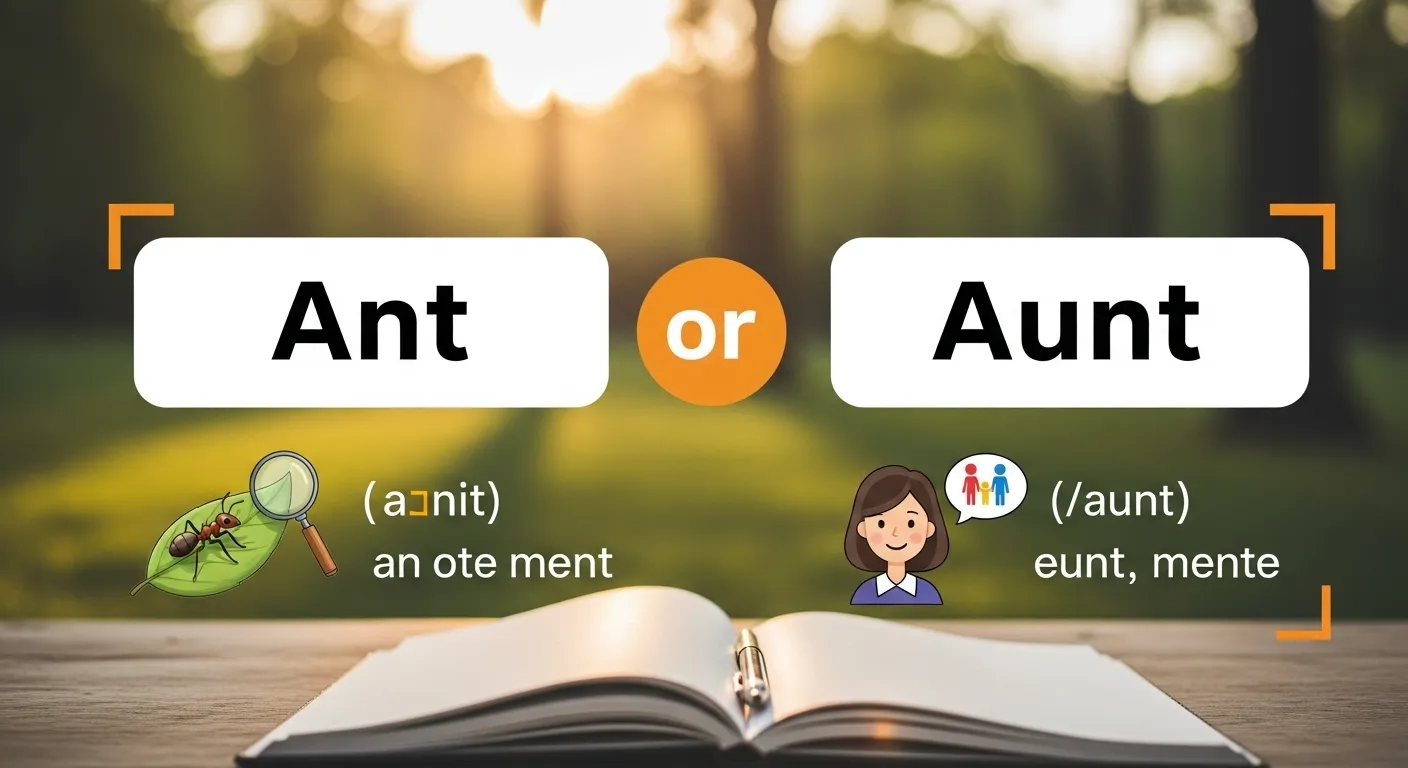
Many people search for “ant or aunt” because the words look almost identical and often sound the same in some accents.
The answer is simple. Ant is a tiny insect that lives in colonies, while aunt is a family member (your parent’s sister or your uncle’s wife).
The confusion usually happens because in some pronunciations aunt sounds very close to ant.
In short: ant = insect, aunt = family member.
Once you remember this meaning difference, choosing the correct word becomes easy.
Ant or Aunt – Quick Answer
The difference between ant and aunt is simple.
- Ant is an insect.
- Aunt is a family member (your parent’s sister or your uncle’s wife).
Examples
Ant (insect)
- An ant crawled across the picnic table.
- The garden is full of ants in summer.
Aunt (family member)
- My aunt lives in London.
- I will visit my aunt this weekend.
Even though the words look similar, their meanings are completely unrelated. One belongs to biology, and the other belongs to family relationships.
The Origin of Ant or Aunt
Understanding the origin of these words makes the difference even clearer.
Origin of Ant
The word ant comes from the Old English word ǣmete. Over time, the spelling changed and became shorter. By the Middle English period, it evolved into the modern word ant.
Ants have existed in the English language for centuries because they are common insects found almost everywhere in the world.
Origin of Aunt
The word aunt comes from the Old French word ante, which itself came from the Latin word amita, meaning father’s sister.
When the word entered English in the Middle Ages, it kept a spelling close to its French roots, which is why the “u” appears in aunt.
Why the Words Look Similar
The similarity is mostly a coincidence. Over time:
- Ant became shorter and simpler.
- Aunt kept its French-influenced spelling.
This is why the two words look similar but have very different meanings and histories.
British English vs American English Spelling
Unlike many English word pairs, ant and aunt do not have different spellings in British and American English. The spelling stays the same everywhere.
The main difference appears in pronunciation.
In many American accents, aunt sounds like “ant.”
In British English, aunt is often pronounced “ahnt.”
Comparison Table
| Word | Meaning | American Pronunciation | British Pronunciation |
| Ant | A small insect that lives in colonies | ant | ant |
| Aunt | Parent’s sister or uncle’s wife | ant / awnt | ahnt |
Because the pronunciation can sound similar, people sometimes confuse the spelling when writing.
Which Spelling Should You Use?
Choosing between ant and aunt depends entirely on the meaning you want.
Use Ant if you are talking about an insect
Examples:
- I saw an ant on the kitchen floor.
- The ants carried food back to their nest.
Use Aunt if you are talking about a family member
Examples:
- My aunt sent me a birthday card.
- We will visit our aunt during the holidays.
Audience Advice
| Audience | Recommended Usage |
| United States | Ant = insect, Aunt = family member |
| United Kingdom | Same spelling rules |
| Canada / Australia | Same spelling rules |
| Global English | Always follow the meaning |
The rule is simple: the spelling depends on meaning, not location.
Common Mistakes with Aunt or Ant
Because the words sound similar in some accents, writers sometimes mix them up.
Mistake 1
❌ I visited my ant last weekend.
✔ I visited my aunt last weekend.
Mistake 2
❌ An aunt crawled across the table.
✔ An ant crawled across the table.
Mistake 3
❌ My ant baked cookies for us.
✔ My aunt baked cookies for us.
Why These Mistakes Happen
- Similar pronunciation in some accents
- Typing errors
- Autocorrect confusion
- Lack of proofreading
The easiest solution is to check the meaning of your sentence.
Ant or Aunt in Everyday Examples
These words appear in many types of writing.
In Emails
- “My aunt will arrive tomorrow.”
- “There are ants in the kitchen.”
In News Articles
- “Scientists discovered a new species of ant in the Amazon rainforest.”
- “The famous singer visited her aunt during the holiday season.”
On Social Media
- “Picnic ruined by ants!”
- “Having dinner with my favorite aunt tonight.”
In Formal Writing
- The study focused on the behavior of ants in complex colonies.
- My aunt inspired my interest in literature.
These examples show how the words appear naturally in everyday communication.
Aunt vs Ant – Google Trends & Usage Data
Search data shows that many people type “ant or aunt” into Google when they are unsure about spelling.
This usually happens for three reasons:
- Pronunciation confusion
- Writing mistakes in school assignments
- Grammar checks while writing emails or articles
Popular Regions for This Search
| Country | Reason for Search |
| United States | Pronunciation overlap |
| United Kingdom | Spelling clarification |
| Canada | ESL learning |
| India | English education |
| Pakistan | Grammar learning |
Students and English learners are the most common group searching for this topic.
Comparison Table: Ant vs Aunt
| Word | Part of Speech | Meaning | Example |
| Ant | Noun | A small insect that lives in colonies | An ant carried a crumb. |
| Aunt | Noun | Your parent’s sister or uncle’s wife | My aunt visited us yesterday. |
This table makes the difference clear at a glance.
FAQs
1. Is it ant or aunt for a family member?
The correct word is aunt. It refers to your parent’s sister or your uncle’s wife.
Example: My aunt lives in New York.
2. Is ant ever used to mean aunt?
No. Ant only refers to the insect. It should never replace aunt in family contexts.
3. Why do ant and aunt sound similar?
In some accents, especially American English, aunt is pronounced like ant. This causes spelling confusion.
4. Are there British and American spelling differences?
No. Both ant and aunt have the same spelling in British and American English. Only pronunciation may change.
5. Which word is more common?
Both are common, but in different contexts:
- Ant appears more in science or nature writing.
- Aunt appears more in personal and family communication.
6. Can aunt be pronounced “ant”?
Yes. In many American accents, aunt is pronounced exactly like ant.
7. How can I remember the difference?
A simple trick:
- Aunt has a “u” like “you” in family.
- Ant is the small insect.
Conclusion
The confusion between ant and aunt is very common, but the answer is simple. Ant refers to the small insect that lives in colonies, while aunt is a family member your parent’s sister or your uncle’s wife.
The spelling is the same in both British and American English, so the key is simply understanding the context of your sentence.
If your sentence talks about an insect, use ant. If it refers to a family relationship, use aunt.
Once you remember this difference, you can avoid common mistakes and write more clearly in emails, school work, or everyday communication.

I’m English language author writing emphasises clarity, structure, and close attention to language. My work is often examined for stylistic comparison, focusing on Grammar work, narrative control, and subtle thematic development.