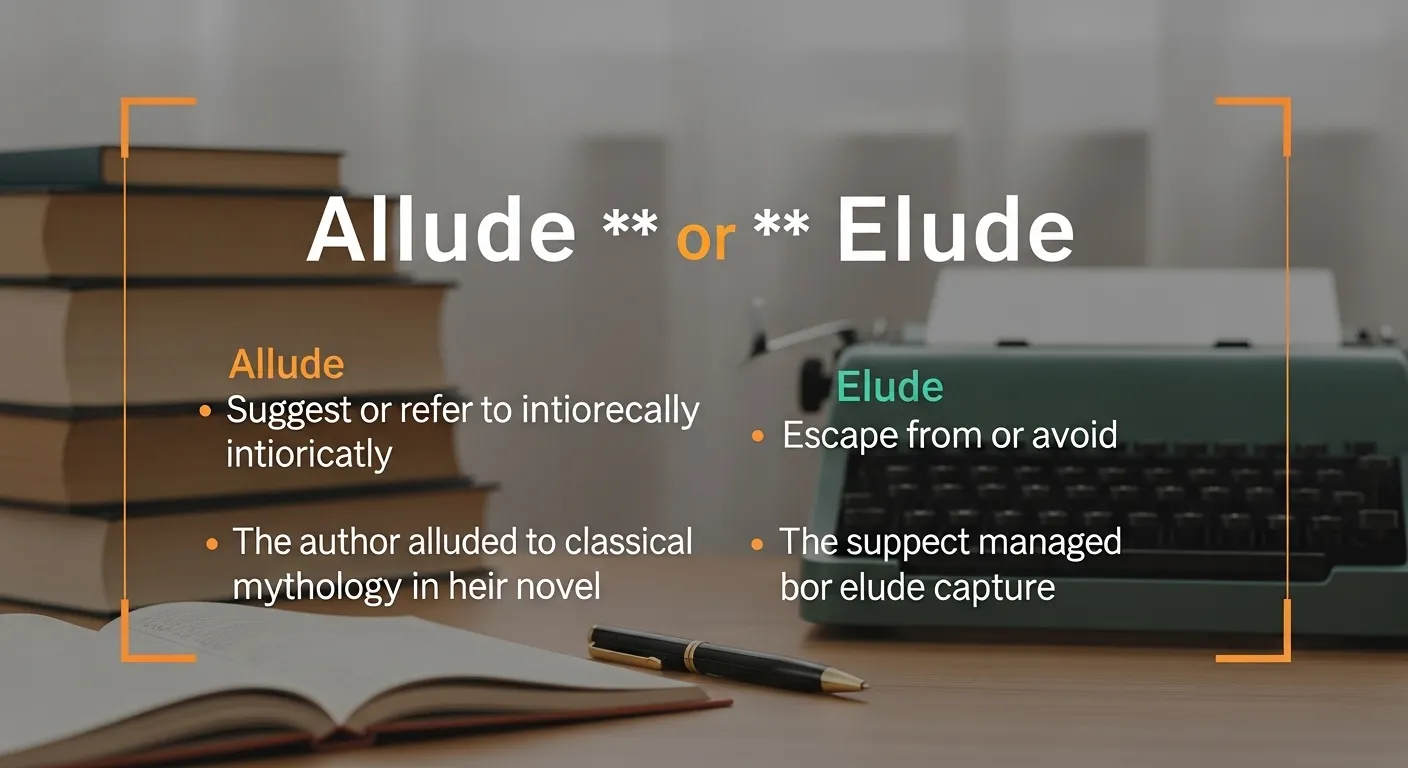
Have you ever typed allude or elude and stopped, unsure which one is right? You are not alone. These two words look and sound similar, but they have very different meanings.
👉 Quick answer:
- Allude means to refer to something indirectly
- Elude means to escape or avoid something
Many people confuse them because both appear in formal writing and daily conversation. But using the wrong word can change your message. For example, “He alluded the police” is wrong. The correct sentence is “He eluded the police.”
This guide will help you understand the difference, avoid mistakes, and use the right word with confidence.
Allude and Elude – Quick Answer
Here is the simple difference:
| Word | Meaning | Example |
| Allude | To refer to something indirectly | She alluded to her past experience. |
| Elude | To escape or avoid something | The thief eluded the police. |
Easy Trick to Remember
- Allude = Refer
- Elude = Escape
Examples
- He alluded to the problem without explaining it.
- The suspect eluded capture for weeks.
The Origin of Elude or Allude
Understanding the origin helps you remember the meaning.
Allude
- Comes from Latin alludere
- Meaning: “to play with” or “to refer indirectly”
- Over time, it became linked with indirect references in speech or writing
Elude
- Comes from Latin eludere
- Meaning: “to escape” or “to avoid”
- Often used in physical or mental escape situations
Why the Confusion Exists
Both words:
- Come from similar Latin roots
- Share similar spelling patterns
- Sound alike in fast speech
That is why many learners mix them up.
British English vs American English Spelling
Unlike many English words, allude and elude do not change spelling between British and American English.
Key Point
- The confusion is about meaning, not spelling differences.
Comparison Table
| Word | American English | British English | Meaning |
| Allude | Allude | Allude | Refer indirectly |
| Elude | Elude | Elude | Escape or avoid |
Examples in Both Styles
- US: The report alluded to financial issues.
- UK: The report alluded to financial issues.
No difference at all.
Which Spelling Should You Use?
Since there is no spelling difference, your focus should be on correct usage.
US Audience
- Use allude for indirect reference
- Use elude for escape or avoidance
UK & Commonwealth
- Same rules apply
- No spelling variation
Global Writing (SEO, Blogs, Business)
- Always choose the word based on meaning
- Avoid guessing based on sound
Pro Tip
If your sentence involves:
- Talking about something indirectly → allude
- Escaping or avoiding → elude
Common Mistakes with Elude and Allude
Here are the most common errors people make:
❌ Incorrect Usage
- He alluded the police.
- She eluded to her past.
✅ Correct Usage
- He eluded the police.
- She alluded to her past.
Mistake 1: Using “Allude” for Escape
Wrong: The criminal alluded capture
Correct: The criminal eluded capture
Mistake 2: Using “Elude” for Reference
Wrong: He eluded to the issue
Correct: He alluded to the issue
Mistake 3: Confusing Sound with Meaning
Both words sound similar, but context decides meaning.
Allude or Elude in Everyday Examples
1. In Emails
- I would like to allude to our previous meeting.
- The issue continues to elude our team.
2. In News
- The minister alluded to possible changes.
- The suspect eluded authorities for days.
3. On Social Media
- She subtly alluded to the drama.
- Success can sometimes elude beginners.
4. In Formal Writing
- The author alludes to historical events.
- The solution continues to elude researchers.
Elude vs Allude – Google Trends & Usage Data
Popularity Insights
- Allude is more common in:
- Academic writing
- Literature
- Essays
- Elude is more common in:
- News reports
- Crime stories
- Daily conversation
Country Usage
- USA: Both words used equally in formal writing
- UK: Same pattern
- Global: Often confused by ESL learners
Search Behavior
People search:
- “Allude meaning”
- “Elude vs allude difference”
- “How to use allude in a sentence”
This shows strong confusion between the two.
Comparison Table: Allude vs Elude
| Feature | Allude | Elude |
| Meaning | Refer indirectly | Escape or avoid |
| Usage Type | Figurative | Physical or abstract |
| Common Context | Writing, speech | Action, movement |
| Example | She alluded to a secret | He eluded capture |
| Memory Tip | Allude = Refer | Elude = Escape |
FAQs
1. What is the main difference between allude and elude?
Allude means to refer indirectly. Elude means to escape or avoid.
2. Can allude and elude be used interchangeably?
No. They have completely different meanings.
3. Is “elude to” correct?
No. The correct phrase is “allude to.”
4. Which word is used in formal writing?
Both are used, but:
- Allude → essays and literature
- Elude → reports and news
5. Why do people confuse allude and elude?
Because they sound similar and have similar spelling.
6. Is there a spelling difference in US and UK English?
No. Both words are spelled the same worldwide.
7. How can I remember the difference easily?
- Allude → “A” for “address indirectly”
- Elude → “E” for “escape”
Conclusion
The difference between allude and elude is simple: allude = refer indirectly, elude = escape or avoid. Though they look alike, their meanings are very different.
Using the right word makes your writing clear and professional, whether in emails, blogs, or essays. Practice with real examples, and soon choosing correctly will feel natural.

I’m English language author writing emphasises clarity, structure, and close attention to language. My work is often examined for stylistic comparison, focusing on Grammar work, narrative control, and subtle thematic development.