Ever typed allright and saw a red underline? You’re not alone. Here’s the quick answer: “allright” is wrong the correct forms are “alright” and “all right.”
This confusion happens because English often joins words, like already or almost, but allright never became standard.
In this guide, you’ll get clear rules, examples, and advice so you’ll always know when to use alright or allright and never make the allright mistake again.
Allright or Alright – Quick Answer
The correct spelling is: “alright.”
“Allright” is incorrect.
You should never use allright in standard English. It is considered a spelling mistake in:
- American English
- British English
- Canadian English
- Australian English
Correct Examples:
- Everything is alright now.
- Are you alright?
- The project is alright for submission.
Incorrect:
- ❌ Everything is allright now.
- ❌ Are you allright?
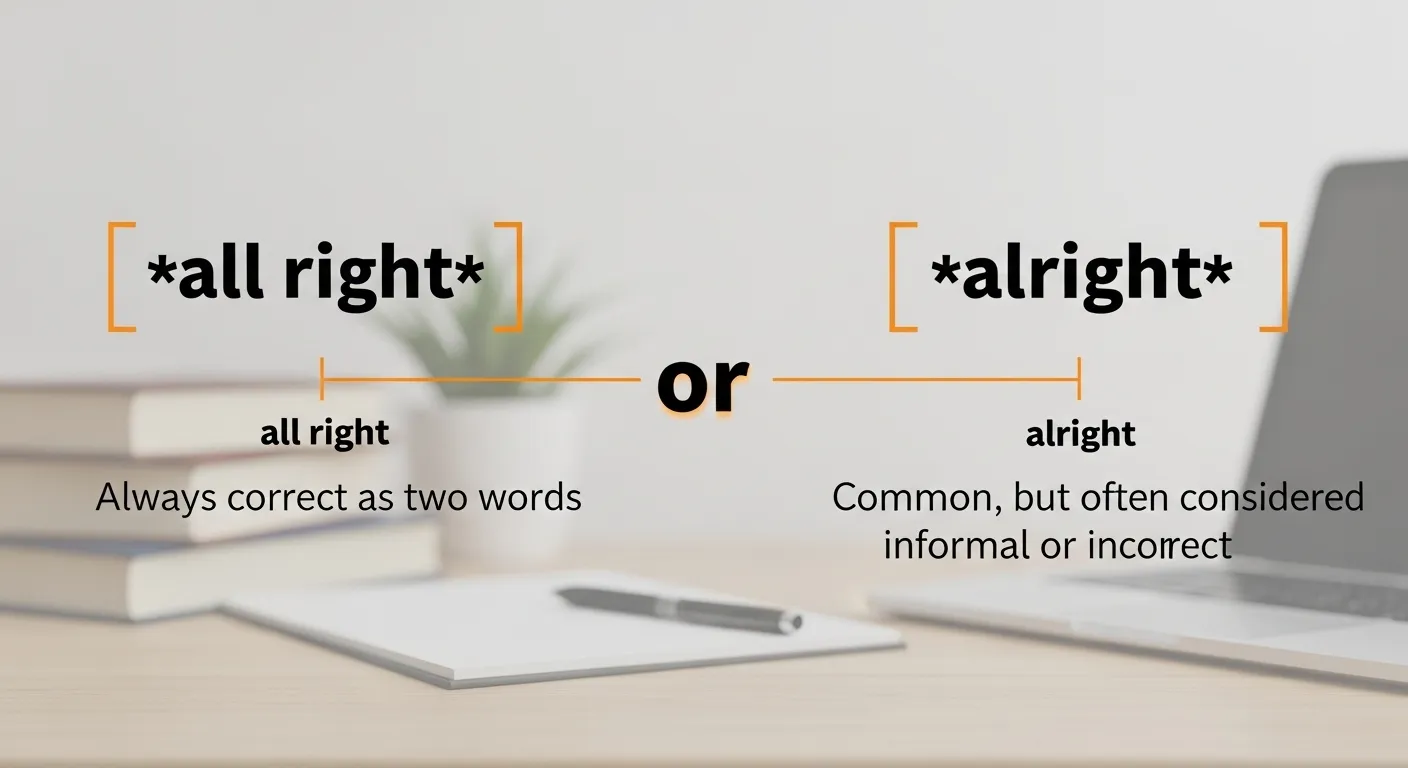
If you want a safe option in formal writing, you can also use “all right” (two words).
So remember:
| Form | Correct? |
| allright | ❌ No |
| alright | ✅ Yes |
| all right | ✅ Yes (more formal) |
The Origin of Allright or Alright
To understand the confusion, we must look at history.
The original form was “all right” (two words). It appeared in English writing in the 1800s. Over time, people started using the shorter form “alright” in casual writing.
Writers sometimes combine words in English. For example:
- Already (all + ready)
- Almost (all + most)
- Although (all + though)
Because of these patterns, people assumed “allright” might also be correct. But English never accepted that form.
The one-word version “alright” became common in the 20th century. Many style guides now accept it, especially in informal writing.
However, “allright” never became standard English. It remains incorrect.
British English vs American English Spelling
Many spelling differences exist between British and American English, such as:
- Color (US) vs Colour (UK)
- Center (US) vs Centre (UK)
- Realize (US) vs Realise (UK)
But “allright or alright” is NOT one of those differences.
Both American and British English agree:
- ❌ allright = wrong
- ✅ alright = correct
- ✅ all right = correct
There is no country where “allright” is standard.
Comparison Table
| Usage | American English | British English |
| allright | ❌ Incorrect | ❌ Incorrect |
| alright | ✅ Informal accepted | ✅ Informal accepted |
| all right | ✅ Preferred formal | ✅ Preferred formal |
So the confusion is not about geography. It is about spelling accuracy.
Which Spelling Should You Use?
The best choice depends on your audience.
🇺🇸 For American Audience
Use:
- all right in formal writing
- alright in casual writing
Avoid:
- allright
🇬🇧 For British / Commonwealth Audience
Use:
- all right for formal writing
- alright for informal writing
Avoid:
- allright
🌍 For Global or Professional Writing
If you want to stay completely safe:
👉 Use all right (two words).
It is more formal and widely accepted in academic, legal, and business contexts.
Use alright in:
- Social media
- Blog posts
- Text messages
- Dialogue
Never use allright anywhere.
Common Mistakes with Alright or Allright
Here are frequent errors people make:
1. Thinking “allright” is British spelling
❌ Wrong. It is incorrect everywhere.
2. Assuming it follows “already” pattern
People see:
- Already
- Almost
- Altogether
So they think “allright” makes sense. But English does not follow strict logic.
3. Using it in formal documents
Even “alright” can look too casual in formal writing. Use “all right” instead.
4. Spell-check Confusion
Spell-check tools may correct “allright” automatically. That is because it is not recognized as a word.
Alright vs Allright in Everyday Examples
Let’s see how it works in real life.
- The report is all right for review. (formal)
- Everything is alright, no worries. (casual)
📰 News Writing
- The patient is in all right condition after surgery.
News outlets usually prefer “all right” in formal reports.
📱 Social Media
- I’m alright, thanks for asking!
- It’s gonna be alright.
Casual tone fits here.
📚 Academic Writing
- The results were all right according to the guidelines.
Academic writing prefers two words.
Allright or Alright – Google Trends & Usage Data
Search data shows that many people type “allright” into Google. Why?
Because it sounds correct. When spoken, “all right” and “alright” sound the same.
Google search trends show:
- “alright” is widely used in the United States.
- “all right” remains strong in academic and formal searches.
- “allright” is searched often, but mostly for correction.
Countries where confusion is common:
- United States
- United Kingdom
- Canada
- Australia
- India
Most searches for “allright” are actually people checking if it is correct.
Comparison Table – All Forms Side by Side
| Word Form | Meaning | Correct? | Formal Use | Informal Use |
| allright | None | ❌ No | ❌ No | ❌ No |
| alright | Acceptable form | ✅ Yes | ⚠️ Limited | ✅ Yes |
| all right | Original form | ✅ Yes | ✅ Yes | ✅ Yes |
FAQs
1. Is “allright” ever correct?
No. It is always incorrect in standard English.
2. Is “alright” accepted in formal writing?
Some style guides accept it, but “all right” is safer in formal documents.
3. Why do people write “allright”?
Because English combines similar words like “already.” But this word does not follow that rule.
4. Do Americans use “alright”?
Yes, especially in casual writing. But formal writing prefers “all right.”
5. Do British people use “alright”?
Yes, mostly in informal speech and writing.
6. Which is older: alright or all right?
“All right” is older. “Alright” developed later.
7. Is “alright” grammatically wrong?
No. It is accepted in modern informal English.
Conclusion
The confusion between allright and alright is easy to clear up: “allright” is always wrong. The correct forms are “all right” (formal) and “alright” (informal).
Use all right for professional writing, emails, and academic work. Use alright in casual writing, social media, or blogs. Both British and American English follow the same rule.
Tip: When in doubt, stick with all right and never use allright. Write confidently and correctly every time!

I’m American writer known for precise, economical use of language and strong narrative voice. My work is frequently studied for sentence rhythm, word choice, and how meaning is shaped through grammar, making it valuable for close reading and English comparison studies.